


Types Of Sexual Harassment Training Ppt




Try Before you Buy Download Free Sample Product
 Impress Your
 Audience
 100%
100% Editable
 Save Hours
 of Time


These slides discuss the types of sexual harassment. These are verbal, physical, visual, and non-verbal. It also classify sexual harassment into two categories, namely Quid Pro Quo and Hostile Work Environment.
People who downloaded this PowerPoint presentation also viewed the following :
Content of this Powerpoint Presentation
Slide 1
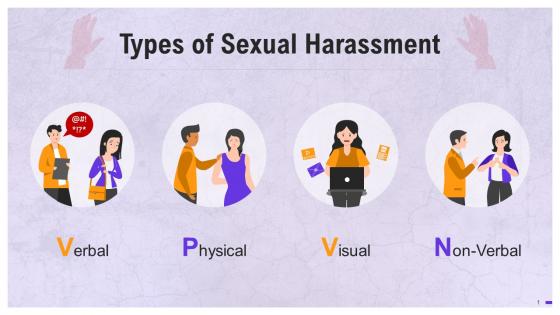
This slide lists types of sexual harassment. These include: Verbal, physical, visual, and non-verbal misconduct.
Slide 2
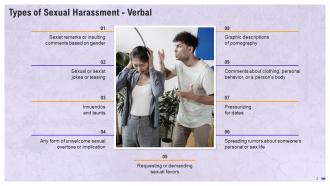
This slide shows examples of verbal harassment as a type of sexual harassment. These may include: Sexist remarks or insulting comments based on gender, sexual or sexist jokes or teasing, innuendos and taunts.
Slide 3
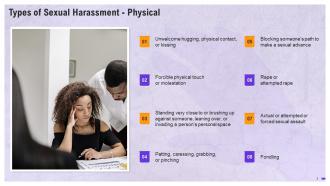
This slide discusses examples of physical harassment as a type of sexual harassment. These may include: Unwelcome hugging, physical contact, or kissing, forcible physical touch or molestation, standing very close to or brushing up against someone, leaning over, or invading a person's personal space.
Slide 4
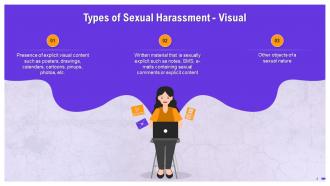
This slide talks about examples of visual harassment as a type of sexual harassment. These may include showing explicit visual content such as posters, drawings, calendars, cartoons, pinups, photos, etc.
Slide 5
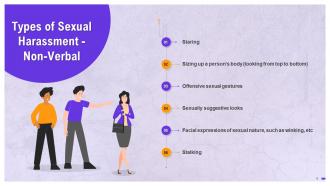
This slide discusses non-verbal harassment as a type of sexual harassment. The examples include staring, sizing up a person’s body (looking from top to bottom), offensive sexual gestures, etc.
Slide 6
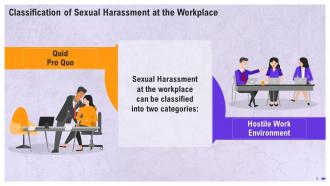
This slide gives an overview of the classification of sexual harassment at the workplace. There are two types of sexual harassment in the workplace: Quid pro quo and hostile work environment.
Slide 7
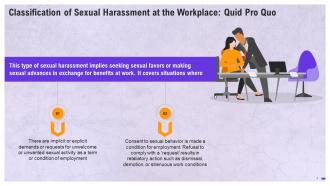
This slide gives information about Quid Pro Quo as sexual harassment at the workplace. This type of sexual harassment implies seeking sexual favors or making sexual advances in exchange for benefits at work.
Slide 8
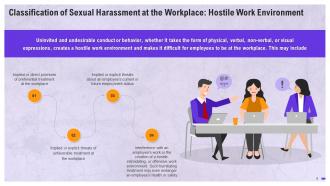
This slide gives information about hostile work environment as sexual harassment at the workplace. Uninvited and undesirable conduct or behavior, whether it takes the form of physical, verbal, non-verbal, or visual expressions, creates a hostile work environment and makes it difficult for employees to be at the workplace.
Types Of Sexual Harassment Training Ppt with all 24 slides:
Use our Types Of Sexual Harassment Training Ppt to effectively help you save your valuable time. They are readymade to fit into any presentation structure.





FAQs for Types Of Sexual
You'll want clear policies plus real workplace examples - skip the death-by-PowerPoint approach. Cover what harassment actually looks like, reporting procedures, and how investigations work. Bystander training is huge too since people see stuff happen but freeze up. Oh, and don't forget regular updates because laws change constantly. Honestly, annual refreshers are non-negotiable. Track who's completing it because there's always that one person who tries to skip out. Interactive scenarios work way better than just reading policies. Keep it current with your actual workplace culture - generic training is pretty useless.
Survey your people first to see what they're actually dealing with day-to-day. Your training materials should show diverse folks as targets AND bystanders, not just the troublemakers. Mix up the scenarios - different backgrounds, roles, identities. I swear some of these trainings feel stuck in 1995. Test everything with focus groups from various departments before rolling it out. Short sentences work. Longer ones that flow naturally work too. Everyone needs to see themselves reflected, not feel like they're watching some generic office soap opera that has nothing to do with their reality.
Look, your team's gonna mirror whatever energy you bring to this. If you're scrolling through emails during training or cracking jokes, they'll think it's all BS too. You've gotta actually show up - like, really participate yourself instead of just forcing it on everyone else. Create a space where people can ask questions without worrying about getting fired or whatever. I've seen too many managers treat this like some corporate box-checking thing, which honestly just pisses everyone off. Your people are watching how seriously you take it. Bottom line - if you want them to report issues, they need to trust it won't screw them over career-wise.
Track your immediate stuff first - post-training surveys and quick knowledge checks right after sessions. But honestly, the real gold is in your complaint data over the next few months. Are reports going up? That might actually be good news since people feel safer speaking up now. Employee climate surveys will tell you way more than anything else about actual culture shifts. Don't forget attendance rates and whether managers are doing follow-ups. Check back quarterly to see the bigger picture - that's when patterns start showing up.
So there's no federal requirement actually, but states are all over the place with this stuff. California, New York, Connecticut - they each have their own rules about how often you need to do it (annually vs every two years, it's kinda messy tbh). Most want you covering the basics like definitions, how complaints work, what supervisors need to know. Interactive elements are usually required too, plus you gotta keep records. Honestly, I'd just hit up your state labor department website first. That'll give you the specific requirements. If it's still confusing, maybe loop in legal to double-check everything.
Oh absolutely, culture plays a huge role in this stuff. Like, what feels normal in one workplace might come across as super inappropriate in another - different rules about personal space, touching, even eye contact. Some cultures are way more casual about dating coworkers or certain types of humor. But here's the thing - you still need consistent standards that protect everyone, even while acknowledging these differences exist. The tricky part is making sure people from all backgrounds feel comfortable speaking up when something crosses the line. It's honestly one of the harder parts of workplace training to get right.
Oh man, there's so much BS to unpack here. Most people think harassment only means physical stuff or "sleep with me or you're fired" - but honestly? The majority of cases are hostile environment things like gross jokes or constant inappropriate comments. People always say victims should speak up right away, which totally ignores how trauma actually works. The "boys will be boys" garbage is still everywhere too, unfortunately. Here's what really gets me though - everyone assumes harassers are these cartoon villains when impact matters way more than intent. Your training needs to hammer home that good intentions don't erase harm, and definitely include bystander scenarios.
Honestly, case studies are a game changer for harassment training. People remember stories way better than boring bullet points - that's just how our brains work. Real scenarios show your team how policies actually work when things get messy and complicated at work. They can practice spotting red flags and figuring out what to do before they're stuck in an awkward situation. The key is picking examples that actually match your workplace vibe, you know? Like if you're in tech vs retail, the dynamics are totally different. It helps people see different perspectives too, which is huge.
Skip the boring lectures - throw people into real scenarios they'll actually face at work. Make it clear upfront this isn't about catching anyone doing something wrong. Small groups are your friend here, nobody wants to look stupid in front of the whole room. Mix things up with videos, role-playing, maybe some anonymous question tools. Honestly, the biggest thing is making sure it connects to what they do every day. Otherwise it just feels like another pointless training they have to sit through.
So everyone needs the basic stuff - recognizing harassment, how to report it, speaking up when you see something. But managers? They need way more training on what to do when someone actually comes to them with a complaint. Investigation steps, proper documentation, how not to screw up the whole situation (which happens more than you'd think). Oh and the legal side of things - liability issues and creating better workplace culture. Short version: employees need to spot problems, managers need to actually fix them without making everything worse.
Check in every few months during regular team meetings or quarterly reviews. Anonymous suggestion boxes are honestly pretty effective for this stuff. Send refresher emails with real scenarios when policies update. People need safe spaces to ask questions without feeling judged - that's the biggest thing IMO. Try guest speakers when relevant news stories pop up, or just share articles that relate. Make it feel normal to discuss instead of this huge taboo everyone dances around. Actually, start small at your next team meeting. Dedicate like 10 minutes to review one key concept and see how it goes.
Hey! So your company needs to update harassment training for remote work - it's a whole different ballpark now. Cover stuff like creepy behavior on video calls, weird DMs, and inappropriate comments during virtual meetings. Some people weirdly think online = different rules, but nope. Also think about how isolated remote workers feel when reporting this stuff - that's huge. Set up reporting channels specifically for remote teams and actually practice these scenarios in training. Oh, and don't forget work-from-home means personal spaces get invaded too, so address those boundary issues.
Honestly, bystander training is way better than the usual "don't be a creep" seminars most companies do. It teaches people how to actually step in when they see sketchy stuff happening - like direct confrontation, creating distractions, or knowing when to loop in a manager. What's cool is it shifts the responsibility to everyone, not just HR dealing with complaints after the fact. Most people already know harassment is wrong, but they freeze up when witnessing it. This gives them real tools to interrupt situations before they get worse. Definitely worth pushing for if your current program sucks.
Honestly, you'll want multiple ways for people to give feedback because not everyone's gonna speak up in the same setting. Anonymous surveys are your friend here. Maybe do some smaller group chats too, or have managers do one-on-ones with people they trust. I've watched companies totally bomb this by doing one massive group meeting - super intimidating. Actually listen to what people tell you and follow through, or they'll just stop bothering to share anything. Oh, and don't make it a one-and-done thing. Start with an anonymous survey like a week after training.
Oh man, those old hour-long training videos were the worst - everyone just zoned out. Now companies are using VR simulations where you can practice handling awkward situations without screwing up for real. Pretty cool actually. They've also switched to bite-sized modules instead of marathon sessions, plus the content adapts based on your specific role. Analytics track if people are actually paying attention (spoiler: they usually weren't before). Some programs include bystander intervention stuff too. When you're shopping around, definitely look for interactive features - your team will thank you for not boring them to death.
-
Colors used are bright and distinctive.
-
The way SlideTeam professionals work is exceptional. Thanks for being so helpful!