


Types Of Communication Styles Training Ppt




Try Before you Buy Download Free Sample Product
 Impress Your
 Audience
 100%
100% Editable
 Save Hours
 of Time


These slides cover the multiple types of communication, such as passive, aggressive, passive-aggressive, and assertive, along with the standard responses for each style.
People who downloaded this PowerPoint presentation also viewed the following :
Content of this Powerpoint Presentation
Slide 1
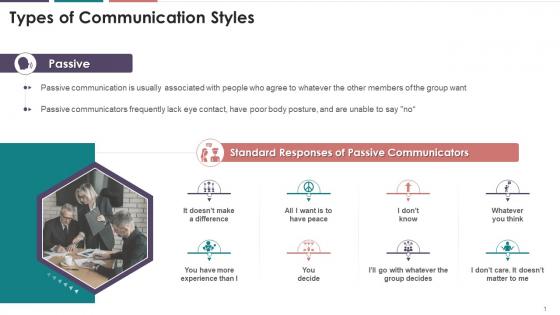
This slide depicts the information regarding passive communication style. It mentions that passive communication is usually associated with people who agree to whatever the other group members want. It also demonstrates that passive communicators frequently lack eye contact, have poor body posture, and cannot say "no."
Slide 2
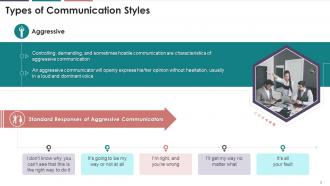
This slide is an introduction to aggressive communication styles. It depicts that controlling, demanding, and sometimes hostile communication are characteristics of aggressive communication. It also mentions that an aggressive communicator will openly express their opinion without hesitation, usually in a loud and dominant voice.
Slide 3
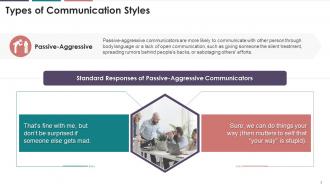
This slide depicts information regarding Passive-Aggressive communication style. It highlights that passive-aggressive communicators are more likely to communicate with another person through body language.
Slide 4
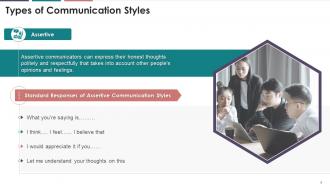
This slide depicts information about the passive communication style. It states that assertive communicators can express themselves politely and respectfully, taking into account other people's opinions and feelings.
Types Of Communication Styles Training Ppt with all 20 slides:
Use our Types Of Communication Styles Training Ppt to effectively help you save your valuable time. They are readymade to fit into any presentation structure.





FAQs for Types Of Communication
So there are basically four styles people use at work. Assertive is what you want - being direct but not a jerk about it. Then you've got passive people who hate conflict and never speak up (frustrating to work with honestly). Aggressive ones just bulldoze everyone. And passive-aggressive? Oh man, they'll say "sure, no problem" then sabotage you later or make snide comments. I used to be way too passive myself. Try being more assertive though - just state what you need clearly. People actually respect that more than tiptoeing around everything.
Okay so basically, when you figure out how your coworkers actually like to communicate, everything gets way smoother. Some people want you to be super direct with feedback. Others need you to ease into it or they get defensive. And some folks - my manager's like this - need to think before they respond, which I used to think meant they weren't listening. Once you start paying attention to these patterns, you can adjust how you talk to each person. Less back-and-forth confusion, more actual work getting done. People feel way more comfortable too when you're speaking their language, you know?
Oh man, this is so true! Your cultural background is like your communication default mode. Some cultures are super direct - they'll tell you exactly what they think. Others dance around topics to keep things smooth. There's also weird stuff like how close people stand, whether eye contact is good or awkward, and how much backstory you need before making a point. I've totally bombed a few work situations because I didn't pick up on this earlier. Honestly though, none of these ways are wrong - they're just different. Watch how your teammates operate and adapt when you can.
You gotta read the room first - figure out if they're detail people or big picture types. Some folks want straight talk, others need you to be gentler about it. I always try to match their vibe, you know? Like if they're super formal, I dial it up. If they're chill, I keep it casual. Data works for some people, but honestly? Stories hit harder with others. Oh and cultural stuff matters too - hierarchy is huge in some places. I just ask myself what they actually need to hear and how they'd want to hear it. Don't be scared to check in like "make sense?" It helps.
So assertive communication is like finding that perfect middle ground - you're not a doormat but you're also not being a total jerk about things. Use "I" statements instead of pointing fingers. Keep good eye contact and speak confidently but calmly. Be direct without being mean, you know? Honestly, it makes such a huge difference at work because people actually know where they stand with you. No more guessing games or weird tension. I'd start small though - like telling the barista your drink order got messed up. Way easier than jumping into big confrontations with your boss or whatever.
Ugh, being passive at work is such a relationship killer. Nobody knows what you're actually thinking, so they just assume you're fine with everything. Meanwhile you're secretly annoyed about stuff but never say anything - super healthy, right? Your coworkers end up making decisions without even asking you since you never share opinions anyway. Honestly, it creates this awkward vibe where everyone's walking on eggshells. Start tiny though - just throw out one real thought in your next meeting. Yeah it'll feel weird, but you've gotta start somewhere.
So basically your body language backs up whatever you're saying out loud. Like when you nod while saying "yes" or use your hands to show how big something is - it just makes everything clearer. Plus it adds the emotional stuff that words can't always capture. Though honestly, sometimes your body gives you away when you're not being totally honest (we've all done the awkward fake smile thing). That's actually useful info for people though! The main thing is just making sure your face and gestures match what you're actually saying. Makes you sound way more genuine.
Honestly, just watch how they ask for stuff and respond to you - that tells you everything. Some people cut right to the chase and want you to do the same. Others throw in personal details and context because relationships matter to them. You'll notice task-focused people ask "what" and "when" a lot, while people-oriented folks are all about "who" and "why." Their energy's different too. Some think out loud, others need a sec to process. I used to overthink this, but really you just observe first without judging. Then match their vibe a bit - be direct if they are, or warmer if that's their thing.
Honestly, you've gotta figure out how each person on your team likes to communicate. Some people want straight facts and data, others need the whole backstory first - it's wild how different we all are. I learned this the hard way lol. Mix things up with emails, face-to-face chats, and group meetings since everyone processes stuff differently. The quiet people? They'll never speak up in big meetings, so give them other ways to share ideas. Just watch how people naturally talk and match their vibe. Trust me, it works.
Oh man, clashing communication styles can totally derail things. Trust goes out the window fast - like when someone thinks you're being rude but you're just being direct, or when their "subtle hints" completely whoosh over your head. Productivity tanks because people misread what's actually important. Team morale? Forget about it. Projects get delayed, conflicts blow up over nothing, and suddenly everyone's walking on eggshells. The worst part is how it just snowballs. Honestly, your best move is catching it early and switching up how you talk to different people.
Dude, stories are a game changer if you're stuck in data-dump mode like I used to be. People remember emotional stuff way better than spreadsheets - it's just how our brains work. I started throwing in quick customer examples or even random personal stuff, and suddenly my presentations didn't suck anymore. Your facts need that human connection to actually land. Next time, try opening with a 30-second story that ties to your main point. Honestly, the difference is night and day once you see how people actually stay awake during your slides.
You basically want to find that sweet spot between being direct but not a jerk about it. Listen first - aggressive people are usually just frustrated, and passive ones are often scared to speak up. When someone's being aggressive, stay calm and try something like "I can see you're stressed about this deadline, let's work it out together." With quiet types, ask questions that actually get them talking. Honestly, the hardest part is not matching their energy - like when someone's yelling, you want to yell back! Use "I" statements instead of "you" ones. Also, regular check-ins help so stuff doesn't just pile up and explode later.
So there's actually some cool tech that can help with this! AI analytics can track your tone and word choice across emails and chats - Grammarly's tone detector has literally saved me from sending passive-aggressive messages I didn't mean to sound that way. Microsoft Insights does similar stuff for calls. You can also connect personality assessment tools to your CRM so it automatically tags people with their communication preferences. The trick is getting real-time feedback instead of just post-mortem analysis. Like, I want to know I'm being too blunt BEFORE I hit send, you know?
Oh god, the biggest myth is thinking assertiveness = being a total bitch. It really doesn't! You can be direct and clear while still being respectful. I used to think I had to pick between doormat mode or mean girl - there's actually a middle ground. People assume you need to be loud or confrontational too, but honestly? The best assertive people I know are pretty calm. They just state what they need and don't back down. It's totally a learnable skill, not some magical personality trait. Practice with small stuff first - like, returning the wrong coffee order or whatever.
You've gotta match how they like to hear stuff. Direct people? Just get straight to the point with specifics. Relationship types want you to start positive and make it feel collaborative. Data nerds need examples and numbers backing everything up - they eat that up. Visual people do better when you write things down or draw it out too. Always double-check they got what you meant by having them repeat it back. Honestly though, the easiest thing is just asking them upfront: "What's the best way to give you feedback on this?" Saves so much guesswork.
-
Their templates are super easy to edit and use even for the one like me who is not familiar with PowerPoint. Great customer support.
-
The design is clean-cut, modern, and sleek, keeping the users' needs in mind. The multiple uses make this product worth every penny!