

Public Speaking For Effective Business Communication Training Ppt




Try Before you Buy Download Free Sample Product
 Impress Your
 Audience
 100%
100% Editable
 Save Hours
 of Time


This set of slides covers public speaking in business communication. It includes slides on the significance and essential verbal and nonverbal skills for impressive public speaking. Further, it contains common errors in public speaking, such as using filler words, overshooting time, and talking too fast or soft.
People who downloaded this PowerPoint presentation also viewed the following :
Content of this Powerpoint Presentation
Slide 2
This slide represents the significance of speaking in publicly. Public speaking helps boost the confidence of the speaker, enhance leadership skills, encourage critical thinking, contribute towards personal development, assist in career advancement, and helps an individual get over the fear of impromptu speaking.
Instructor’s Notes:
- Career Advancement: Effective public speaking skills help with career advancement, as they indicate creativity, critical thinking skills, leadership abilities, poise, and professionalism. These qualities are always in high demand in the job market. Public speaking skills improves the effectiveness of what you say, making you the star in office meetings; your ideas and suggestions are accepted. Speaking skills also help you excel in job interviews
- Boost Confidence: Public speaking can significantly boost your confidence. The nervousness and the butterflies in stomach that result from just stepping up on stage and facing a huge crowd never really goes way. With practice and rehearsal, however, this just fades away
- Critical Thinking: Public speaking is considered the best way to develop and enhance critical thinking skills. After careful thought from all aspects, the message which needs to be delivered has to be tailored to the requirements, needs and even expectations of the target audience
- Personal Development: Public speaking equips the person with skills required to analyze and interpret any topic. Improved confidence and ability to speak in a crowd contributes to the personal development of an individual
- Impromptu Speaking: When called over a stage at the wedding to speak a few words, at a performance award ceremony, or on any other special occasion, you might not get the words immediately to convey. If you acquire public speaking skills, however, you will always find yourself graciously accepting the opportunity in such a situation. Public speaking skills helps you let go of constant worrying and tackling the fear of being asked to say something, especially at formal events
- Leadership Skills: Leaders need to have the capability to drive change. Public speaking skills are vital in being effective at that. Speaking powerfully, you can change people’s minds about an issue. If you master this skill of bringing a change and encouraging individuals, you can hop to leadership positions. You already have command over a significant aspect of leadership
Slide 3
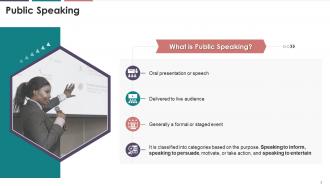
This slide explains the meaning of public speaking as a component of business communication.
Slide 4
This slide illustrates various verbal and Nonverbal skills that are considered absolutely essential to public speaking.
Slide 5
This slide explains the most common errors that must be avoided. It is suggested that the speaker must refrain from using filler words, speaking at a normal rate, make constant eye contact with different members of the audience, and pre-plan start and finish time of their speech.
Instructor’s Notes:
- Neglecting to Prepare: One of the most common mistakes in public speaking is not giving enough time to preparation. This is the root cause of ineffective and inefficient public speaking
Solution: Before presentation or speech, a person must set some time aside to make sure that work has been completed in all aspects and proper time has been given to preparation. - Using Filler Words: Filler words in speaking refer to ‘um’ and ‘uhs’ that mark out the public speaker as unprofessional and unprepared. The audience will perceive information delivered with frequent use of such filler words with skepticism
Solution: To avoid this, the speaker should make sure that he devotes enough time for practice and preparation before delivering the speech. - Talking Too Fast or Soft: Whenever an individual presents publicly, he/she gets nervous and makes another common mistake: Speaking too fast, which confuses the audience. The other end of the spectrum is talking too softly. The audience might not understand and hear what you have said if you will speak too softly
Solution: To avoid speaking too fast, the speaker should practice the delivery and speed before the actual delivery and allow the audience enough time to grasp the information shared. Also, to improve talking too slowly, the speaker should make sure that his voice is audible to all and avoid mumbling. - Eye Dart: In most cases, speakers fail to maintain constant eye contact with the target audience, reflecting insincerity and disinterest
Solution: The speaker must maintain eye contact for at least 2-3 seconds with every person present before to engage and connect with them. - Overshooting Time: Overshooting time refers to overutilizing the time than the actual requirement, i.e., taking 1 hour for a 30-minutes planned task. Extended time will disturb the schedule and make it challenging to engage the audience for long
Solution: The speaker should always pre-plan and formulate the best-suited content according to the time allotted. - Lack of Pauses: Rushing through the content while speaking is considered a negative sign in business communication. It is believed that the person is either anxious or nervous if he/she is too fast, does not pause in the conversation, and rushes throughout the conversation
Solution: The speaker should take short breaks and pause before and after sentences. It simplifies the understanding process for the audience.
Slide 6
This slide mentions an exercise for trainees to improve their speaking skills.
Instructor’s Notes:
Sample topics for practicing impromptu speaking:
- Goals are good for you
- Intelligence is not enough
- Beauty is always in the eyes of the beholder
- Youth is wasted on the young
- Does money make the world go round?
Public Speaking For Effective Business Communication Training Ppt with all 22 slides:
Use our Public Speaking For Effective Business Communication Training Ppt to effectively help you save your valuable time. They are readymade to fit into any presentation structure.











FAQs for Public Speaking For Effective Business
Dude, honestly I used to way overthink this stuff. But here's what actually works: nail your opening and closing lines - practice those until they're bulletproof since people remember them most. Connect emotionally, not just with facts. Stories beat dry data every time. Your message needs to be clear and focused, then structure it so each point builds on the last one. Oh and delivery matters more than you'd think - good eye contact, purposeful gestures, vocal variety. All that keeps people from zoning out. Being authentic trumps being perfect though, trust me on that.
Honestly, visuals are a game changer for presentations. Your audience won't zone out as much when there's something to look at besides just you talking. Complex stuff becomes way clearer with a good chart or diagram - I learned this the hard way after watching people's eyes glaze over during my first few work presentations. People remember things better when they can picture them too. Just don't go overboard with fancy animations or whatever. Keep it simple and definitely test your tech beforehand. Nothing kills momentum like spending five minutes trying to get your laptop to connect to the projector.
**Practice out loud a bunch - I know it feels dumb but do it anyway.** Visualize crushing it and prep for questions they'll probably ask. Day of, get there early so you're not scrambling. Do those Superman poses in the bathroom (I swear it actually helps). Breathe deep and slow. Find the friendly faces in the crowd and talk to them. You'll want to rush through everything, but speak slower than feels right. Oh, and lead with your best stuff to get some momentum going. **Most people are rooting for you anyway.**
Dude, audience analysis is everything. Seriously - it makes or breaks your whole speech. Think about it: you wouldn't explain blockchain to your grandma the same way you'd talk to crypto bros, right? I always spend like 20% of my prep time just figuring out who's gonna be sitting there. What's their background? What do they actually care about? Once you nail that down, you can pick examples and language that'll actually hit. Otherwise you're just throwing generic stuff at the wall and hoping something sticks. It's honestly the difference between people nodding off and actually listening.
Oh dude, stories are like magic for presentations! Your brain just latches onto them way better than boring bullet points. I learned this the hard way after bombing a few talks with just data dumps. Personal stories work best - doesn't have to be some crazy dramatic thing either. Maybe you got lost using GPS, or your coffee maker broke. Just needs setup, problem, solution. Case studies count too if you don't want to get personal. Honestly, try starting your next presentation with a 30-second story instead of that agenda slide everyone ignores. You'll see the difference immediately.
Honestly, the biggest thing is just switching up how you talk - don't drone on in the same tone the whole time. I throw in rhetorical questions or get people chatting with whoever's next to them, because let's be real, nobody wants to just sit there like a bump on a log. Stories work way better than boring abstract stuff too. Oh, and definitely scan the room - if you see people on their phones or getting that glazed look, time to shake things up! I bombed a presentation once because I ignored all the warning signs. Mix up your volume and pace. Short bursts work great sometimes.
So basically, you want your body language backing up what you're saying, not fighting against it. Stand confident - shoulders back, don't slouch. Hand gestures are good for emphasis but honestly, don't overdo it or you'll look ridiculous. Eye contact is huge - scan different parts of the room so everyone feels included. When you switch topics, move with purpose instead of just wandering around nervously. Oh, and practice this stuff beforehand! I can't stress that enough. Your gestures should feel natural, not like some weird choreographed dance. The goal is supporting your message, not becoming the main event.
Honestly, just record yourself practicing with your phone - you'll catch so many weird habits you didn't know you had. Mentimeter's solid for keeping people engaged with live polls during your talk. If you're nervous about blanking out, teleprompter apps are lifesavers. Prezi and Canva make way cooler slides than boring old PowerPoint. Oh, and apparently VR practice is a thing now? Seems excessive but whatever works. The recording thing though - that's where you'll actually see yourself lose energy or do that awkward hand thing we all do.
Ugh, the worst thing you can do is memorize everything word-for-word. You'll sound like a robot or totally blank when you forget your script. I learned this the hard way lol. Also don't cram too much stuff in - I've watched people frantically speed through their ending because they ran out of time. Super awkward. Practice out loud, not just in your head. Time yourself properly. Oh and have a backup plan for when the tech inevitably fails. Work on your transitions between points too. Start practicing like a week early so you're not scrambling.
Dude, feedback is like a cheat code for public speaking. After each talk, ask specific stuff - not just "how'd I do?" Ask if your main points landed or if you seemed too hyped/flat for the room. You'll start noticing patterns, like maybe you race through slides when you're nervous (I do this too lol). Stories might kill with some crowds but bomb with others. Keep a little log after presentations. Sounds nerdy but it actually works. Even recording yourself helps - though watching yourself back is kinda painful at first. Trust me on this one.
So I'd go with the three-act thing - setup, conflict, then resolution. Movies do this constantly because it just works. First, show them the problem they actually care about. Build some tension around what could go wrong or what's standing in the way. Then boom - hit them with your solution. You could also try that hero's journey approach where your audience becomes the hero dealing with some challenge. Just don't throw in random stories that go nowhere - everything needs to tie back to your main point somehow. Oh, and pick one structure and don't jump around. That gets messy fast.
Okay so basically you gotta match your vibe to the room. Executives want numbers and ROI stuff. Tech people? Get into the weedy details they love. But regular folks need stories they can actually relate to - nobody wants to sit there confused by a bunch of buzzwords. Figure out what they already know about your topic first. Marketing teams think totally different than engineers or college kids, you know? I always try to research their backgrounds beforehand. What problems are they dealing with? Then use examples that hit close to home for them. Makes such a huge difference honestly.
Be honest with your data - don't stretch the truth or make stuff up. Your reputation tanks fast if people catch you lying. Respect who you're talking to too. I hate when speakers act like everyone's an idiot, it's so awkward to watch. Since you'll have influence up there, don't manipulate people's emotions just to get your way. That's sketchy. Do your homework beforehand. Quote real sources. Oh and here's a good test - would you feel comfortable if your audience knew everything behind what you're saying? If not, maybe rethink it.
Okay so first thing - don't immediately go defensive when someone asks something tricky. Take a second to actually hear what they're saying. Then buy yourself time with "that's a really good question" or whatever feels natural. Honestly? If you don't know something, just admit it. People can smell BS from a mile away and it's way worse than just being honest. You can always say you'll get back to them or throw it to the room like "anyone else have thoughts on this?" The whole thing works better if you treat it like you're just having a normal conversation instead of being grilled. Oh, and definitely practice with friends beforehand - have them ask you weird stuff so you're ready.
Honestly, less is more with these things. Stick to 2-3 colors max and one font throughout - I learned this the hard way after my slides looked like a rainbow threw up on them. Make your text at least 24pt so people can actually see it from the back. White space isn't boring, it's genius. Don't cram everything together like you're running out of room. Those bouncy animations? Skip them. They're distracting as hell. Test it on a projector first because colors can look totally washed out under weird conference room lighting. Trust me on that one.
-
Great quality slides in rapid time.
-
Nothing beats the well-formatted and professionally designed templates offered. Kudos to SlideTeam for their amazing collection of PPT slides.