


Business Development Training Powerpoint Presentation Slides




Try Before you Buy Download Free Sample Product
 Impress Your
 Audience
 100%
100% Editable
 Save Hours
 of Time


Our professionally designed Business Development Training PowerPoint presentation highlights the importance of training and development programs for organizations to keep their employees up to date with the latest technologies and fill skill gaps. The presentation covers the essential steps for planning and budgeting for training programs and forecasting expected outcomes. It also includes three crucial skill sets required for employees to achieve their goals while maintaining the right attitude within the organization. The first skill set is interpersonal skills, covering communication skills, emotional intelligence, and teamwork spirit. The second skill set is leadership skills, including strategic thinking, people management, and change management, which help handle employees in a fair and positive way, boosting their confidence and efficiency. Lastly, the deck focuses on technical skills, such as working with technologies like Python, SQL, CRM, spreadsheets, word documents, and presentation techniques. With our training program, organizations can improve their employees interpersonal, leadership, and technical skills, resulting in increased efficiency, productivity, and employee satisfaction. Get access now.
People who downloaded this PowerPoint presentation also viewed the following :
Content of this Powerpoint Presentation
Slide 1: This slide introduces Business Development Training. State your company name and begin.
Slide 2: This slide states Agenda of the presentation.
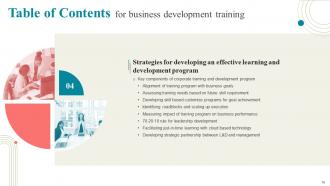
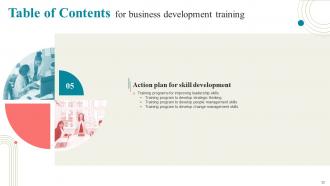
Slide 3: This slide shows Table of Content for the presentation.
Slide 4: This is another slide continuing Table of Content for the presentation.
Slide 5: This slide depicts the Title for the Topics to be covered in the next template.
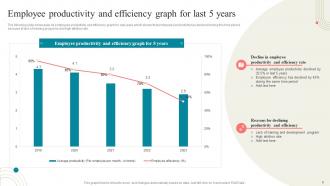
Slide 6: This slide showcases he employees productivity and efficiency graph for last 5 years.
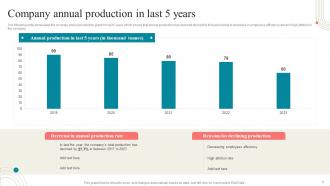
Slide 7: This slide presents the Company annual production in last 5 years using vertical Bar-Graphs.
Slide 8: This slide highlights the Impact of declining efficiency and production rate on company revenues.
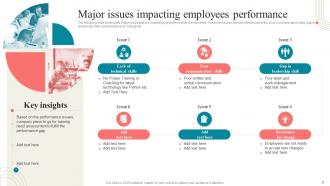
Slide 9: This slide includes the Major issues impacting the performance of the employees.
Slide 10: This slide contains the Title for the topic to be discussed in the next template.
Slide 11: This slide displays the Interpersonal skill matrix of employees using a Tabular format.
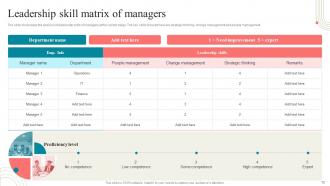
Slide 12: This slide highlights the Leadership skill matrix of managers.
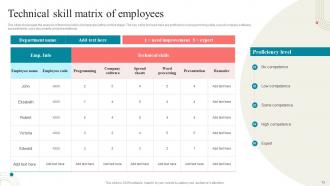
Slide 13: This slide showcases the Technical skill matrix of employees.
Slide 14: This slide highlights the Heading for the Content to be covered in the following template.
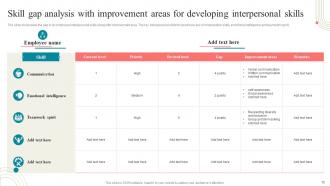
Slide 15: This slide reveals the Skill gap analysis with improvement areas for developing interpersonal skills.
Slide 16: This slide shows the Skill Gap analysis with improvement areas for developing technical skills.
Slide 17: This is another slide continuing the Skill gap analysis with improvement areas for developing technical skills.
Slide 18: This slide depicts the Title of the idea to be discussed in the forth-coming template.
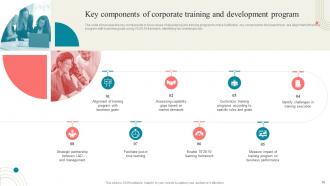
Slide 19: This slide highlights the Key components of corporate training and development program.
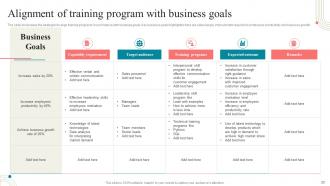
Slide 20: This slide elucidates the Alignment of training program with business goals.
Slide 21: This slide gives a glimpse of the way of Assessing training needs based on future skill requirement.
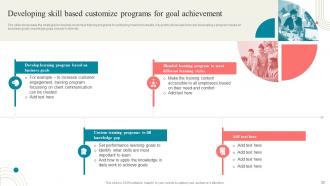
Slide 22: This slide contains the Development of the skill based customized programs for goal achievement.
Slide 23: This slide gives a glimpse of Identifying roadblocks and scaling up execution.
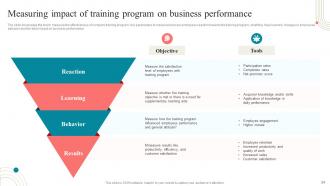
Slide 24: This slide represents the Impact measurement of the training program on business performance.
Slide 25: This slide shows the 70-20-10 rule for leadership development.
Slide 26: This slide presents the cloud-based tools to promote quick learning at the workplace.
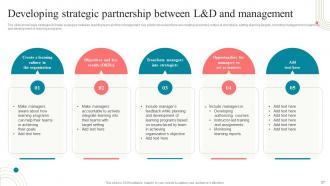
Slide 27: This slide provides information about the Developing strategic partnership between L&D and management.
Slide 28: This slide includes the Title for the Topics to be covered in the forth-coming slide.
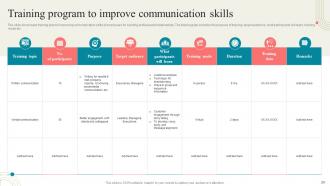
Slide 29: This slide shows the Training program to improve communication skills.
Slide 30: This slide represents the Training program to develop emotional intelligence.
Slide 31: This slide focuses on the Training program to improve teamwork skills.
Slide 32: This slide reveals the Heading for the content to be discussed in the next template.
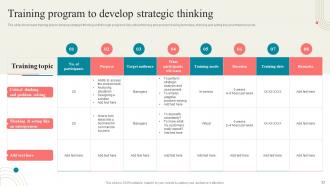
Slide 33: This slide showcases the Training program to develop strategic thinking.
Slide 34: This slide highlights the Training program to develop people management skills.
Slide 35: This slide includes the Training program to develop change management skills.
Slide 36: This is the slide depicting the Title for the Topics to be covered in the next slide.
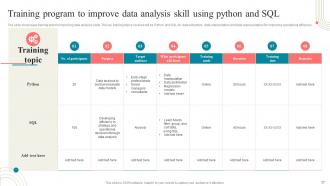
Slide 37: This slide includes the Training program to improve data analysis skill using Python and SQL.
Slide 38: This slide shows the Training program to learn software tools such as CRM and performance management.
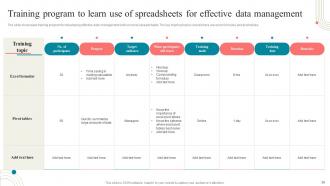
Slide 39: This slide depicts the Training program to learn the use of spreadsheets for effective data management.
Slide 40: This slide includes the Training program to learn the usage of word documents for professional writing.
Slide 41: This slide incorporates the Training program to learn the use of presentations for data representation.
Slide 42: This slide includes the Title for the content to be discussed in the forth-coming template.
Slide 43: This slide showcases the Resource planning to check requirements for training programs.
Slide 44: This slide contains the Heading for the content to be discussed in the next template.
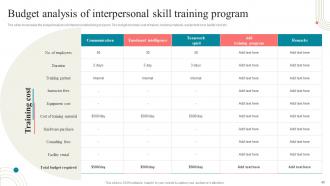
Slide 45: This slide potrays the Budget analysis of Interpersonal Skill training program.
Slide 46: This slide depicts the Budget analysis of leadership skill training program.
Slide 47: This slide showcases the Budget analysis of technical skill training program.
Slide 48: This slide highlights the Title for the Topics to be discussed in the forth-coming slide.
Slide 49: This slide reveals the Training log to track employee skilling program in a tabular form.
Slide 50: This slide represents the Yearly training timeline for employee skilling program.
Slide 51: This slide shows the Six months training calendar timeline for a team.
Slide 52: This slide elucidates the Employee monthly training calendar.
Slide 53: This slide provides information about the Heading for the ideas to be discussed in the next template.
Slide 54: This slide includes the table for the Measurement of the ROI of training program.
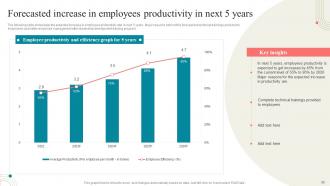
Slide 55: This slide shows the Forecasted increase in employees productivity in the next 5 years.
Slide 56: This slide depicts the Forecasted increase in company annual production in the next 5 years.
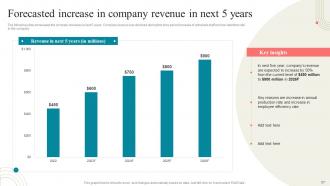
Slide 57: This slide states the Forecasted increase in company revenue in the next 5 years in the form of Bar-Graphs.
Slide 58: This slide showcases the Employee Satisfaction level after the training program.
Slide 59: This slide contains the Title for the content to be discussed in the next template.
Slide 60: This slide is titled as the Dashboard to track employee performance using statistics.
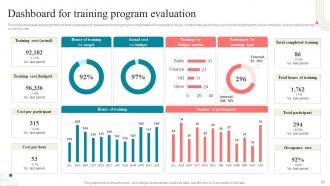
Slide 61: This slide potrays the Dashboard for training program evaluation.
Slide 62: This is the Icons Slide including all the Icons used in the Presentation.
Slide 63: This is the Additional slides for providing some extra information.
Slide 64: This slide provides 30 60 90 Days Plan with text boxes.
Slide 65: This is Our Team slide with names and designation.
Slide 66: This is a Timeline slide. Show data related to time intervals here.
Slide 67: This slide displays Column chart with two products comparison.
Slide 68: This is a Comparison slide to state comparison between commodities, entities etc.
Slide 69: This is Our Goal slide. State your firm's goals here.
Slide 70: This slide presents Roadmap with additional textboxes.
Slide 71: This slide shows Post It Notes. Post your important notes here.
Slide 72: This slide contains Puzzle with related icons and text.
Slide 73: This is a Thank You slide with address, contact numbers and email address.
Business Development Training Powerpoint Presentation Slides with all 78 slides:
Use our Business Development Training Powerpoint Presentation Slides to effectively help you save your valuable time. They are readymade to fit into any presentation structure.





































FAQs for Business Development Training
Honestly, start with one solid sales methodology and build from there - don't try to cram everything in at once. You'll definitely need relationship building and pipeline management basics. CRM training is huge too (seriously, so many people just use random spreadsheets forever and it's a mess). Make sure they get actual hands-on practice with prospecting and negotiation, not just boring theory sessions. Role-playing helps a ton. Also throw in some market research and competitive analysis so they can actually position themselves well against competitors. The key is real scenario practice - that's where people actually learn this stuff.
Templates are honestly lifesavers for BD training. Your team won't waste time staring at blank slides anymore - they can jump straight into working on their actual pitch. Speed things up too since nobody's struggling with design stuff. What I really like is how they keep everyone's presentations looking professional instead of that hodgepodge mess you usually see. Oh, and definitely customize them for different scenarios - prospecting, renewals, whatever. I'd start with maybe 3-4 templates for your most common situations. Makes a huge difference in how polished everything looks.
Track the obvious stuff first - completion rates, feedback scores, pre/post test results. But honestly? That's just scratching the surface. The metrics that actually matter are business ones: lead gen rates, deal conversions, average deal size, how long your sales cycles are taking. Revenue per person trained is huge. Also worth watching - new partnerships, client retention rates, that kind of thing. Oh, and don't just check right after training ends. Set up reviews at 90 days and 6 months because initial excitement always fades.
So yeah, every industry does BD training totally differently based on how they actually sell stuff. Tech bros are obsessed with demos and getting technical. Healthcare? It's all compliance paperwork and schmoozing doctors - honestly pretty tedious. Financial services won't shut up about building trust and knowing regulations inside out. Manufacturing companies focus on those massive long-term supply contracts. Complete opposite of retail where you're just trying to get people to buy NOW and have a decent experience. Best move is figuring out what your top salespeople actually do all day, then train everyone else on those real situations instead of generic BS.
Dude, training tech has gotten insane lately. AI platforms now customize everything based on what you suck at, which is honestly way more helpful than sitting through generic courses. VR simulations let you practice tough conversations without actually bombing with real clients – though I still think some of the avatars look creepy. Mobile apps keep you learning during downtime, and the analytics actually pinpoint your weak spots instead of making you guess. CRM integrations are clutch too since you're working with real data. Ask your training team what tools they've got because most companies are using something now.
Ditch the boring case studies and use actual client stories instead. People's brains are wired for stories - way more memorable than bullet points. Each training module should start with something real your team went through: client's problem, messy complications, how you fixed it. I always do the classic setup-conflict-resolution thing because it just works. Your trainees need to see themselves as heroes in future client stories, you know? Give them story templates they can fill in with their own examples. That way they'll actually engage prospects with compelling narratives instead of rattling off features like robots.
Honestly, getting people off their phones is the worst part. Mixed skill levels will drive you crazy too - you've got newbies sitting next to know-it-alls who think they've seen it all. Different industries want different examples, which gets messy fast. Most people hate changing how they already do sales, even when it's not working. Oh, and I learned this the hard way - do a quick skills check before you start. Break them into smaller groups whenever you can. Trust me, it saves your sanity and actually works better anyway.
Honestly, I'd start with monthly sessions where people share real wins and losses - the epic fails are usually way more educational anyway. Get your experienced reps to shadow newbies too, not just the other way around. Fresh eyes catch things we miss. Maybe do case study presentations where everyone teaches something they're actually good at? The trick is keeping it structured but not boring - nobody wants another mandatory meeting that feels like homework. I'd test one session per month first and build from there based on what your team actually responds to.
First thing - get a decent CRM, doesn't have to be fancy but you need something for tracking your pipeline. LinkedIn Sales Navigator is worth every penny, seriously. I've seen teams double their outreach success with it. For training, mix up role-playing with real case studies from your space. Maybe throw in some personality assessments so your reps can figure out if they're dealing with an analytical buyer or someone who just wants the big picture. Oh and you'll want a sales enablement platform for all your decks and content. Start simple though - CRM first, then add tools as you spot the gaps.
Honestly, most training fails because companies treat it like a one-time thing. You've got to build in follow-up sessions and peer coaching - otherwise people just forget everything in two weeks. I've watched so many places waste money on fancy workshops that nobody remembers! What actually works? Get people practicing new skills right away. Set up mentorship programs. Monthly check-ins are huge too. And here's the thing - managers need to reinforce this stuff during regular work, not just ignore it. Track progress over months, not days. Oh, and skill assessments help you see what's actually sticking versus what isn't.
Honestly, role-playing is where it's at - have people actually practice their pitches while others jump in with feedback. Case studies work great too, especially with real scenarios from whatever industry you're dealing with. Don't just lecture though, that kills the vibe completely! Mix in small group stuff, maybe some networking exercises, or have them build actual prospect lists. Keep each activity around 15-20 minutes max. I learned this the hard way - people zone out fast if you drone on. Oh, and make sure it feels like a workshop where they're actually doing things, not sitting there taking notes the whole time.
Honestly, diverse teams are game-changers for business development training. Different backgrounds mean fresh perspectives on customer problems and market opportunities - stuff you'd miss otherwise. Training gets way more engaging too when everyone's throwing in unique insights. Your team members bring examples from totally different industries and client situations, which makes the learning so much richer. I've noticed the sessions feel less like... well, typical corporate training when there's real variety in the room. Mix up your groups on purpose next time. You'll probably be surprised how much better the discussions get.
Oh man, this is SO important. What kills in the US can totally bomb in Japan - like being super direct when they value relationship-building first. You've gotta flip your whole approach depending on the culture. Some places love group work, others are all about individual performance. Communication style, feedback methods, even how you set up activities - it all changes. I've watched training programs crash and burn because nobody bothered researching the cultural stuff beforehand. Honestly? Get a local consultant if you can. They'll save you from looking like an idiot.
Honestly, you need multiple angles to figure out if training actually worked. Send surveys right after while it's fresh in their minds, but here's the thing - follow up again in like 30-60 days. That delayed feedback is gold because you'll see what people actually retained versus the initial "wow that was amazing" responses. Don't forget to loop in their managers too. They'll notice behavioral changes way better than self-reported surveys. Maybe throw in some focus groups if you want deeper insights on specific parts. Ask what worked AND what would make it better - not just those boring 1-10 rating questions.
Honestly, micro-learning is where it's at right now - nobody wants those awful day-long training marathons anymore. AI personalization is getting really good at spotting what each rep actually needs to work on. VR role-playing sounds gimmicky but it's surprisingly effective for practicing tough conversations. Social selling training is massive since buyers expect more of that consultant vibe these days. Oh, and everything's moving to bite-sized content people can grab whenever they need it. I'd probably start by looking at your current stuff and seeing what you can chop up into smaller pieces that actually stick.
-
Great and nice ppt
-
Awesomely designed templates, Easy to understand.
-
One word for SlideTeam–Versatile!