


Importance Of Business Communication In Organizations Training Ppt




Try Before you Buy Download Free Sample Product
 Impress Your
 Audience
 100%
100% Editable
 Save Hours
 of Time


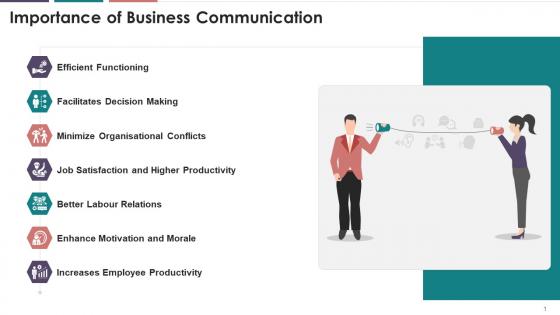
This slide depicts information on the importance of business communication. The importance is efficient functioning, facilitation of decision making, minimizing organizational conflicts, job satisfaction and higher productivity, better labor relations, enhanced motivation and morale, and increased employee productivity.
People who downloaded this PowerPoint presentation also viewed the following :
Importance Of Business Communication In Organizations Training Ppt with all 17 slides:
Use our Importance Of Business Communication In Organizations Training Ppt to effectively help you save your valuable time. They are readymade to fit into any presentation structure.






FAQs for Importance Of Business Communication In
Oh okay so verbal is just your actual words - like what you say, how fast you talk, your tone, all that. Non-verbal is everything your body's doing. Your posture, face, gestures, eye contact. Even what you're wearing counts. But here's what's wild - the body language stuff actually matters way more than the words. If you say "yeah I'm totally confident" but you're hunched over avoiding eye contact? People notice that mismatch immediately. I learned this the hard way in presentations lol. Just make sure both match up when you're trying to get a point across.
Dude, you've gotta pay attention to cultural differences or you'll totally blow it with international clients. I've watched so many deals crash because someone didn't get the basics - like how being too direct can seem rude in some places, while others expect it. Silence doesn't always mean "yes" either, which honestly threw me off at first. Different countries have wild expectations about hierarchy and timing too. Quick tip: spend like 10 minutes googling business etiquette before calls. Trust me, when you match their communication style, they'll actually want to work with you.
Honestly, digital communication just removes all those annoying delays that used to kill productivity. Files get shared instantly, brainstorming happens in real-time, and location doesn't matter anymore. Slack and Teams are lifesavers for this stuff – though I still think email threads work fine for some things. You're not sitting around waiting for someone to show up at the office. Everything gets saved automatically too, which is clutch when you need to reference old decisions later. Remote teams especially can't function without it. Just pick whatever tool fits the conversation type and stick with it consistently.
Look, your brand needs to show up in everything - visuals, tone, the stories you tell. Don't just slap logos everywhere (though good design obviously matters). Start with your actual values and let them come through naturally when you're storytelling. Real customer examples work way better than generic fluff. Match your presentation style to your personality too. If you're the innovative type, why bore people with some cookie-cutter deck? That makes zero sense. Customer stories that actually demonstrate your brand promise hit different. End with something memorable - what do you want them walking away thinking about your company?
Honestly, it's usually three big things that screw up communication at work. Poor listening is huge - people zone out in meetings or half-read emails. Then there's information overload where everyone's drowning in messages. And vague messaging drives me crazy - like when someone sends "we need to talk" with zero context. Cultural differences can complicate things too. But here's what actually works: be ridiculously clear when you communicate. Ask questions to make sure people get it. Pick the right way to deliver your message - don't send a novel-length email when a quick call would work better. Most important thing? Create space where people aren't afraid to say "wait, I'm confused."
Honestly, just build feedback into everything from day one. Do regular check-ins and those quick pulse surveys. Oh, and here's something that actually works - ask "what questions do you have?" instead of "any questions?" Sounds weird but people respond way better. Not everyone's gonna speak up in meetings though, so give them other ways to share stuff - anonymous forms, one-on-ones, whatever. The real trick? Actually do something with their feedback and tell them what changed. Otherwise you're just wasting everyone's time. I'd start with just one team first.
Okay so first thing - figure out what your audience actually gives a damn about. Hook them right away, then keep your slides super clean. I swear, people cram way too much text on there (I've definitely done this too lol). Tell it like a story - problem, then how you solve it. Practice talking TO people, not AT them, you know? Oh and visuals should help your point, not distract from it. End with something concrete - like what do you actually want them to do? Otherwise they'll just sit there nodding and do nothing.
Honestly, emotional intelligence is just being able to read people and not be a total disaster in conversations. You pick up on someone's vibe - maybe they're stressed or their tone seems off - then you adjust how you talk to them. Instead of pushing your idea when they're clearly overwhelmed, you back off and offer help. Plus you don't send stupid emails when you're pissed off (learned that one the hard way lol). The trick is actually paying attention to how people react to your messages. Someone always responds with short replies? They probably prefer brief updates. It's not rocket science, but most people are too busy thinking about what they'll say next to notice these things.
Honestly, work communication is changing so fast right now. Tools like ChatGPT and Grammarly are making everyone's writing way sharper. Video calls aren't going anywhere obviously, but now they actually play nice with other apps. You can collaborate in real-time on stuff like Notion and Miro - your whole team jumping on the same project at once. Automation handles the boring repetitive messages too. Oh, and here's what I'd do: just pick one tool this month and really figure it out instead of half-learning five different things.
Dude, stories work because our brains are just wired that way - we connect with narratives way more than boring data dumps. I've watched presentations go from total snoozefests to everyone actually leaning forward once someone throws in a real customer example or talks about how they screwed up and fixed it. People remember emotional stuff better, plus it makes complicated things easier to digest. Trust me on this one. Next time you're presenting anything, start with a specific case study or example that shows your point. Way more effective than jumping straight into charts and bullet points.
Honestly, I'd focus on both engagement stuff and actual results. Open rates and response times are obvious ones, but don't sleep on employee feedback surveys - people will straight up tell you if your emails suck or actually help. Customer satisfaction scores matter too if you're doing external comms. The real test though? Whether people actually DO what you want them to do after reading your stuff. Like, did they show up to that meeting or finish the project on time? Oh, and don't go crazy tracking everything - pick maybe 3-4 metrics that actually matter to you first.
Cut the fluff and get to your point fast. Use active voice—say "we decided" instead of "it was decided." Break up those monster sentences nobody can follow. I swear, bullet points are your friend when you're covering multiple things. Simple words work better than fancy ones your audience won't get. Oh, and read stuff out loud before sending it—you'll catch weird phrasing that way. The goal? Someone should understand your main point even if they're just skimming. Trust me, clarity beats sounding smart every time.
Okay so basically you gotta read the room first. With executives? Keep it short, focus on business impact stuff. Technical people want all the nitty-gritty details and industry terms. But with customers, drop the jargon completely - speak like a normal human. I totally bombed this once by sending a client this super corporate-y email that sounded ridiculous. Also think about where you're communicating. LinkedIn needs to be more polished than just shooting a quick Slack message to your teammate. Do some homework on who you're talking to first. What do they actually care about? How do they like getting info? Makes all the difference honestly.
Honestly, just be straight up about everything - your capabilities, timelines, when stuff might go wrong. Yeah, it's awkward sometimes but way better than the alternative. Keep confidential stuff locked down tight, don't share it without permission. I made that mistake once and... oof. Watch your language too, make sure you're not accidentally excluding people or coming across wrong. Don't cherry-pick facts to make things sound better than they are. Quick test: would you be cool with your boss seeing whatever you're about to send?
Honestly, active listening is such a game-changer for managers. You'll catch problems way earlier and actually understand what your team needs instead of just guessing. Plus it builds real trust. I see this all the time - people are already planning their response while the other person is still talking. Total mistake. Try this thing where you repeat back what you heard before jumping in with your answer. Sounds weird but it actually works really well. Oh, and it separates the decent managers from the ones people actually want to work for.
-
I'm happy to discover your PowerPoint presentations and templates. They met my expectations precisely. Very innovative!
-
The presentations are very helpful. I am always able to get appropriate templates for the different topics related to my profession.