

Storytelling Its Importance And Characteristics In Business Communication With Activity Training Ppt




Try Before you Buy Download Free Sample Product
 Impress Your
 Audience
 100%
100% Editable
 Save Hours
 of Time


This set of slide showcase the significance of storytelling in business communication. It includes information on the characteristics of a good story, which are it should be audience-specific and action-oriented. Further, it has an activity that the trainer can use to discuss the experiences of the target audience.
People who downloaded this PowerPoint presentation also viewed the following :
Content of this Powerpoint Presentation
Slide 1
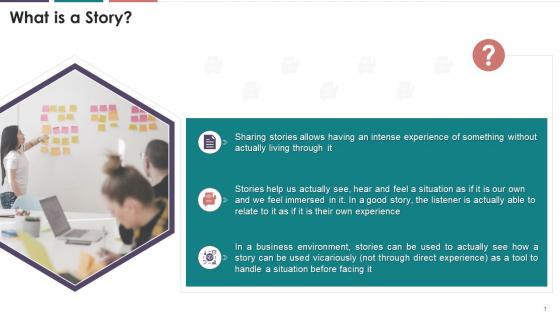
This slide explains the meaning of a story.
Slide 2
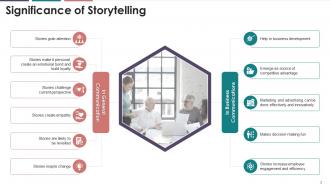
This slide illustrates the main points of importance of storytelling in general as well as particularly for business communication.
Instructor’s Notes:
In General Communication-
- Stories grab attention: Stories can quickly grab people's attention as they create a new reality and connect emotions to it. Stories help the people see their life from different perspectives, or they usually relate to these, imagining every scenario with the motive of finding out how they have would have responded to it
- Stories make it personal, emotionally connect people, and create loyalty: Through storytelling, the speaker can formulate and frame business concepts relating them to the personal experiences of life. It provides an explanation and relevance to business statistics and helps people connect it to their life
- Stories challenge current perspective: Stories challenge current assumptions and norms when provided with new perspectives. It is experienced while rewriting the stories. Many times stories are modified or rewritten, reframing them to show a different perspective
- Stories create empathy: The success behind stories is that they create empathy with the situation and the characters involved. It is all about the experience of how people and how they relate to the story of their own life that unfolds before them. The key is that stories can simulate a natural and authentic experience
- Stories are likely to be revisited: It is evident that people usually remember the stories that bring some motivating lesson or a real-life experience, and then they revisit such stories and share them with multiple people transferring their knowledge and learning. Good stories contribute to culture and survive the test of time
- Stories inspire change: Stories can be used as an inspirational tool to motivate people to change. The speaker can make audience relate to some tragic or success stories. The Stories that that grab attention and have qualities like empathy, emotional connection, etc. motivate people to see and do things differently. The Speaker should make use of compelling storytelling techniques to encourage individuals and groups to change
In Business Communication-
- Business development: Every business idea is backed by some story- whether it's related to product development or business expansion. The story must provide context to the audience and the stakeholders to understand the worthiness of a product/service. Every story must build a connection with the audience using real-life scenarios. This makes it easier for them to understand the importance of your products and services
- Competitive advantage: Consumers are usually lost in the noise as they are exposed to too much information. A business might be offering something better than its competitors, but making decisions is more of an emotional process than a logical one. Telling a story in a presentable way can distinguish you from your competitors, providing a competitive advantage
- Marketing and advertising: Storytelling is considered a marketing strategy for businesses as people want to connect with different brands and companies. Storytelling inspires people to take action by humanizing a brand. It also helps customers to know and understand the relevance of products or services you offer
- Decision making: The reviews posted on social networks are more of stories than facts. These reviews influence the decision-making process of people, which can be a purchase decision or something else. While connecting with any brand, a person looks for multiple factors and reasons. In fact, these are looking stories that can provide answers to their diverse questions
- Stories increase employee engagement and efficiency: Employees are the company's best assets, and a company succeeds only when the employees do. Research indicates widespread non-engagement on the part of US employees. Over 70% of the US employees are not engaged or are actively disengaged from work. It is suggested that an organization should cultivate the right culture at work by using storytelling. They can share stories relating to its history, struggles, aims, and how it achieved its goals. The story should only revolve around the essential aspects that should be communicated to the employees and why that aspect is relevant for them. This initiative will not only encourage their behavior, but also motivate them to work efficiently and effectively
Slide 3
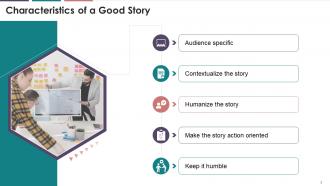
This slide mentions the main features of a good story.
Instructor’s Notes:
- Audience specific: To know more about your target audience, informal conversations are best. Building on this knowledge, a speaker can always prefer storytelling to glean out their needs and requirements. The closer your story is to audience’s concerns, the better it is for all stakeholders
- Contextualize the story: An individual, while sharing a story must make sure that he/she contextualizes the story. To contextualize means to analyze an event in terms of concepts surrounding it. For Example, when reading a novel written during women’s civil rights movement, it’s advised to keep feminist perspectives in mind
- Humanize the story: To humanize means to make a story friendlier and relatable to humans. Humanization makes the concept more understandable and refined so that people find it easy to relate and appreciate
- Make the story action oriented: Being specific reduces the chances of confusion. While recounting a story, the speaker should prefer giving practical advice and clear direction. The message then hits home and empowers audience; it also helps them take action and make their own story
- Keep it humble: A story should be kept humble i.e., it should not include elements like excessive pride. It should simply provide a motivating and encouraging lesson which people can relate to their life
Slide 4
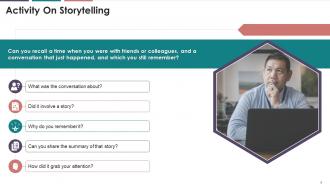
This slide illustrates an activity that the trainer can use to discuss some stories or experiences of the target audience. This activity will help the trainer to grab attention and energize the crowd.
Instructor’s Notes:
After this activity, participants will realize that it's easy to connect with and remember stories rather than concepts. To send a message that a person should relate to, it should “preferably” be in the form of a story.
Storytelling Its Importance And Characteristics In Business Communication With Activity Training Ppt with all 20 slides:
Use our Storytelling Its Importance And Characteristics In Business Communication With Activity Training Ppt to effectively help you save your valuable time. They are readymade to fit into any presentation structure.






FAQs for Storytelling Its Importance And Characteristics In Business Communication With
Honestly, it's all about structure, emotion, and making people actually care. Start with a clear problem-journey-solution arc. Characters need to feel real - like when I totally bombed that exec presentation with boring data slides, ugh. But anyway, your audience has to *feel* something, you know? Urgency, hope, whatever fits. Don't be vague either. Instead of saying "customers love our product," tell them about Sarah from Denver who saved three hours every week. That hits different. Try turning just one data point in your next presentation into a real story about an actual person. You'll see the difference immediately.
Honestly, stories are like magic for getting your team to actually *feel* your company values instead of just reading them on a poster. Share stuff about employees crushing it or bouncing back from setbacks - everyone relates to that. Company history works great too, plus customer wins or even epic fails that taught you something. I've watched this totally transform team meetings (way less eye-rolling). The trick is doing it regularly, not just when you remember. Oh, and grab stories from different departments - marketing always has the weirdest ones. Make it part of how you normally talk to people.
Dude, storytelling is everything for presentations. Your brain literally craves stories, so when you structure things like beginning-middle-end, people actually listen instead of scrolling Instagram. I used to bore everyone with endless data slides - learned that lesson fast! Start with the problem, explain what you did about it, then show the results. Simple formula but it works. Plus it forces you to cut the fluff and focus on what actually matters. Honestly, once you try this "challenge-action-outcome" approach, you'll never go back to those bullet-point nightmares.
Okay so audience analysis is honestly everything - it turns boring generic stories into ones people actually give a shit about. You gotta figure out their pain points and what drives them first. I bombed a client presentation once because I didn't do this! Engineers want details, executives want the big picture. Same story, totally different approach. Like, cost savings means something way different to a CFO than to someone in HR, you know? Before you even start writing, just ask yourself what this specific group actually cares about. Then build your story around that.
Don't lead with the numbers - that's where most people mess up. Start with the human problem first. Like instead of "conversion went up 23%" say "customers were getting pissed at our checkout process" then drop the 23% as proof your fix worked. Think of data as backup evidence, not the main story. Charts help too since people's eyes glaze over when you rattle off percentages. Oh and always tie it back to real impact on actual people - that's what makes numbers stick. Data without context is just... well, boring math basically.
Honestly, get super specific with the details - like that weird quiet tension when everyone's waiting for the client to respond, not just "the meeting was stressful." People connect when you show what's actually at stake for real humans, you know? I've found being a bit vulnerable helps too. Admitting you screwed up or were scared makes you way more relatable than pretending everything went perfectly. Focus on the emotional stuff, not just whether you hit your numbers. Try one story this week and see what happens!
Basically, sharing your own stories makes people trust you way more than just spouting textbook advice. Like when you tell someone about a time you totally screwed up or had to figure something out the hard way - that's when they really listen. People can smell BS from a mile away, you know? They know the difference between someone who's lived it versus someone who just googled it. Just make sure your story actually connects to whatever point you're trying to make. Random stories are just... random. Keep it short though - nobody wants your entire life story.
It's all about who you're talking to, honestly. Marketing stories? You're selling to customers, so focus on benefits and that emotional "this will change your life" vibe. Internal stuff is different - you're trying to get everyone on the same page or pump up your team. Marketing stories are usually super polished. But internal ones can be messier, which is actually better sometimes. I've seen great presentations that were literally about epic failures - way more engaging than another "we crushed our targets" story. So figure out first: are you trying to sell something or just help people get it?
Visual aids make abstract stuff way more memorable. Charts show your "before and after" moments. Images hit emotions that words can't reach. Infographics map out the whole journey you're describing. I watched this one presentation where a basic timeline turned a super boring process into an actual story - honestly made all the difference. Here's the thing though: your visuals need to push your story forward, not just look pretty. When you're putting slides together, ask yourself if each image actually helps tell your story or if you're just filling empty space.
Look, most people just feel weird about it - like storytelling is too touchy-feely for work stuff. But honestly? People are dying for connection instead of boring data slides. The other big issue is rambling - we tell these long stories that go nowhere business-wise. Start tiny: drop one quick personal example into your next meeting. Always do the "so what?" check after - connect it back to your actual point. Once you see how much more people pay attention (and trust me, they will), the awkwardness fades fast. It's kinda wild how much difference it makes.
Dude, stories are like leadership superpowers. Your team will actually remember what you're saying instead of zoning out during another boring data presentation. I've seen this work so many times - share a quick story about a challenge you faced or a win the team had, and suddenly everyone's paying attention. People connect with narratives way more than facts and figures. It builds trust too, especially when you're a bit vulnerable about mistakes or struggles. Complex changes? Stories make them click instantly. Honestly, try dropping one relevant story into your next meeting and watch how different the energy feels.
Honestly, start with A/B testing - send half your team the boring facts version of an announcement, give the other half the story version. See which gets better response. Track the usual stuff like engagement scores and retention rates before/after you switch to story-driven comms. For customers, watch how narrative campaigns perform vs regular marketing - conversion rates, brand sentiment, that kind of thing. Yeah, surveys help too but who actually enjoys those? The trick is getting your baseline numbers first. Then you can actually see if stories move the needle better than just dumping information on people.
Look at Nike - they never talk about shoe specs, just show people crushing their goals with "Just Do It." Apple does this perfectly too, those iPhone ads are always about capturing life moments, not camera megapixels. Airbnb shares actual stories from hosts and guests instead of boring amenity lists. Dove's been nailing the real beauty angle forever. Oh and Patagonia weaves environmental stuff into everything, which honestly feels authentic coming from them. The trick is connecting your product to actual human moments and feelings. People buy stories, not features - that's just how we're wired.
Honestly, start by figuring out how your audience actually communicates. Japanese folks tend to love subtle, indirect stories, but Germans? They want you to get straight to the point with hard facts. Colors and symbols can mess you up big time - I've seen campaigns totally bomb because nobody checked if red meant "good luck" or "death" in that market. Your characters need to feel familiar to locals, not like stock photo people. Oh, and definitely test everything with native speakers first! Maybe create a little cheat sheet for each country listing what works and what doesn't.
Look, being real is everything when you're presenting. People can smell fake from a mile away, and honestly? Nobody wants to hear your perfect success story anyway. Share the actual messy stuff - the failures, the "oh crap" moments, the times you had no idea what you were doing. That's what people connect with. I've watched so many presentations bomb because they sounded like they came straight from a corporate handbook. Your genuine experiences hit different because they're... well, genuine. Don't polish away the interesting parts. Those imperfect, real moments are what make your audience actually give a damn.
-
Satisfied with the way SlideTeam resolved my query regarding the right business PPTs that I was having difficulty finding. I found the perfect match with their assistance.
-
Topic best represented with attractive design.