


Case study on business communication with solution ppt slide





Try Before you Buy Download Free Sample Product
 Impress Your
 Audience
 100%
100% Editable
 Save Hours
 of Time


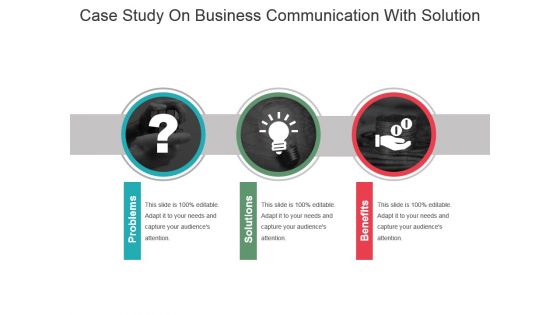
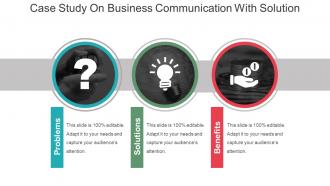
Take advantage of this case study on business communication with solution PPT slide which is ideal for any customer communication presentation. It illustrates problems, solutions and benefits through circular shapes of different colors. The icons appropriately signify each heading but you can replace them with your own icons as per your requirement. The corporate communication PowerPoint template covers topics such as information sharing, customer relations, community engagement, professional communication, organizational communication, business communication case study, company-customer relationship, business dialogue, and conference call. During business meetings, it will encourage your team to bring up issues that may be hampering effective delivery of your message to the clients. A good customer relationship helps increase sales and promote business growth through marketing which is also a part of communication. Download case study on business communication with solution presentation diagram to be included in your next presentation. Inch ahead of the competition with our Case Study On Business Communication With Solution Ppt Slide. Increase the extent of advantage you have.
People who downloaded this PowerPoint presentation also viewed the following :
Case study on business communication with solution ppt slide with all 6 slides:
Create enduring credibility with our Case Study On Business Communication With Solution Ppt Slide. Faith in you will continue to build.
FAQs for Case study on business communication with
Okay so first thing - know who you're talking to and match your vibe accordingly. Your boss needs different info than a client, you know? Be clear and get to the point because honestly, everyone's drowning in messages these days. Actually listen when people talk (shocking concept, I know). Pick the right way to communicate too - some stuff needs a real conversation, not just another email. Oh and timing is everything. Before you send anything, just think "what do they actually need from me?" Saves so much back-and-forth later.
Ugh, miscommunication is the worst - it literally destroys projects from the inside out. People end up doing the same work twice, missing deadlines left and right. Everyone's chasing different goals thinking they're doing the right thing. Then the blame game starts because nobody knows who messed up what. I've seen teams completely fall apart over this stuff. Your timeline goes out the window, you're suddenly over budget, and people get bitter real fast. Honestly, the only way to avoid it is setting up good communication from day one and checking in constantly. Catch the confusion early or you'll regret it later.
Honestly, your body language matters way more than most people realize. I made this mistake early on - kept crossing my arms during client meetings and couldn't figure out why things felt off. Eye contact and open posture build trust instantly. Mirror how they communicate too, it creates this psychological comfort zone. Here's the thing though - watch their non-verbals more than you listen to their words sometimes. A client might say "everything's fine" but their fidgeting tells a completely different story. Works every time.
Honestly, cultural differences can make or break your business communication overseas. What seems perfectly direct to you might piss people off in Japan, while Germans actually want you to be more blunt. Some cultures need tons of small talk before getting to business - drives me crazy but it works. Others just want the facts, no fluff. Pay attention to how formal people get in meetings too. Research your target markets first, then tweak everything from email tone to presentation style. Even timing matters - don't schedule calls during their lunch prayers, you know?
Start with the "so what" - tell them what it means before getting into the weeds. Charts beat tables every time, trust me. Clean slides with minimal text work way better than cramming everything on there. I bombed a presentation once with 20 slides of pure data dump and watched everyone zone out completely. Practice your main points ahead of time. Know your sources inside and out because someone will definitely ask. Oh, and match the detail level to who you're presenting to - C-suite doesn't need the same depth as your analyst team. Story first, numbers second.
Honestly, tech tools can be a game changer or totally backfire. Video calls and Slack are amazing for remote work - you can brainstorm with someone across the country like they're right there. But man, constant pings from five different apps will destroy your focus. Everything feels urgent when it's not. You miss so much without seeing body language too. I've learned to be picky about what tool fits what situation. Save video for the messy conversations, email when you need a paper trail, and chat for the random "hey can you send me that file" stuff. Makes a huge difference.
Honestly, templates are a game-changer for this stuff. Set them up for project updates, meeting notes - whatever your team does repeatedly. Gets everyone on the same page about tone and detail level too. I can't tell you how many times I've seen people write these massive emails when three bullet points would've worked better. Oh, and here's something that actually works - have people read their messages out loud before sending. Sounds weird but it catches all the awkward bits. You should also throw together a quick style guide covering the basics like date formats and email structure. Nothing fancy, just the fundamentals that'll make everything feel more cohesive.
Honestly, most communication problems come down to people being unclear or just not really listening. Information overload is huge too - everyone's drowning in messages these days. Tech glitches don't help either. Best thing you can do? Lead with your main point right away. Pick the right channel - don't send a novel over Slack when you need a quick call. Actually check if people got what you meant instead of assuming they did. And listen properly - ask questions rather than just waiting to jump in. Oh, and keep emails short with bullet points. Makes life easier for everyone when your message lands the first time.
So here's what works for tracking if your communication is actually hitting. Check engagement first - are people opening emails, showing up to meetings, responding to stuff? Then do quick check-ins to see if they actually *got* what you meant. Employee feedback is honestly your best friend here - they'll tell you if things are confusing. Look at whether people actually followed through on what you communicated too. Oh and track how fast issues get resolved since clear communication usually speeds that up. Just throw together a basic dashboard to check monthly. You'll catch problems way faster that way.
Okay so basically - be honest with your facts and don't exaggerate stuff. Transparency matters too, like don't hide important context from people. Watch what you share though, especially anything confidential or private. I've literally watched colleagues torpedo themselves by oversharing in company emails lol. Use inclusive language that doesn't alienate anyone. Timing's huge - nobody wants terrible news dropped on them right before their weekend starts. That's just cruel. Also think about bias creeping into your writing. Quick test: would you be mortified if this communication got forwarded to everyone tomorrow? If yes, rework it.
Dude, storytelling is a total game-changer for presentations. Nobody remembers those boring bullet points, but they'll definitely remember a good story. Try weaving your main points into an actual narrative - beginning, middle, end. Share customer wins, walk through how you solved problems, or throw in personal stuff that connects to your message. I swear people zone out the second you start rattling off data. But start with "Let me tell you about this time..." and watch how different their reaction is. Just make sure your story actually ties back to whatever point you're trying to make, otherwise it's just rambling.
Honestly, bad communication kills team morale faster than anything else I've seen. People get frustrated and checked out when they don't know what's going on. You've got to keep everyone in the loop about goals and changes - makes them feel like they actually matter. But here's the thing: it can't just be you talking at people. They need to feel heard too, ask questions, give feedback. Two-way street and all that. I'd start by looking at how you communicate now and figure out what's missing. Trust me, fixing those gaps will make a huge difference in how motivated everyone feels.
Oh man, the coordination stuff is brutal. Half your team catches those random hallway chats while remote people are totally out of the loop. Reading the room in meetings? Forget it - everyone's on mute staring at black squares. Time zones get weird even when you're all supposed to be "local" (my teammate Sarah is basically nocturnal now). Communication just fragments everywhere. You really need solid protocols from day one, plus make sure remote folks actually get heard in meetings instead of being afterthoughts.
Honestly, good feedback is pretty straightforward - be specific and don't wait forever to say something. Instead of "you're bad at listening," try "when you interrupted Sarah three times yesterday, she couldn't finish explaining the problem." Way more helpful. I usually do it privately because nobody wants to get called out in front of everyone. The whole "sandwich method" thing where you say something nice first can feel fake, but whatever works. Make it a conversation too - ask what they think went well before jumping into what needs fixing. Timing's everything though.
Dude, visuals are everything for presentations. Like, people remember 65% more stuff when you show them pictures or charts instead of just talking. Makes sense, right? I've sat through way too many slide decks that were just walls of text - total snoozefest. Your brain processes images so much faster than reading. Good charts or infographics keep people awake instead of scrolling Instagram under the table. Just don't go overboard with flashy graphics that don't actually help your point. Swap out those bullet-heavy slides for one solid visual that does the work for you.
-
Very unique and reliable designs.
-
Thanks for all your great templates they have saved me lots of time and accelerate my presentations. Great product, keep them up!