


Storytelling In Business Communication Training Module On Business Communication Edu Ppt





Try Before you Buy Download Free Sample Product
 Impress Your
 Audience
 100%
100% Editable
 Save Hours
 of Time


This PowerPoint training contains slides to explain the concept of Storytelling in Business Communication. It includes the significance of storytelling, the characteristics of a good story, and the 5Cs of storytelling circumstance, curiosity, characters, conversations, and conflict. Further, it contains techniques for making the story captivating, along with case studies and activities. It also contains key takeaways, discussion questions, MCQs, and memes to make the training session interactive. Further, it includes additional slides on about us, vision, mission, goal, 30-60-90 days plan, timeline, roadmap, training completion certificate, energizer activities, detailed client proposal, and training assessment form.
People who downloaded this PowerPoint presentation also viewed the following :
Content of this Powerpoint Presentation
Slide 4
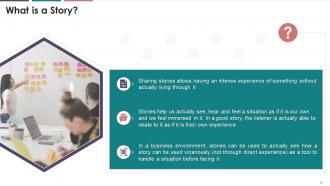
This slide explains the meaning of a story.
Slide 5
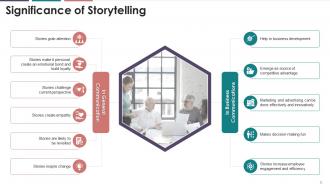
This slide illustrates the main points of importance of
storytelling in general as well as particularly for business communication.
Instructor’s Notes:
In General Communication-
·
Stories grab attention: Stories
can quickly grab people's attention as they create a new reality and connect
emotions to it. Stories help the people see their life from different
perspectives, or they usually relate to these, imagining every scenario with the
motive of finding out how they have would have responded to it
·
Stories make it personal, emotionally
connect people, and create loyalty: Through storytelling, the
speaker can formulate and frame business concepts relating them to the personal
experiences of life. It provides an explanation and relevance to business
statistics and helps people connect it to their life
·
Stories challenge current perspective:
Stories
challenge current assumptions and norms when provided with new perspectives. It
is experienced while rewriting the stories. Many times stories are modified or
rewritten, reframing them to show a different perspective
·
Stories create empathy: The
success behind stories is that they create empathy with the situation and the
characters involved. It is all about the experience of how people and how they
relate to the story of their own life that unfolds before them. The key is that
stories can simulate a natural and authentic experience
·
Stories are likely to be revisited: It
is evident that people usually remember the stories that bring some motivating
lesson or a real-life experience, and then they revisit such stories and share
them with multiple people transferring their knowledge and learning. Good
stories contribute to culture and survive the test of time
·
Stories inspire change: Stories
can be used as an inspirational tool to motivate people to change. The speaker
can make audience relate to some tragic or success stories. The Stories that
that grab attention and have qualities like empathy, emotional connection, etc.
motivate people to see and do things differently. The Speaker should make use
of compelling storytelling techniques to encourage individuals and groups to
change
In Business Communication-
·
Business development: Every
business idea is backed by some story- whether it's related to product
development or business expansion. The story must provide context to the
audience and the stakeholders to understand the worthiness of a
product/service. Every story must build a connection with the audience using
real-life scenarios. This makes it easier for them to understand the
importance of your products and services
·
Competitive advantage: Consumers
are usually lost in the noise as they are exposed to too much information. A
business might be offering something better than its competitors, but making
decisions is more of an emotional process than a logical one. Telling a story
in a presentable way can distinguish you from your competitors, providing a
competitive advantage
·
Marketing and advertising: Storytelling
is considered a marketing strategy for businesses as people want to connect
with different brands and companies. Storytelling inspires people to take
action by humanizing a brand. It also helps customers to know and understand
the relevance of products or services you offer
·
Decision making: The
reviews posted on social networks are more of stories than facts. These reviews
influence the decision-making process of people, which can be a purchase
decision or something else. While connecting with any brand, a person looks for
multiple factors and reasons. In fact, these are looking stories that can
provide answers to their diverse questions
·
Stories increase employee engagement
and efficiency: Employees are the company's best assets,
and a company succeeds only when the employees do. Research indicates
widespread non-engagement on the part of US employees. Over 70% of the US
employees are not engaged or are actively disengaged from work. It is suggested
that an organization should cultivate the right culture at work by using
storytelling. They can share stories relating to its history, struggles, aims,
and how it achieved its goals. The story should only revolve around the
essential aspects that should be communicated to the employees and why that aspect
is relevant for them. This initiative will not only encourage their behavior,
but also motivate them to work efficiently and effectively
Slide 7
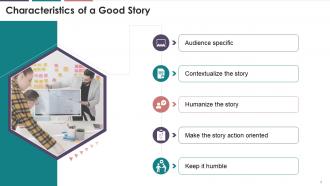
This slide mentions the main features of a good story.
Instructor’s Notes:
·
Audience specific: To
know more about your target audience, informal conversations are best. Building
on this knowledge, a speaker can always prefer storytelling to glean out their
needs and requirements. The closer your story is to audience’s concerns, the
better it is for all stakeholders
·
Contextualize the story: An
individual, while sharing a story must make sure that he/she contextualizes the
story. To contextualize means to analyze an event in terms of concepts
surrounding it. For Example, when reading a novel written during women’s
civil rights movement, it’s advised to keep feminist perspectives in mind
·
Humanize the story: To
humanize means to make a story friendlier and relatable to humans. Humanization
makes the concept more understandable and refined so that people find it easy
to relate and appreciate
·
Make the story action oriented: Being
specific reduces the chances of confusion. While recounting a story, the
speaker should prefer giving practical advice and clear direction. The
message then hits home and empowers audience; it also helps them
take action and make their own story
·
Keep it humble: A
story should be kept humble i.e., it should not include elements like excessive
pride. It should simply provide a motivating and encouraging lesson which people
can relate to their life
Slide 8
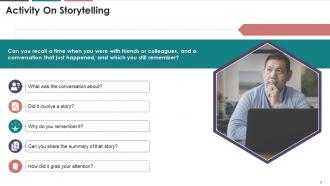
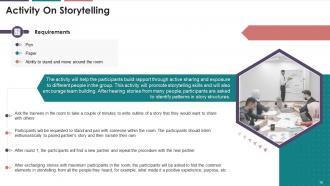
This slide illustrates an activity that the trainer can
use to discuss some stories or experiences of the target audience. This
activity will help the trainer to grab attention and energize the crowd.
Instructor’s Notes:
After this activity, participants will realize that
it's easy to connect with and remember stories rather than concepts. To send a
message that a person should relate to, it should “preferably” be in the form
of a story
Slide 10
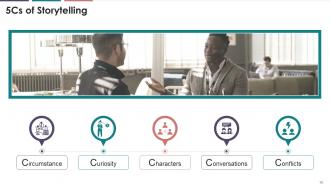
This slide illustrates the 5Cs of storytelling that are
circumstance, curiosity, characters, conversations, and conflicts.
Instructor’s Notes:
·
Circumstance: The
circumstance is one of the core elements of storytelling. While crafting a
story, the speaker has to introduce the circumstances in which the action in
the story happens. It is equivalent to the context. The circumstance helps the
speaker establish the scene and provide the audience with all the required
information to better understand the story. The circumstance clarifies the
when, where and why of the story. This improves audience engagement and adds a
compelling reason to be the story
·
Curiosity: A
brilliant introduction is crucial for a story's success, but it does not mean
that the whole task is done. Once you gain the audience's attention, your next
concern should be to stimulate the listener to be consistent throughout the
story. Creating suspense makes them curious to know about what will happen
next. Eventually, this builds interest and encourages the audience to learn
more
·
Characters: The
speaker needs to be very particular while choosing the characters featured in
the story. The characters, roles, emotions, characteristics, etc., play a
considerable role in storytelling as people want connection. The characters
become the basis that people can relate to or want to be like. Choose your
characters carefully to make it easier for the audience to visualize or relate
to them
·
Conversations: People
these days are more likely to engage with and pay attention to the conversation
between multiple characters involved. Conversations refer to the dialogues
involved in your story, which drive real engagement on the part of the
audience. A dull story without any exchanges involved may lead to a lack of
interest, so the success of storytelling depends upon human-interest element.
The speaker should consider factors like: Will my story get people talking?
Will they revisit my story and reshare it with their peers? The true success of
the story lies in answers to all these questions
·
Conflicts: Every
story must include a conflict. The conflict here refers to a problem followed
by corresponding solution. Conflict is the key to grabbing audience's attention
as it encourages them to invest time in making efforts to unfold. Most
successful business stories deeply connect with their target audiences. These
leveraging the power of relevant conflicts, adding value to them. While
crafting a story related to business or otherwise, the speaker should carefully
consider the problems and challenges that it wants to highlight. Then, it must
showcase how the business can help resolve the issues highlighted
Slide 11
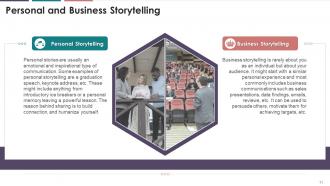
This slide mentions the difference between personal and
business storytelling in business communication.
Slide 12
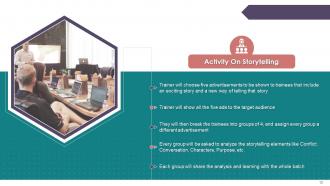
This slide illustrates an activity that the trainer can
use to discuss and understand trainees' learning.
Slide 14
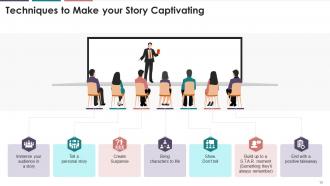
This slide explains the different techniques that can
be used by the speaker while sharing a story with the target audience.
Instructor’s Notes:
·
Immerse your audience in a story: The
best way to immerse your audience. This can only happen when you include clear
and precise details that engages all our senses. The audience has to see, hear
and feel the story. The story presented should be able to create a clear
picture of the problem or the storyline in mind by using short but effective
descriptions
·
Tell a personal story: Originality
in storytelling helps you make an instant connection with your audience.
Personal storytelling is the most effective way of communication as it builds a
connection with your audience
·
Create suspense: Several
techniques are available that can increase the level of suspense of your story.
One way is to chronologically tell a story and then build up to a climactic
conclusion. Another way is to plop the listener in the middle of the action and
then go back in time to explain how that occurred. The third way to create
suspense in a story is to tell a predictable part and then surprise them with a
completely different ending, completely at odds with the general expectation
·
Bring characters to life: Characters
are the core elements of any story, as their actions and reactions make people
curious about a evoke curiosity. It is found that the most successful and
influential stories have characters that are easily identifiable and have
distinctive characteristics. The storyteller must focus on providing enough
details of the characters involved to bring them to life in the audience's
minds. Master storyteller Malcolm Gladwell once created a vivid picture of
Howard in one of his storytelling presentations by mentioning his hobbies and
interests and describing his appearance
·
Show. Don’t Tell: Instead
of telling a story, the speaker should show it off by converting the concept
into a scene. For example, while introducing an article, I could simply tell
you that I had a classmate who was an introvert, but one day wowed his whole
class with a marvelous presentation. But this approach would not have been so
influential; instead, I prefer to use descriptions of setting and conversations
to make you feel in the middle of a scene. So, while delivering a story, a
speaker should try scene-by-scene construction of events, use dialogues instead
of plain narration to make the story more lively
·
Build up to a S.T.A.R. moment
(Something they’ll always remember): When used in storytelling,
S.T.A.R. refers to "Something They'll Always Remember." Like a
story's climax, the S.T.A.R. moment is something the audience will always
remember and revisit. This moment can take the form of some shocking statistics
or some dramatization. For example, Bill Gates, in one of his TED talks in
2009, used this technique when he mentioned the increasing investment in
eradicating malaria. He supported his point by giving statistics to prove how
serious the problem was and then surprised the room full of the audience by
opening a jar full of mosquitos. His punchline was there is no rule which
stated that only poor people should have this experience
·
End with a positive takeaway: An
effective presentation should include not only a conflict and a climax, but
also a positive resolution. A story should deliver a message or advice that can
help people overcome their problems and bring a change for the better. For
example, in one of the talks on domestic abuse, a speaker mentioned that
instead of blaming the victims, we as citizens should “perceive the survivors
as wonderful and loveable people, each with full futures.”
Slide 15
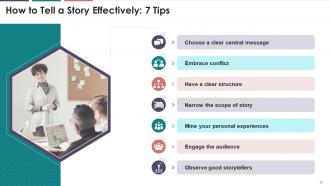
This slide mentions the tips for telling a story
effectively in business communication.
Slide 16
This slide illustrates an activity that the trainer can
conduct with the trainees.
Slide 17
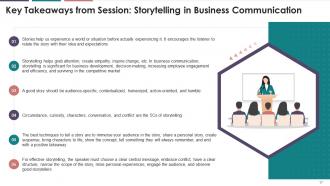
This slide mentions the key takeaways from the session
storytelling.
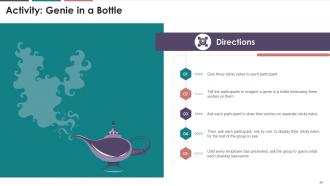
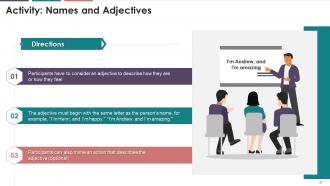
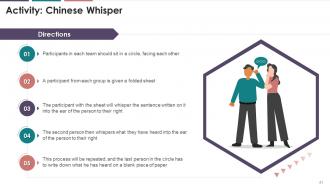
Slide 30 to 41
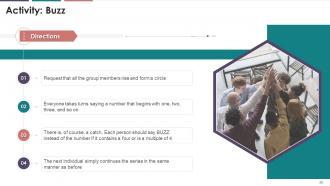
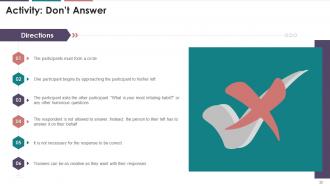
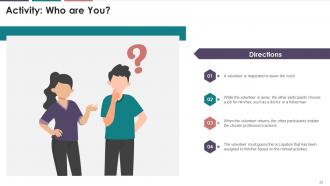
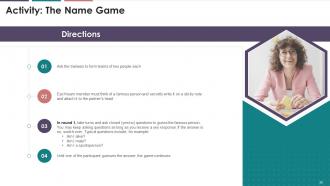
These slides depict energizer activities to engage the
audience of the training session.
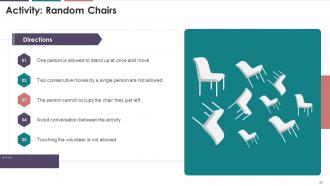
Slide 44
The above slide displays the activity for the team
members found less energetic and enthusiastic. It will ensure an increase in
energy levels and the productivity of employees at the workplace.
Instructor's Notes:
·
Multiple chairs are to be adjusted in the
empty and spacious room in a random order
·
The chairs should be put in a manner that
every chair points in a different direction and all the chairs are occupied
Now,
·
Ask for a volunteer from the batch. (Batch
may include a maximum of 15 people for a regular size room)
·
The volunteer is supposed to walk slowly
and approach his/her empty chair and sit down. If the chair is already
occupied, then he/she is expected to occupy the other/next alternative empty
chair available
·
All other members will try to stop the
person from approaching the relevant chair
Strategy Formulation:
·
Multiple teams can be made to conduct the
activity
·
Each team can be allotted 2 minutes for
planning
·
Each round is to be reviewed for the
outcomes achieved from the activity
·
Each team should have a different
volunteer, preferably the person with the lowest energy levels from the batch
·
The volunteer should move cautiously so as
to not bump into any of the props or persons in the room
Activity Review/Outcomes:
·
How did the activity influence the teamwork
and engagement skills of all the participants?
·
How was the experience while planning and
working with 15-20 members at a time?
·
Was everybody clear about the purpose and
conduct of the respective activity?
·
Did you observe any flaws that you wish to
improve? Or any other instructions you want to include to make the activity
conduct easier?
Slide 46
This slide highlights the cover letter for the training
proposal. It includes details regarding what the company providing corporate
training can accomplish for the client.
Slide 49
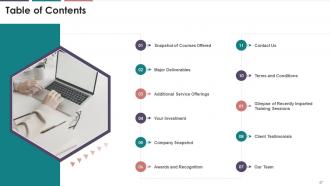
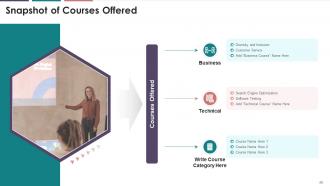
The purpose of this slide is to showcase the multiple
types of courses offered by the training company.
Slide 51
This slide indicates the major deliverables that the
corporate training firm will provide to the client. The key deliverables
highlighted are session plans, PowerPoint deck, evaluation material, and
training handouts.
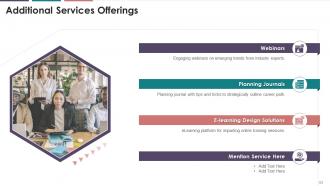
Slide 53
This slide represents the multiple additional services
offered by the training firm to the client, such as webinars, planning
journals, and e-learning design solutions.
Slide 55
This slide tabulates the major deliverables offered by
the training company to the client along with their associated costs.
Slide 56
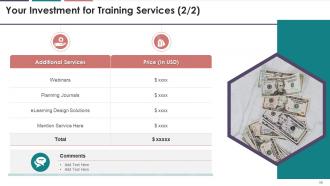
The purpose of this slide is to highlight the multiple
additional services offered by the training firm along with their cost details.
Slide 58
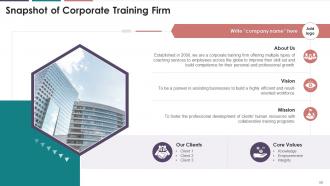
This slide provides an overview of the corporate
training firm's vision and mission statements, core values, and key clients.
Slide 60
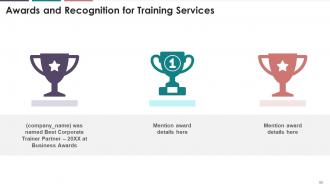
This slide highlights the major awards and recognition
won by the training firm for their exceptional service to clients.
Slide 62
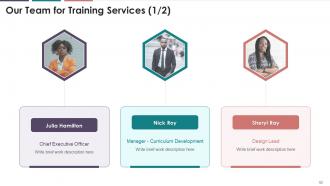
The slide provides information regarding the team
members that would be providing the training services to the client. It
includes details of the trainer and their respective designations
Slide 63
The slide provides information regarding the team
members that would be providing the training services to the client. It
includes details of the employees names and their respective designations.
Slide 65
This slide provides information pertaining to
testimonials given by satisfied clients of the training firm.
Slide 66
This slide highlights the testimonials from multiple
satisfied clients of the training firm providing information regarding
congratulatory messages, client name, and company details.
Slide 68
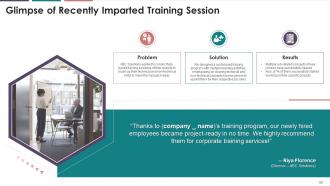
This slide showcases the case study for the training
proposal. It includes information regarding the problem faced by the client and
solutions offered by the training firm. It also covers details of the results
and client testimonial.
Slide 70
This slide provides information regarding the contract
terms and conditions of the training proposal. It also includes details of
deliverables that the training company will provide to the client.
Slide 72
The purpose of this slide is to provide the contact
information of the corporate training firm. It includes the firm’s official
address, contact number, and email address.
Slide 73
This slide highlights the training evaluation form for
instructor assessment. It also includes sections to fill details of training
information and attendee details.
Slide 74
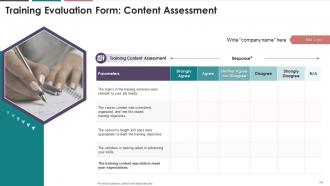
This slide showcases the questions for the assessment
of the training content by the attendees.
Slide 75
The slide indicates the evaluation form for course
assessment. It also includes questions pertaining to the future actions of the
attendees.
Storytelling In Business Communication Training Module On Business Communication Edu Ppt with all 80 slides:
Use our Storytelling In Business Communication Training Module On Business Communication Edu Ppt to effectively help you save your valuable time. They are readymade to fit into any presentation structure.



























FAQs for Storytelling In Business Communication Training Module On Business
Honestly, three things matter most: structure, relevance, and hitting them in the feels. Start with a clear beginning-middle-end - someone relatable facing a problem your audience actually deals with. Don't go telling mountain climbing stories when you're selling accounting software (unless it genuinely connects somehow). The stories that stick? They make people feel something - frustrated, hopeful, relieved. People forget your slides but remember how you made them feel. Keep it tight and circle back to your point. Oh, and try opening with something like "So our client Sarah was dealing with..."
Honestly, stories just hit different than throwing numbers at people. Your audience can actually picture themselves in those situations, you know? Like when you tell them about a customer's struggle or how your team figured something out - they start rooting for the outcome. Same reason we binge Netflix shows, basically. Just don't make it sound too rehearsed or people will tune out. Next time you're presenting, maybe kick things off with why this stuff actually matters to real humans first? Then hit them with the data once they're already invested.
Honestly, visuals are game-changers for presentations. They make your audience actually *feel* something instead of just listening to facts. Charts and images hit people's brains differently than words - you're getting both the logical and emotional sides working. Here's the thing though: your visuals need to actually push your story forward, not just look pretty on slides. I see so many people just throwing in random stock photos that add nothing. Your message is the star here - visuals should back it up, not distract from it. Quick test: does this image move my story along or am I just avoiding white space?
Okay so here's what I'd do - figure out what problem you actually solve first. Like, what change do you create for people? Most companies I see totally overthink this and end up sounding like everyone else. Look at why you started the business beyond just making money. Check your customer stories too. There's usually a common thread there that shows what transformation you're really creating. Once you find that specific thing you do differently, just weave it into everything - sales calls, team meetings, whatever. Oh and test it with actual customers before you commit to anything.
Here's what works for me - flip the script on your data presentation. Don't dump numbers first. Instead, paint the problem your audience actually deals with, then boom - your data becomes the surprise solution. I'm obsessed with before/after structures because they're naturally dramatic. Turn your metrics into story characters (sounds weird but trust me). Build up the stakes, show what happens if nothing changes, then let your data swoop in and save everyone. Oh and definitely end with concrete next steps - people need to know what to do with all this info you just gave them.
Start with a story that hits close to home instead of diving into features right away. Tell them about another client who had the same headache they're facing now. Honestly, stories just stick better than throwing numbers at people. Keep it simple - here's what sucked for this other client, here's how we fixed it, boom here's what happened. Just make sure the situation actually matches theirs or you'll lose them. The whole thing works because our brains are wired for stories, not spec sheets. Try it on your next pitch - you'll see what I mean.
Honestly, storytelling is a game-changer for motivation. Instead of just listing goals, tell your team about actual customer wins or moments when everything clicked. People remember stories way better than boring bullet points - our brains are literally wired that way. It helps everyone see how their work actually matters in the real world. Next time you'd normally send a "here's what we need to do" email, try sharing why it matters to a specific customer instead. Makes everything feel more human, you know? Way more effective than the usual corporate speak everyone tunes out anyway.
Honestly, customer stories are your best friend for making presentations stick. Pick ones that match whatever problem you're solving - so if you're pitching efficiency stuff, share how Client X slashed their processing time by 40%. Structure matters too: context, challenge, solution, results. People eat up concrete numbers. Just don't randomly throw in testimonials that don't fit. Each story should feel like a natural example backing up your point. Oh, and keep them under 2 minutes when you're presenting - nobody wants a novel. Always ask permission first obviously.
Don't make your story a 10-minute epic novel - nobody has time for that. Keep it short and actually relevant to your point. I've watched so many people bomb with random stories that go nowhere, it's painful. Skip anything too personal or controversial that'll make the room awkward. Also, stop making yourself the hero every single time because honestly? It sounds super self-serving. Focus on your customers or team wins instead. Practice your timing beforehand - there's nothing worse than a story that just dies. Oh, and have a backup ready just in case.
Dude, this stuff actually matters way more than people think. Japanese audiences want you to be subtle - let them connect the dots instead of spelling everything out. Germans? Total opposite. They want direct facts and clear results. Americans eat up those underdog stories, but if you're pitching in collectivist cultures, focus on the team wins instead. Pacing is huge too. Some places expect you to build relationships first before getting to business. Others just want the main point fast. Honestly, just ask someone local to review your story beforehand - saves you from looking totally clueless.
Nike's the obvious example - "Just Do It" is all about overcoming stuff, not shoes. Airbnb nails this too with real host and traveler stories that make you feel part of something bigger than just booking a place. Coca-Cola's been doing it forever with their whole "share happiness" thing (those holiday ads hit different, honestly). The magic happens when companies lead with human stories first. Product details come second. Oh, and don't even get me started on how emotional some of these campaigns get - they know exactly what they're doing. What kind of story could your brand tell beyond just what you're selling?
Okay so basically stories are like cheat codes for people's brains. When you tell someone a story instead of just dumping facts on them, they can actually picture what you're talking about. Think about it - you probably remember random movie plots from years ago but can't recall what you studied last week, right? That's because our brains love narrative structure. Once someone gets hooked on the story part, they'll absorb all the complicated stuff way easier. Honestly, I wish more people did this at work. Next time you're explaining something complex, just wrap it in a simple customer story or before/after scenario. Works every time.
Honestly, the magic is in being vulnerable about your actual failures, not just humble-bragging about wins. People smell fake from a mile away. Your story needs to connect directly to whatever problem your business solves - otherwise it's just random oversharing. Get super specific too! Don't say "I faced challenges," tell them exactly what went wrong and how it sucked. Structure helps: what life was like before, the messy middle part, then where you ended up. Start with a 2-minute version you can tell smoothly, then trim it down for elevator pitches.
Honestly, stories are what make people actually remember you. Everyone else is just screaming about features and pricing - boring. But when you tell the story about your founder's crazy journey or how you helped some customer completely turn things around? That sticks. People connect with that stuff emotionally, and they'll forget your competitor's specs but remember how your story made them feel. It's like... you become the company they can actually picture themselves working with, not just another option on their list. Just start with one real story about why you even started this thing in the first place.
Honestly, people just connect with stories way better than dry corporate speak. When you're dealing with a crisis, you can actually walk them through what went wrong and how you're handling it - like a real narrative instead of boring bullet points. Facts are fine, but stories hit emotionally, which is huge when everyone's mad at you. Plus you get to show your values through actual examples rather than just saying "we care about customers" or whatever. The whole thing works because you're being genuine about the messy journey from screwup to fix, not just spinning it.
-
A library of engaging, customizable and content-ready templates.
-
Extensive range of templates! Highly impressed with the quality of the designs.