


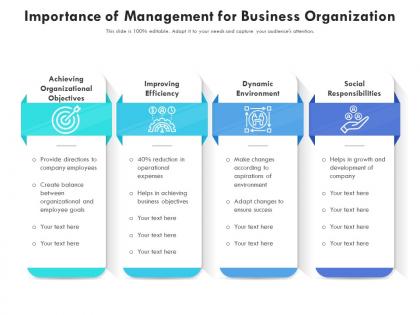
Importance of management for business organization




Try Before you Buy Download Free Sample Product
 Impress Your
 Audience
 100%
100% Editable
 Save Hours
 of Time


Our Importance Of Management For Business Organization are topically designed to provide an attractive backdrop to any subject. Use them to look like a presentation pro.
People who downloaded this PowerPoint presentation also viewed the following :
Importance of management for business organization with all 2 slides:
Use our Importance Of Management For Business Organization to effectively help you save your valuable time. They are readymade to fit into any presentation structure.
FAQs for Importance of management
Effective managers in today's environment demonstrate adaptability, emotional intelligence, strategic thinking, clear communication, and digital fluency. These leaders streamline operations by fostering collaboration, making data-driven decisions, and empowering teams through transparent goal-setting, ultimately delivering enhanced productivity and employee engagement while maintaining competitive advantage in increasingly dynamic markets.
Management styles can be adapted through situational leadership approaches, personality assessments, flexible communication methods, individualized goal-setting, and regular feedback mechanisms. By recognizing that some team members thrive with autonomy while others need structured guidance, managers can enhance productivity, improve employee engagement, and ultimately deliver stronger team performance across diverse organizational environments.
Emotional intelligence enables effective management by enhancing communication, building stronger team relationships, and improving decision-making through better understanding of both personal and employee emotions. Through heightened self-awareness and empathy, managers streamline conflict resolution, boost employee engagement, and create more collaborative work environments, with many organizations finding that emotionally intelligent leaders ultimately deliver higher productivity and reduced turnover rates.
Managers effectively balance short-term and long-term objectives by establishing clear priorities, allocating resources strategically, and maintaining flexible planning frameworks that adapt to changing market conditions. Through quarterly reviews and milestone tracking, organizations across industries like retail and manufacturing ensure immediate operational needs support broader strategic vision, ultimately delivering sustained growth while meeting current performance targets.
Technology enhances management practices through data analytics, automated reporting, cloud-based collaboration tools, AI-driven insights, and real-time performance monitoring systems. These solutions streamline decision-making by providing comprehensive dashboards, predictive modeling, and instant communication across teams, with many organizations finding that digital integration significantly reduces response times, improves strategic planning accuracy, and delivers measurable competitive advantages.
Managers can foster innovation by encouraging calculated risk-taking, providing dedicated time for creative projects, establishing psychological safety for idea-sharing, and implementing structured feedback processes. Through regular brainstorming sessions, cross-functional collaborations, and recognition programs, teams develop creative confidence, while managers who celebrate both successes and learning from failures ultimately deliver enhanced problem-solving capabilities and competitive advantage.
Effective strategies include regular team meetings, collaborative digital platforms, cross-functional project assignments, open feedback channels, and clear communication protocols. These approaches enhance transparency and trust by establishing consistent information flow, breaking down departmental silos, and creating structured opportunities for input, with many organizations finding that streamlined communication ultimately delivers faster decision-making and improved project outcomes.
Effective team conflict resolution involves active listening, identifying root causes rather than symptoms, facilitating open dialogue between parties, and establishing clear communication protocols. Through structured mediation sessions, teams in sectors like healthcare and finance find that addressing conflicts early prevents escalation, ultimately improving collaboration, productivity, and workplace satisfaction while strengthening long-term team dynamics.
Best practices for setting and measuring performance expectations include establishing clear, specific goals, creating measurable metrics, setting realistic timelines, providing regular feedback, and aligning individual objectives with organizational strategy. These approaches enhance accountability and transparency by enabling consistent evaluation processes, facilitating meaningful performance conversations, and ultimately delivering improved productivity and employee engagement across teams.
Managers can identify future leaders by observing employees who demonstrate initiative, emotional intelligence, problem-solving abilities, effective communication skills, and the capacity to influence others positively. Through mentorship programs, cross-functional assignments, leadership training initiatives, and stretch projects, organizations systematically develop these high-potential individuals, ultimately building robust succession pipelines and competitive advantage.
Remote work fundamentally reshapes traditional management practices by requiring enhanced digital communication, outcome-based performance evaluation, and flexible leadership approaches rather than physical oversight. These changes enable managers to focus on strategic results, streamline decision-making processes, and develop trust-based relationships with distributed teams, ultimately delivering improved productivity and employee satisfaction across industries.
Managers can drive employee development and engagement through regular feedback sessions, goal-setting conversations, recognition programs, skill assessments, and personalized development plans. Through structured feedback mechanisms, organizations streamline performance improvement, enhance employee satisfaction, and accelerate career growth, with many companies finding that consistent feedback ultimately delivers higher retention rates and improved productivity across teams.
Effective management performance metrics include employee engagement scores, team productivity rates, retention percentages, goal achievement ratios, and 360-degree feedback results. These measurements work together by tracking both quantitative outcomes and qualitative leadership impact, with many organizations finding that combining financial performance indicators with employee satisfaction data delivers the most comprehensive evaluation of managerial effectiveness.
Cross-cultural management skills enhance global team performance by fostering inclusive communication, building cultural awareness, and adapting leadership approaches to diverse working styles. These competencies enable managers to leverage varied perspectives, minimize misunderstandings, and create cohesive collaboration across time zones, with multinational organizations finding that culturally-aware leadership significantly improves project outcomes and employee engagement.
Managers can support work-life balance through flexible scheduling, remote work options, clear boundary setting, workload management, and mental health resources. These approaches enhance employee satisfaction, reduce burnout, and improve retention, with many organizations finding that strategic work-life initiatives ultimately deliver higher productivity and competitive advantage in talent acquisition.
-
Great quality slides in rapid time.
-
Excellent products for quick understanding.