

Importance Of Nonverbal Communication At Workplace Training Ppt





Try Before you Buy Download Free Sample Product
 Impress Your
Audience
 100%
Editable
 Save Hours
of Time


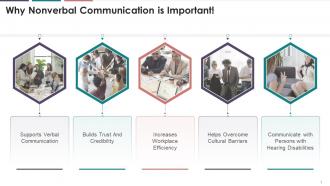
This slide lists the significance of nonverbal communication at the workplace, such as supporting verbal communication, building trust and credibility, increasing workplace efficiency, overcoming cultural barriers, and communicating with persons with hearing disabilities.
People who downloaded this PowerPoint presentation also viewed the following :
Importance Of Nonverbal Communication At Workplace Training Ppt with all 17 slides:
Use our Importance Of Nonverbal Communication At Workplace Training Ppt to effectively help you save your valuable time. They are readymade to fit into any presentation structure.







FAQs for Importance Of Nonverbal Communication At
Dude, body language is HUGE for presentations. I've watched people with amazing content totally bomb just because they kept staring at their slides the whole time - it's painful to watch. Your posture and gestures either back up what you're saying or completely sabotage it. Stand tall, make eye contact with different parts of the room, and use your hands purposefully. Don't just wave them around randomly though. Recording yourself practicing is actually super helpful for catching weird nervous habits you don't even know you're doing. Trust me on this one.
Honestly, eye contact is a game changer for presentations. Makes people feel like you're actually talking TO them, not just reading off slides. Plus you can tell when you're losing them - blank stares, phone checking, that glazed look we've all seen. I usually do this lighthouse thing where I sweep my gaze around every few seconds. Don't pick one person and stare them down though, that's just awkward for everyone. When you connect with different sections of the room, they stay way more engaged. You'll notice the difference immediately.
Watch for fake vs real smiles - genuine ones crinkle the eyes. Raised eyebrows usually mean surprise or they're skeptical about something. Jaw clenching and pressed lips? Dead giveaway for tension. Eye contact's tricky though - too little means they're uncomfortable, but staring feels aggressive. The mouth area gives away SO much, especially when people disagree but are trying to stay polite. Honestly, micro-expressions are everywhere once you notice them. Try watching faces during your next meeting when something controversial comes up. You'll see people's reactions way before they actually say anything.
Dude, posture is like your secret weapon! Stand tall and people instantly think you're more confident - it's wild how fast they judge that stuff. Slouching? Makes you look unsure or whatever. I learned this the hard way in presentations lol. Open stance, shoulders back, chin up a bit - even just uncrossing your arms helps. People see you as way more credible when you take up space properly. It's honestly one of those things where fake it til you make it actually works. Try checking yourself mid-meeting sometime and adjusting if you're hunching over.
Your gestures can totally make or break what you're saying. Like when you nod while saying "yes" or stretch your arms out describing something huge - that stuff makes you way more convincing. But here's the thing that trips people up: if you're telling someone "I'm super confident about this" while you're fidgeting or looking everywhere except at them, your body's basically calling you a liar. People always believe what they see over what they hear, which honestly makes sense. Your hands and posture are constantly talking alongside your actual words, so just make sure they're not having a completely different conversation.
Oh man, you gotta watch out for body language stuff when presenting internationally. Eye contact that seems confident here? Might come off super aggressive in Japan or Korea. I made that mistake once - yikes. Hand gestures are tricky too since some are straight-up offensive in certain places. Personal space is another minefield. Honestly, the whole pointing-at-slides thing even varies by culture. My advice? Do a quick Google search on their nonverbal norms beforehand, or just ask someone who knows. Trust me, it'll save you from some seriously awkward moments that'll haunt you later.
When someone's interested, they'll lean forward and keep eye contact - bodies naturally move toward stuff that grabs them. You'll see open arms and hands visible too. Disinterest is pretty obvious: leaning back, scanning the room, phone checking, crossed arms. Fidgeting's weird though - could mean they're engaged OR restless, depends on what else is happening. Don't rely on just one signal. If you're getting multiple "check out" signs, that's when you pause and throw in a question to pull them back in.
Okay so here's what works - start back from your audience to establish yourself, then gradually move closer during your big moments. Creates this intimacy thing that actually works. If you can walk around or get near people, do it! Makes everything feel like a real conversation instead of some boring lecture. I've watched speakers who just stand behind podiums the whole time and honestly? It's painful to watch. When you're sharing something personal, step forward. For calls-to-action, get as close as possible. Your physical proximity literally pulls people in - they'll feel included rather than lectured at.
Mirror practice is your best friend - you'll catch all those weird fidgety habits you don't realize you're doing. Don't stare at just one person though, that's creepy. Look at different sections of the room instead. Your hands should actually help tell your story, not just flail around randomly (guilty of looking like a windmill myself). Recording yourself is brutal but super helpful for spotting those "um" and "like" moments. Oh, and slow everything down - when you're nervous, you move way faster than you think. Deliberate gestures make you look way more confident.
Honestly, paying attention to body language is huge for work stuff. You'll catch when someone's totally lost but still nodding along, or when they're getting frustrated before they even say anything. Like if you see crossed arms or that glazed-over look, you know to switch gears or ask if something's unclear. Your own posture matters too - keeps you looking engaged instead of bored out of your mind. Next meeting, just watch people's faces and how they're sitting. It's wild how much you can pick up once you start noticing.
Honestly, the body language trick works way better than I expected. Deep breathing automatically relaxes your shoulders and face - weird how that happens. Even when you want to curl up, keep your arms uncrossed and feet planted. I was such a fidgeter in meetings before learning this stuff. Try gentle eye contact instead of staring at the floor. Mirror their energy a bit too. Your brain's actually pretty gullible - it sees these "confident" signals and thinks oh okay, we're chill now. Do the power pose thing for like two minutes before whatever's stressing you out.
Look, people size you up in like 3 seconds based on how you look - kinda shallow but that's just how it works. Clean, wrinkled-free clothes show you've got your act together and respect the workplace. Poor grooming can totally tank your credibility before you even open your mouth. The trick is reading the room - you don't want to show up in a tux when everyone's wearing jeans, but also don't be the slob. I'd say watch what the people you respect are wearing and dress just a notch above that. It's honestly one of those unfair advantages that's pretty easy to nail once you figure out the vibe.
Dude, your voice matters way more than you'd think - like 38% of what people actually hear from you. Crazy, right? If you're talking super fast, people think you're either pumped up or stressed out. Go too slow and they'll assume you're bored or being condescending. Here's the thing though - your tone can totally flip your words. Say "great job" sarcastically and suddenly it's an insult, not a compliment. People trust how you sound over what you actually say, which is kinda annoying but true. Just match your voice to what you actually mean.
Video recordings are clutch for studying body language - you can pause and rewind to catch stuff you'd totally miss otherwise. I do this with my own presentations sometimes (cringe but worth it lol). Watch for eye contact, gestures, posture shifts, facial expressions. Here's what works: try watching with sound off to focus purely on the nonverbal stuff. Or make a quick checklist of behaviors to track. Honestly, most people hate watching themselves but it's so helpful. Record your next practice run and spend like 10 minutes just analyzing the body language parts.
Ugh, virtual meetings are so weird for reading people! You're basically stuck with just faces and maybe some hand waving. The eye contact thing always trips me up - gotta stare at that tiny camera dot instead of actually looking at people on screen. Honestly, everyone's way more distracted when they think you can't see their whole body. Audio lag makes everything awkward too. My advice? Put your camera at eye level and be way more dramatic with your expressions than normal. Sounds ridiculous but it actually works better on video.
-
This visual representation is stunning and easy to understand. I like how organized it is and informative it is.
-
Easy to use and customize templates. Helped me give a last minute presentation.