Business Communication Definition Process And Basic Elements Training Ppt
Try Before you Buy Download Free Sample Product
Audience
Editable
of Time
This set of slides provides a brief introduction to business communication with examples. It also covers the communication process and key elements such as sender, business information, receiver, and feedback.
People who downloaded this PowerPoint presentation also viewed the following :
Content of this Powerpoint Presentation
Slide 1
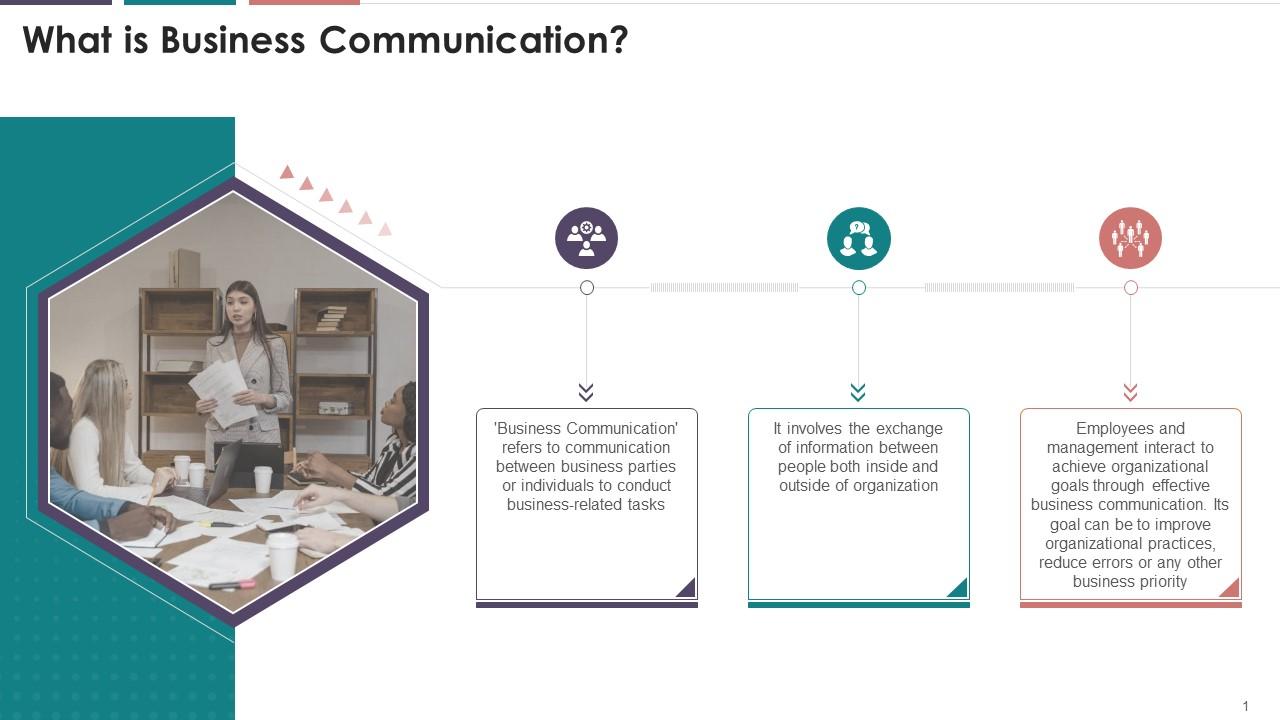
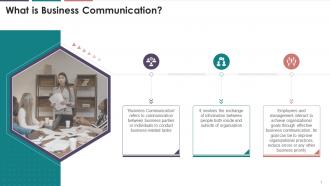
This slide depicts an overview of business communication. It emphasizes that business communication is communication between business parties or individuals to carry out business-related tasks. It also entails exchanging information between individuals both within and outside the organization.
Instructor’s Notes:
Some examples of business communication are:
- A group of employees is having a brainstorming session
- Two co-workers sharing information to collaborate on a project
- A supervisor providing feedback to a direct report
- A leadership team communicating the company's vision to its employees
- A client is presented with a deliverable by an account manager
- A customer providing feedback on a deliverable
In addition to sharing information, effective communication is also required for carrying out day-to-day business processes and tasks such as:
- Creating and disseminating plans and proposals
- Introducing new concepts to clients, co-workers, or management
- Having productive meetings
- Making decisions as a group or organization
- Order taking, sending, and fulfilment
Slide 2
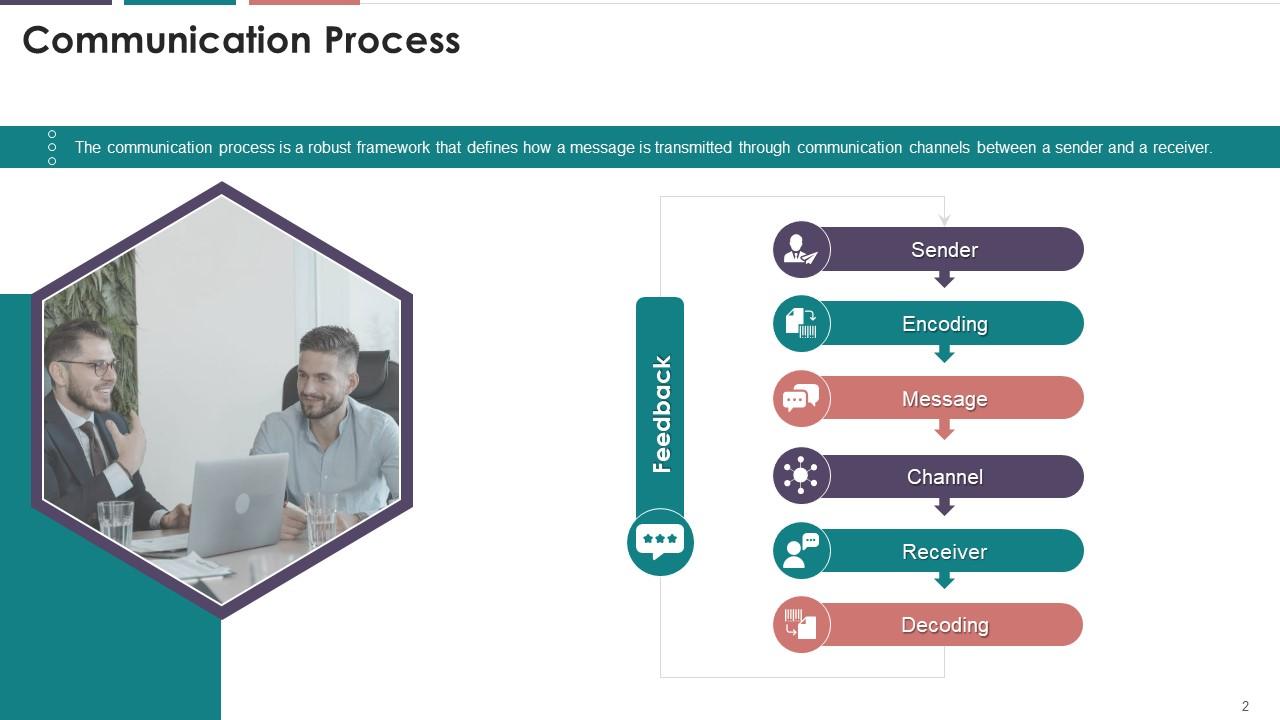
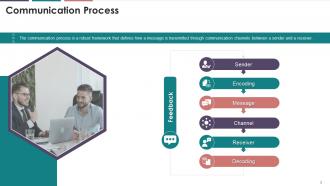
This slide illustrates the communication process. It mentions that the communication process is a six-stage robust framework that defines how a message is transmitted through communication channels between a sender and a receiver. The framework elements are sender, encoding, message, channel, receiver, and decoding.
Instructor’s Notes:
Key Components of the Communication Process
- Sender: The person who came up with the idea and wished it would be delivered to the recipient
- Encoding: The process of describing or translating information into a message
- Message: The concept, fact, or opinion that the sender wishes to convey
- Communication channel: The method by which the message is delivered for example e-mail, voice message, telephone etc.
- Receiver: intended audience of the message
- Decoding: the process of interpretation of the message
- Feedback: the response or action taken by a receiver after decoding a message
Slide 3
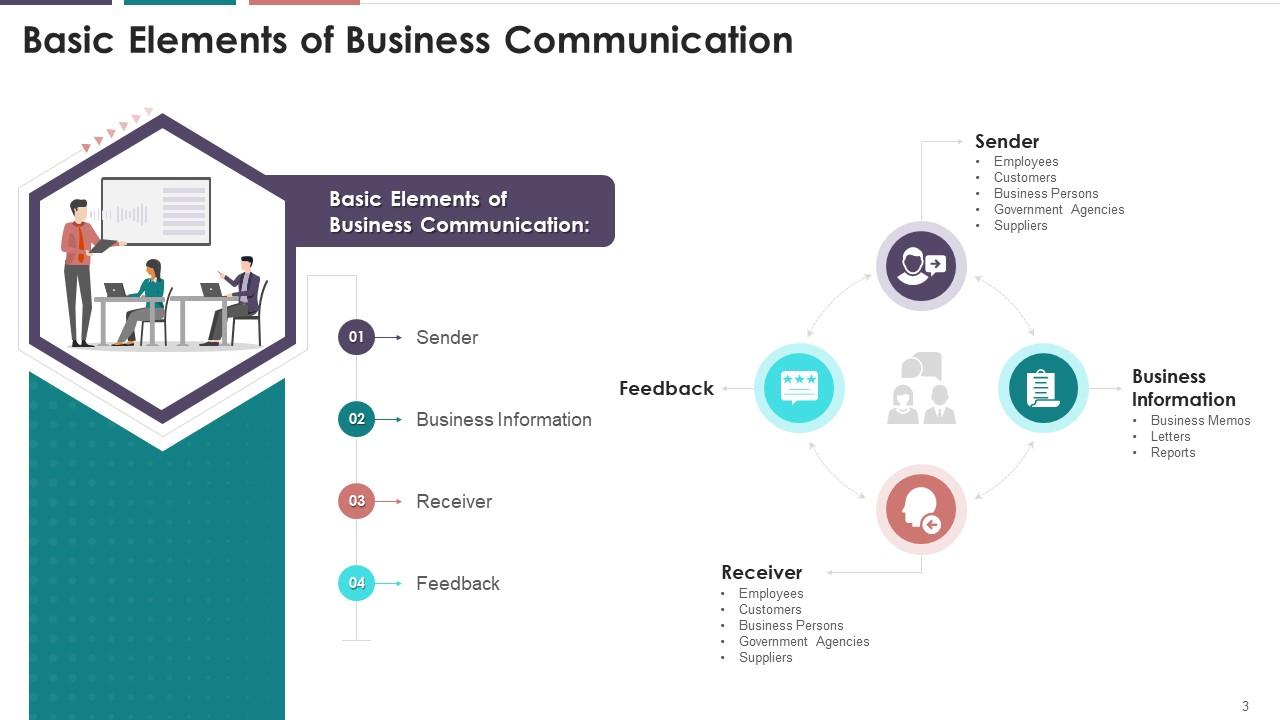
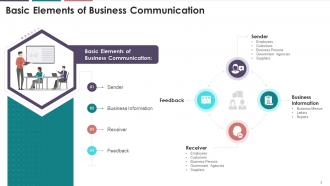
This slide illustrates information on the essential elements of business communication. The elements are sender, business information, receiver, and feedback.
Business Communication Definition Process And Basic Elements Training Ppt with all 19 slides:
Use our Business Communication Definition Process And Basic Elements Training Ppt to effectively help you save your valuable time. They are readymade to fit into any presentation structure.
FAQs for Business Communication Definition Process And Basic
Key elements of effective business communication include clarity, conciseness, active listening, appropriate tone, and strategic message structuring. These components work together by eliminating ambiguity, fostering mutual understanding, and building stronger professional relationships, with many organizations finding that streamlined communication processes ultimately enhance operational efficiency and accelerate decision-making across departments.
Presentation templates enhance clarity and engagement by providing consistent visual frameworks, standardized layouts, professional design elements, and structured content organization that reduces preparation time. Through cohesive branding and clear information hierarchy, teams can deliver more focused messages, maintain audience attention throughout meetings, and ensure key points are effectively communicated, ultimately streamlining decision-making processes.
Non-verbal communication significantly influences professional interactions through body language, facial expressions, posture, eye contact, and tone of voice. These elements enhance message clarity, build trust, and establish credibility, with many organizations finding that employees who master non-verbal skills achieve better client relationships, more effective presentations, and stronger leadership presence.
Businesses can ensure culturally sensitive messaging through diverse team collaboration, comprehensive audience research, inclusive language guidelines, cultural consultation processes, and regular sensitivity reviews. These approaches streamline communication by avoiding cultural missteps, enhancing global brand reputation, and building authentic connections with diverse markets, ultimately delivering broader customer engagement and competitive advantage in increasingly multicultural business environments.
Effective audience-tailored communication strategies include analyzing audience demographics and preferences, adjusting language complexity and tone, selecting appropriate channels and formats, customizing message content and examples, and incorporating cultural considerations. These approaches enhance engagement by matching communication style to audience expectations, with many organizations finding that personalized messaging significantly improves response rates and stakeholder satisfaction.
Technology enhances business communication processes by automating workflows, enabling real-time collaboration, and centralizing information across platforms. Through cloud-based systems and AI-powered tools, organizations streamline meetings, accelerate decision-making, and improve transparency, with many companies finding that integrated communication technologies ultimately deliver faster response times and enhanced operational efficiency.
Common barriers to effective business communication include language differences, technological limitations, hierarchical structures, cultural misunderstandings, and information overload. Organizations overcome these challenges by implementing unified communication platforms, establishing clear protocols, providing cross-cultural training, and creating feedback mechanisms, ultimately enhancing collaboration, reducing misunderstandings, and streamlining decision-making processes across departments.
Feedback is crucial in business communication as it ensures message clarity, confirms understanding, prevents costly misinterpretations, and enables continuous improvement in organizational dialogue. Through structured feedback mechanisms, companies streamline decision-making processes, enhance team collaboration, and reduce project delays, with many organizations finding that regular feedback loops ultimately deliver improved productivity and stronger stakeholder relationships.
Professional email best practices include clear subject lines, concise messaging, proper greetings and closings, structured paragraphs, and timely responses. These practices enhance workplace communication by reducing misunderstandings, improving response rates, and maintaining professional relationships, with many organizations finding that standardized email protocols streamline collaboration and ultimately deliver better client interactions and operational efficiency.
Visual aids enhance presentations by transforming complex data into digestible charts, graphs, and infographics while supporting narrative flow through strategic imagery, timelines, and visual metaphors. These elements enable presenters to maintain audience engagement, simplify technical concepts, and reinforce key messages, with many organizations finding that well-designed visuals increase comprehension rates and decision-making speed significantly.
Social media transforms business communication strategies by enabling real-time customer engagement, direct brand messaging, and immediate feedback loops across multiple platforms. These channels streamline customer service interactions, enhance marketing reach, and facilitate two-way conversations, with many organizations finding that strategic social media integration delivers improved customer relationships, faster response times, and competitive market positioning.
Leaders foster open communication by encouraging feedback, practicing active listening, establishing regular check-ins, maintaining transparency in decision-making, and creating psychological safety for honest dialogue. Through consistent one-on-ones, team meetings, and accessible leadership approaches, organizations streamline collaboration, enhance trust, and ultimately deliver improved performance, with many finding that open environments significantly boost employee engagement and innovation.
Effective techniques include active listening, staying solution-focused, using neutral language, setting clear boundaries, and preparing key points beforehand. These approaches enable professionals to navigate conflicts, performance discussions, and strategic disagreements by maintaining respect, reducing defensiveness, and steering conversations toward actionable outcomes, with many organizations finding that structured communication protocols ultimately enhance workplace relationships and business productivity.
Measuring communication effectiveness involves tracking employee engagement scores, response times to internal communications, feedback quality during meetings, message clarity assessments, and cross-departmental collaboration metrics. Through regular surveys, performance analytics, and communication audits, organizations streamline information flow, enhance productivity, and reduce misunderstandings, with many companies finding that systematic measurement ultimately delivers improved employee satisfaction and operational efficiency.
Key trends include AI-powered communication tools, real-time collaboration platforms, video-first interactions, mobile-optimized messaging, and data-driven personalization strategies. These technologies streamline workflows, enhance remote collaboration, and deliver personalized customer experiences, with many organizations finding that strategic communication integration ultimately drives operational efficiency and competitive advantage in an increasingly digital marketplace.
-
Easily Editable.
-
It is my first time working with them and that too on a friend's recommendation. I would say, I am not expecting such a worldly service at this low price.