


Effective Communication In Business Meetings Training Ppt




Try Before you Buy Download Free Sample Product
 Impress Your
 Audience
 100%
100% Editable
 Save Hours
 of Time


These slides cover the types of business meetings which are in-person and telephonic. It also provides information about the importance of business meetings, such as making better decisions, resolving conflicts, information exchange, etc. Further, it includes details about the common business meeting errors and associated solutions.
People who downloaded this PowerPoint presentation also viewed the following :
Content of this Powerpoint Presentation
Slide 2
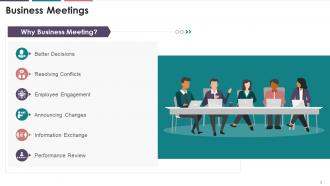
This slide illustrates the significance of business meetings. Business Meetings can help in taking better decisions, resolving conflicts, making the employee feel important or recognized in the organization, information exchange, and appraise performance of employees at regular intervals.
Instructor’s Notes:
- Better Decisions: The main objective behind any meeting is taking essential decisions on current and predetermined issues. The meeting for decision-making should be a regular activity and based on collective opinion. All decisions, whether of routine or non-routine nature, should be discussed in such meetings
- Resolving Conflicts: Conflicts are common in all organizations. If the conflict is healthy and competitive, it will increase productivity. An unhealthy or ugly conflict needs immediate resolution. Conducting meetings regularly help individuals arrive at a compromise and resolve the conflict on a positive note
- Employee Engagement: Organization goals, objectives, and the success rate is always discussed in meetings. Explaining and motivating the team for their contribution towards the organization's success rate motivates employees. Updating them on their targets and goals helps them perform better
- Announcing Changes: Business meetings should convey the existing and upcoming changes related to the policies, benefits, hierarchy, etc, to the target audience in meetings conducted. This will make people understand and accept the changes with minimal resistance
- Information Exchange: Meetings are arranged to exchange or provide valuable information to members
- Performance Review: Meetings are also called upon to review performance and convey the progress of any ongoing or completed project. Members can also discuss and gain valuable opinions from other members present on ongoing projects and issues
Slide 3
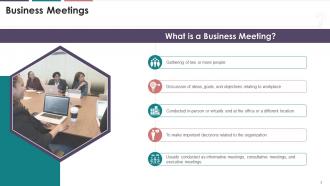
This slide explains the meaning and types of business meetings as a component of business communication.
Instructor’s Notes:
- Informative Meetings: The meetings whose purpose is to inform the target audience about new schemes, products, policies, members, etc.
- Consultative Meetings: These are the meetings where the members of the organization are consulted, and their opinions are taken for solving an existing or expected problem
- Executive Meetings: In executive meetings, authorized or competent persons take or implement significant decisions. The authorized individuals persons may include top-level officials, professionals hired, etc.
Slide 4
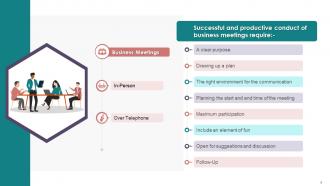
This slide shows various elements that help conduct a business meeting effectively and efficiently, along with the different ways in which a meeting can be conducted, i.e., in person or by telephone.
Instructor’s Notes:
In Person Speaking- In-Person Speaking can also be referred to as face-to-face communication, where both the speaker and receiver are physically present.
Advantages:
- Allows the use of both of verbal and Nonverbal aspects
- Discussion of visual elements or real-life situations becomes easy
- The conversation remains interactive and allows the participants to clear confusion, then and there
Disadvantages:
- Face-to-face communication can be expensive and has a added layer of complexity when the subject under discussion is likely to hurt one of the parties
- This kind of conversation is difficult to be delayed to re-directed
By Telephone- It is a type of communication where the speaker and the receiver connect via a device known as ‘telephone’ or ‘cell phone.’ They are not physically present and interact from two different places.
Advantages:
- It is a cheaper and convenient form of communication
- People find it easy to collect notes in the telephonic form of communication
Disadvantages:
- Only the most obvious of nonverbal communication is transmitted
- Difficulty in presenting visual objects
- The voice quality of a person may sometimes seem to be of higher pitch, rude or non-serious
Slide 5
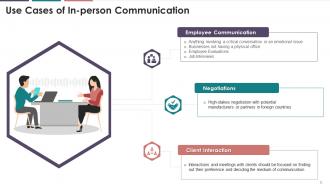
This slide mentions the areas of application of In person communication.
Slide 6
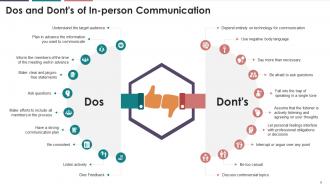
This slide explains the points that needs to be considered communicating at the workplace.
Slide 7
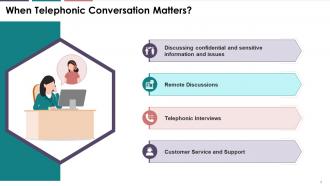
This slide mentions the areas of application of telephonic communication.
Slide 8
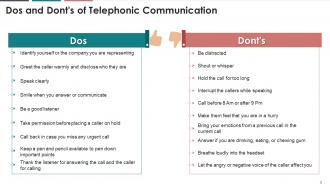
This slide explains the etiquette that needs to be kept in mind while answering the phone call. These are usually applicable to both formal and informal communication, being an integral part of telephone conversations.
Slide 9
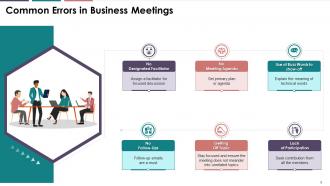
This slide covers the prevailing errors which creep into business meetings, reducing the effectiveness of the communication. Errors like frequent use of jargon and technical terms, lack of participation, delayed follow-ups, distracting conversations, etc., can turn the meetings ineffective.
Instructor’s Notes:
- No Designated Facilitator: A meeting without a designated facilitator usually ends in informal and unnecessary discussions. When no one is given charge of a meeting, it can easily run off-track
Solution: It is always advised to have someone as a facilitator to ensure that off-topic and unnecessary discussions are reduced, and the discussion remains focused and positive.
- No Meeting Agenda: Meeting without any agenda is usually taken as unimportant by the members. Business meetings need a thoughtful structure to be efficient.
Solution: The meeting, whether on-call or in person, should always have some set or primary plan.
- Use of Buzz Words: Buzz Words are words with heavy and deep meanings. These can be technical terms or phrases which are not commonly understood by the audience and should be avoided in business documents
Solution: In case the speaker makes use of any technical or heavy word, he should make sure that the audience is clear about what it means.
- Lack of Participation: The meeting facilitator should ensure active participation from all members, or the meeting will be a huge waste of time and effort. When only one or two persons participate in the process, it becomes difficult for others to pay attention or feel part of the discussion
Solution: Contribution from all members helps the speaker in getting across his/her message with a lot more flair.
- Getting Off Topic: It is common for the members to get distracted from the original objective of the meeting. It usually happens when the meeting is conducted in a blended mode, i.e., few people are present virtually and few physically. The speaker of the meeting should make sure that the members stick to the agenda
Solution: The Speaker can say, That’s an excellent topic to discuss. Let's talk about this once the meeting is over.
- No Follow-Ups: Not following-up regularly after the meetings can mean that important issues remain unaddressed
Solution: Immediately after the meeting is over, the facilitator should send a follow-up email mentioning the key takeaways from the meeting. He/she can also add the meeting results like discussions held, decisions made, etc.
Effective Communication In Business Meetings Training Ppt with all 25 slides:
Use our Effective Communication In Business Meetings Training Ppt to effectively help you save your valuable time. They are readymade to fit into any presentation structure.






FAQs for Effective Communication In Business
Honestly, the biggest game-changers are speaking clearly (ditch the jargon) and making actual eye contact with people. I used to just stare at my slides like an idiot until someone called me out on it lol. Confident but chill tone works best - you're not giving a TED talk, you know? Mix up your pace so people don't zone out. Oh, and gestures help way more than you'd think. During Q&A, actually listen instead of just waiting for your turn to talk. Before your presentation, practice out loud and pick specific faces in the crowd to connect with. Makes it feel less scary.
Honestly, watching your audience while you're presenting is a game changer. I can tell when someone's confused or completely zoned out just by their face. Then I'll slow down or ask if they need me to explain something differently. Body language tells you everything - way more than people realize. Questions are huge too, like the tone someone uses when they ask something. I used to just power through my slides no matter what, which was probably boring as hell. Now I actually pause and see how people are reacting. It makes the whole thing feel more like a conversation instead of me just talking at them.
Dude, your body language is honestly way more important than whatever you're actually saying up there. I've watched people with amazing content completely bomb because they looked like deer in headlights the entire time. Eye contact keeps people engaged, good posture makes you look like you know what you're talking about, and using your hands helps drive points home. Oh, and don't forget about your voice - how fast you talk and your tone can make or break everything. Seriously, record yourself practicing. You'll cringe but it's so worth it.
Honestly, knowing your audience is everything. It's like... you wouldn't explain blockchain to your mom the same way you'd talk to a developer, you know? Once you figure out who you're talking to, the whole thing gets easier. You can ditch the confusing jargon, pick examples that actually make sense to them, and focus on stuff they care about. I learned this the hard way after bombing a presentation once. Now I always spend a few minutes thinking about their background and what motivates them before I start writing or talking. Makes such a difference.
Okay so first thing - chunk everything down into smaller pieces. Nobody wants their brain melted by info overload. Use analogies people actually get, like comparing data flow to traffic or whatever makes sense for your crowd. Visuals help SO much too. Here's something that actually works: group stuff into threes. People's brains just latch onto that pattern better for some reason. And honestly? Ditch the fancy jargon completely. Talk like you're explaining it to your neighbor, not writing a dissertation. Oh, and pause to make sure they're following along - you'll save yourself from that awkward "wait, what?" moment later.
Honestly, less is more with visuals. Only use them for stuff that's actually hard to explain - like data or step-by-step processes. Keep slides super clean because nobody wants to read paragraphs while you're talking (I learned this the hard way). Charts and photos work way better than walls of text. Here's the thing: if you can explain it clearly just by talking, skip the visual entirely. And definitely practice with everything beforehand so you're not clicking around awkwardly. Trust me, your audience will notice if you're struggling with tech issues mid-presentation.
Ugh, the worst thing you can do is just read your slides word for word - so awkward. When you get nervous, you'll probably talk way too fast, so consciously slow down. Eye contact matters more than you think. Also those slides with like 47 bullet points? Pure torture for everyone involved. I always pretend I'm just chatting with friends instead of giving some formal presentation. Practice how you'll move between topics so you're not like "um, so anyway..." Tech will definitely fail at some point, so have backup slides ready. Most people forget this part - actually look at faces while you're talking to see if anyone looks totally lost.
Dude, your body language is like 70% of communication - way more powerful than words. You could be saying "totally confident about this project" while slouching with crossed arms, and people will believe what they see, not what they hear. Little stuff makes a huge difference too. Eye contact shows you're actually present. Hand gestures help drive your points home. Vocal variety keeps people from mentally checking out (which happens so fast honestly). Before your next presentation, maybe record yourself practicing? Or grab someone to watch and call out any weird disconnect between your words and how you're delivering them.
Honestly? Stop letting them just sit there like zombies. Ask real questions and wait for answers - yeah it'll be awkward but push through it. Throw in polls or quick discussions, maybe even just "raise your hand if..." stuff. I always share some random personal story that relates, makes everything way less formal. Oh and definitely admit when you're clueless about something! People love that. Walk around if you can instead of staying planted in one spot. The biggest thing though - actually listen to what they say and build on it. Don't just nod and say "good point" then ignore them completely.
Honestly, figure out who you're talking to first. Beginners need way different explanations than experts do. Some people want all the data and charts, others just want real examples they can relate to. Oh, and culture matters more than you'd think - being super direct works in some rooms but totally backfires in others. I bombed a presentation with international clients because of this! The setting changes everything too. Boardroom energy hits different than a casual team chat. My advice? Spend like 10 minutes beforehand figuring out what your audience actually cares about. It'll save you so much awkwardness later.
Timing's everything - give feedback right after while it's still fresh in everyone's head. Skip the useless "good job" comments (seriously, what does that even tell someone?). Get specific instead: "Your slide 5 data really cleared up those budget questions" or "Slowing down during the tech stuff helped me actually follow." When you're getting feedback, don't jump to defend yourself right away. Ask stuff like "Can you give me an example?" It shows you actually want to get better at this whole presenting thing, not just hear praise.
Honestly? Just practice with stuff that doesn't matter first. Like ordering coffee or whatever. I know it sounds basic but it actually works. Deep breathing is clutch before you speak - calms your whole system down. Don't write a script but have a few key points ready so you're not scrambling. I used to overthink literally every word which made everything ten times worse lol. Focus on what you're trying to say instead of how awkward you think you sound. Recording yourself is super weird but you'll catch habits you didn't even know you had. Your confidence builds up naturally when you stop obsessing over yourself and actually try connecting with whoever you're talking to.
Dude, stories work because our brains just eat that stuff up way better than boring stats. People actually remember what you're saying when there's emotion involved. I've watched the stuffiest executives totally flip after hearing one good customer story - it's wild how fast walls come down. Your brain processes narratives differently than raw data, which is why wrapping key points in a quick anecdote hits so much harder. Keep them short though, and make sure they actually connect to your main point. Next time skip the bullet points at the start and just tell them what happened to someone first.
Dude, cultural awareness can totally make or break your international presentations. Different cultures have wildly different communication styles - some want direct feedback, others prefer the diplomatic route. Time concepts are crazy different too (some cultures are super flexible about punctuality, which honestly drives me nuts sometimes). Research their values beforehand and hierarchy expectations. Even colors and gestures can accidentally offend people. You might need to restructure your whole approach - like whether they respond better to storytelling vs. data dumps. Definitely ask local colleagues about communication norms before you present. Trust me, it's worth the prep work.
Honestly, tech can make or break your presentation. Interactive polls and real-time Q&A are amazing for keeping people engaged, and visual aids help explain tricky concepts way better than just talking. But ugh, technology always crashes at the worst possible moment! Also, I've seen so many people just read off their slides instead of actually connecting with the room. Use tech to boost your message, not hide behind it. Oh, and always – and I mean always – have a backup plan ready. Your storytelling skills matter way more than whatever fancy transitions you've got going on.
-
The information is visually stunning and easy to understand, making it perfect for any business person. So I would highly recommend you purchase this PPT design now!
-
“I required a slide for a board meeting and was so satisfied with the final result !! So much went into designing the slide and the communication was amazing! Can’t wait to have my next slide!”