


Szpekmans communication framework presentation visuals





Try Before you Buy Download Free Sample Product
 Impress Your
 Audience
 100%
100% Editable
 Save Hours
 of Time


Improve existing goodwill with our Szpekmans Communication Framework Presentation Visuals. Get folks to behave in a friendlier fashion.
People who downloaded this PowerPoint presentation also viewed the following :
Content of this Powerpoint Presentation
Description:
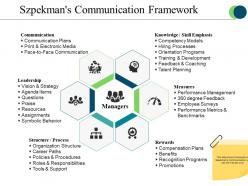
The image showcases Szpekman's Communication Framework, a comprehensive model illustrating key facets of organizational communication. At the center of this framework is the pivotal role of managers and their interactions with various elements crucial for effective communication and leadership within an organization.
Starting at the top left, the framework outlines facets of 'Communication,' which includes Communication Plans, Print & Electronic Media, and Face-to-Face Communication. This suggests a focus on strategic communication and the use of various mediums to facilitate it.
Moving clockwise, 'Knowledge/Skill Emphasis' is the next section, highlighting areas such as Competency Models, Hiring Processes, Orientation Programs, Training & Development, Feedback & Coaching, and Talent Planning. This indicates an emphasis on cultivating the necessary knowledge and skills among team members.
Following that, 'Measures' encompass Performance Management, 360-degree Feedback, Employee Surveys, and Performance Metrics & Benchmarks. These points reflect the importance of assessment and evaluation tools in managing performance.
Next, the 'Rewards' segment covers Compensation Plans, Benefits, Recognition Programs, and Promotions, reflecting strategies used to motivate and recognize employees.
The bottom section, 'Structure/Process', addresses the organizational bedrock with elements like Organization Structure, Career Paths, Policies & Procedures, Roles & Responsibilities, and Tools & Support. This underlines the backbone that supports communication within a company.
Lastly, 'Leadership' is mentioned with components such as Vision & Strategy, Agenda Items, Questions, Praise, Resources, Assignments, and Symbolic Behavior. This implicates the role of leadership in guiding and supporting the team.
Use Cases:
This framework is highly applicable in various industries and scenarios where effective communication and leadership are paramount. Here are seven industries and their potential use cases:
1. Human Resources:
Use: To develop and refine communication strategies and leadership development within an organization.
Presenter: HR Manager or Director.
Audience: HR professionals and company leadership.
2. Corporate Training:
Use: Structuring communication and leadership modules for training programs.
Presenter: Training Specialist.
Audience: Employees and management teams.
3. Organizational Development:
Use: To facilitate organizational change and development initiatives.
Presenter: Organizational Development Consultant.
Audience: Senior management and change agents.
4. Business Management:
Use: As a model for effective communication practices in business operations.
Presenter: Business Consultant or Strategist.
Audience: Business owners and executive teams.
5. Health Care Administration:
Use: To enhance the management and leadership communication within healthcare institutions.
Presenter: Healthcare Administrator.
Audience: Healthcare management and department leaders.
6. Education Administration:
Use: For improving communication and leadership within educational institutes.
Presenter: School Superintendent or Principal.
Audience: Educational leaders and administrators.
7. Public Relations:
Use: To guide communication strategies both internally and with the public.
Presenter: Public Relations Manager.
Audience: PR team members and organizational spokespeople.
Szpekmans communication framework presentation visuals with all 5 slides:
Create a green connect with our Szpekmans Communication Framework Presentation Visuals. Generate awareness of eco friendly features.

FAQs for Szpekmans communication
So the Szpekmans thing breaks down into four parts - Context, Content, Connection, and Clarity. Context is setting up why they should even listen. Then you hit them with your actual content in some logical order. Connection's where you make it about *them* specifically (this is honestly where everyone screws up). Oh, and clarity means actually checking they got it, not just assuming they did because they're nodding. Works for everything though - quick check-ins, big presentations, whatever. I'd try mapping out your next big conversation using these four beforehand and see how it goes.
So the Szpekmans Framework is basically about figuring out who actually matters before you start sending updates to everyone and their mom. You map stakeholders by interest and power levels first - honestly wish I'd known this earlier in my career. Then you can customize how you talk to each group instead of boring everyone with identical emails. Executives want quick summaries, tech people need all the details, regular users just care about benefits. Oh and it has built-in feedback loops so you're not just guessing what works. Start with that interest/influence grid thing and go from there.
So basically the Szpekman thing is about getting your words and body language on the same page. Like, you can't say "I'm totally confident" while you're slouching and staring at the floor - dead giveaway. What you do is check if everything matches up. Your tone, expressions, posture - they should all back up what you're actually saying. There are specific checkpoints you can use to catch yourself doing this. Honestly, most people mess this up without realizing it. Practice getting both sides aligned before big meetings or whatever. Makes a huge difference.
So the Szpekmans Framework is pretty solid for fixing team communication mess. It maps out who needs what info and when, which honestly saves so much drama later. You get structured feedback loops instead of those awful email threads that go nowhere. Different departments actually start working together because there's clear pathways for everything. Regular check-ins catch problems before they blow up. Plus it standardizes how people communicate - no more guessing which Slack channel to use. I'd start by looking at where communication breaks down now. That's your low-hanging fruit right there.
When things go sideways, Szpekmans' framework is your best friend - seriously, it works. First thing: figure out who you're dealing with. Employees, customers, media, whoever's affected. Each group needs different messaging. Stay crystal clear because everyone's already freaking out. Nobody has time for corporate speak when the world's on fire! Use that acknowledge-explain-act approach: admit what happened, stick to facts (no guessing), then tell people what you're doing next. Honestly, I've seen companies try to spin their way out and it always backfires. Just be straight with people and update them regularly.
Honestly, I'm not familiar with the Szpekmans Communication Framework at all - never heard of it before. You'd probably get better info going straight to their official stuff or website rather than me just guessing. If you can grab some of their materials though, I'd be down to help you figure out what they're saying about empathy. Their framework might be really interesting actually. Maybe try finding someone who's been trained in it? Or check if they have any published resources online. Sorry I can't be more helpful right off the bat with this one!
So basically you map out communication styles and expectations before jumping into conversations with different cultures. Like, some cultures are super direct while others hint around things, right? You figure out their hierarchy preferences and how they make decisions. Honestly, it's wild how much this stuff varies when you actually think about it. But here's the thing - you don't just go "oh yeah, cultural differences exist" and move on. You actually plan how to bridge those gaps for your specific situation. Instead of crossing your fingers and hoping it works out, you're tweaking your approach and timing based on who you're talking to.
Yeah totally! Digital platforms work great with Szpekmans - just tweak the core stuff for whatever you're using. Slack, email, video calls, whatever. Here's the thing though: teams always assume digital means you can be super casual and skip structure. That's completely wrong. Online you actually need MORE intentional communication since you can't see people's faces or body language. I'd start by taking your normal Szpekmans steps and figuring out how they fit your platform's setup. The structured approach still matters - maybe even more so when you're not in the same room.
Honestly, the biggest pain is just getting people to actually stick with it. Everyone's so used to winging their communication that asking them to follow a structure feels super formal at first. You'll definitely see some people jump on board while others completely ignore it - which is frustrating but totally normal. Oh and the whole reverting back to old habits thing? Yeah, that's gonna happen. I'd say pick just one or two specific situations to work on instead of trying to change everything. Rome wasn't built in a day and all that. Just give them space to mess up and get excited about the small victories.
Honestly, it's pretty solid for building soft skills because you get actual practice, not just theory. You'll work on stuff like active listening and reading body language through structured exercises. What I like is how it breaks everything down - so instead of trying to fix your whole communication style at once, you can focus on one thing. Like maybe just tackle difficult conversations this week, you know? People I've talked to say they feel way more confident after sticking with it for a while. Oh, and definitely start with their self-assessment thing first - it'll show you exactly where you're struggling most.
Honestly, pulse surveys are my go-to - super quick but they tell you everything you need to know about clarity and engagement. Track your communication response rates before and after using the framework, that's huge. Also watch if people actually *do* what you're asking them to do, since comprehension shows up in task completion. I always combine the numbers with actual feedback comments though, that's where the good stuff lives. Oh and don't try to measure everything at once - pick one or two things that actually matter for what you're trying to achieve, then add more later. Behavioral changes take time to show up but they're worth tracking.
So basically you map out everyone's communication style first - like who needs straight directions vs people who want to brainstorm together. It's honestly like having insider info on your whole team lol. When things get tense, you'll know exactly how to talk to each person. The cool part is catching miscommunications before they explode into drama. Oh and it helps bridge those annoying gaps between different work styles too. Next meeting, try using these "communication maps" - I swear everything just runs smoother when you do.
Hmm, I'm not familiar with the Szpekmans Communication Framework - and I've honestly never come across any case studies for it either. Could you be thinking of a different model maybe? This one sounds pretty niche, or it might be something newer that hasn't hit my radar yet. Where did you first hear about it? That'd probably help me figure out what you're looking for. Your best bet is probably going back to whoever mentioned it or checking the original source they got it from. They'd definitely have better examples than I can give you right now.
So basically you're always checking in - doing communication audits and asking stakeholders "hey, is this actually landing?" Track stuff like how clear your messages are, engagement rates, response times. The smart thing is treating every single interaction as data, not just the big presentations. Then you adjust your style, timing, which channels you use based on what you learn. Honestly it's like having a feedback loop that never stops running. I'd say start small though - pick one way you communicate a lot and set up some simple way to get feedback this week. Makes way more sense than trying to fix everything at once.
So the Szpekmans thing is basically about being way more intentional with remote communication since you don't have those random hallway conversations anymore. Most teams just throw everything into Slack and hope for the best - total mess. You've got to separate your quick updates from actual strategic discussions, which sounds obvious but nobody does it. The whole point is setting up clear communication rhythms before things go sideways. I'd start by looking at where your current communication actually breaks down (probably everywhere lol) and tackle those spots first with some real structure.
-
Great experience, I would definitely use your services further.
-
Awesomely designed templates, Easy to understand.