


Introduction To Communication Process Framework Training Ppt




Try Before you Buy Download Free Sample Product
 Impress Your
 Audience
 100%
100% Editable
 Save Hours
 of Time


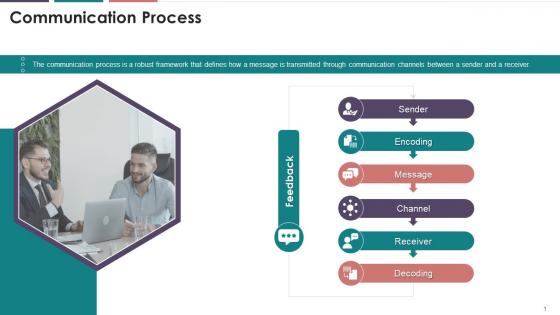
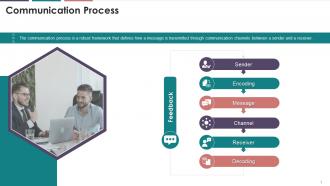
This slide illustrates the communication process. It mentions that the communication process is a six-stage robust framework that defines how a message is transmitted through communication channels between a sender and a receiver. The framework elements are sender, encoding, message, channel, receiver, and decoding.
People who downloaded this PowerPoint presentation also viewed the following :
Introduction To Communication Process Framework Training Ppt with all 17 slides:
Use our Introduction To Communication Process Framework Training Ppt to effectively help you save your valuable time. They are readymade to fit into any presentation structure.








FAQs for Introduction To Communication Process
The key components of the communication process framework include sender, message, encoding, channel, receiver, decoding, feedback, and noise. These elements work together by establishing clear message transmission, ensuring accurate interpretation, and enabling two-way dialogue, with many organizations finding that structured communication frameworks enhance operational efficiency, reduce misunderstandings, and ultimately deliver improved collaboration across teams.
Feedback significantly enhances communication effectiveness by enabling message clarification, confirming understanding, and allowing real-time adjustments to delivery methods. Through continuous feedback loops, organizations streamline decision-making processes, reduce miscommunication errors, and improve stakeholder engagement across departments, with many companies finding that structured feedback mechanisms ultimately deliver faster project completion and stronger collaborative outcomes.
Noise disrupts communication through physical distractions, semantic misunderstandings, psychological barriers, and technical interference, ultimately reducing message clarity and comprehension. In organizational settings, background conversations, cultural differences, emotional stress, and poor technology create communication breakdowns, with many businesses finding that addressing these noise sources significantly enhances operational efficiency and employee collaboration.
The sender initiates communication by encoding messages, selecting appropriate channels, and ensuring clarity to minimize misunderstandings throughout the transmission process. In business environments, effective senders adapt their messaging style, timing, and medium to their audience, with many organizations finding that trained communicators significantly enhance project outcomes, stakeholder engagement, and operational efficiency.
Visual aids enhance the communication process by improving message clarity, reducing misunderstandings, and accelerating comprehension through multiple sensory channels. According to established frameworks, organizations using infographics, charts, and presentation slides find that complex data becomes more accessible, stakeholder engagement increases significantly, and decision-making accelerates, ultimately delivering competitive advantage through more effective internal and external communications.
Strategies to overcome communication barriers include active listening techniques, clear message structuring, choosing appropriate channels, providing timely feedback mechanisms, and cultural sensitivity training. These approaches streamline information flow by eliminating noise, enhancing message clarity, and building mutual understanding, with many organizations finding that systematic barrier identification ultimately delivers improved collaboration and operational efficiency.
Cultural context significantly influences communication by shaping message interpretation, nonverbal cues, communication styles, and feedback mechanisms within any framework. Different cultures approach directness, hierarchy, and relationship-building differently, with organizations in global markets finding that understanding these nuances enhances cross-cultural collaboration, reduces misunderstandings, and ultimately delivers more effective international business outcomes.
Techniques for clear message delivery include active listening, structured frameworks, visual aids, feedback loops, and confirmation protocols. These methods enhance understanding by simplifying complex information, encouraging two-way dialogue, and verifying comprehension, with many organizations finding that combining multiple techniques significantly reduces miscommunication while improving operational efficiency and stakeholder engagement.
The communication process framework enhances business presentations by establishing clear sender-receiver dynamics, message encoding through visual aids and verbal delivery, and incorporating feedback mechanisms like Q&A sessions and audience engagement cues. Through strategic channel selection, noise management, and real-time feedback interpretation, presenters can streamline message clarity, boost audience comprehension, and ultimately deliver more impactful presentations that drive decision-making and organizational alignment.
Verbal communication involves spoken or written words, tone, and language structure, while non-verbal communication encompasses body language, facial expressions, gestures, posture, and spatial positioning. Within this framework, organizations increasingly find that non-verbal cues often convey more authentic messages than verbal content alone, with many businesses training teams to align both channels for enhanced credibility and stronger stakeholder relationships.
Active listening enhances effective communication by demonstrating genuine engagement, encouraging open dialogue, and minimizing misunderstandings through focused attention and thoughtful responses. Through active listening techniques, organizations streamline collaboration, build stronger stakeholder relationships, and accelerate decision-making processes, with many finding that this approach ultimately delivers improved team performance and competitive advantage.
The communication process framework proves most useful during organizational changes, crisis management, cross-functional project coordination, and stakeholder alignment initiatives. Organizations implementing mergers, launching new products, or managing remote teams find that structured communication frameworks streamline information flow, reduce misunderstandings, and ensure consistent messaging, ultimately enhancing operational efficiency and employee engagement across departments.
Technology facilitates communication processes by automating message encoding, enabling real-time delivery through digital channels, and providing instant feedback mechanisms. Through AI-powered platforms, video conferencing systems, and collaborative tools, organizations streamline internal communications, reduce response times, and enhance message clarity, with many enterprises finding that integrated communication technologies ultimately deliver faster decision-making and improved operational efficiency.
Communication success measures include feedback analysis, message comprehension assessments, behavioral change tracking, engagement metrics evaluation, and outcome-based performance indicators. Through systematic evaluation approaches, organizations can streamline their communication strategies by monitoring response rates, measuring knowledge retention, and assessing actionable outcomes, with many finding that regular assessment cycles ultimately enhance stakeholder engagement and organizational effectiveness.
Interpersonal relationships significantly influence communication dynamics by affecting trust levels, message interpretation, feedback quality, and channel selection within the framework. Strong relationships enhance open dialogue, reduce defensive barriers, and improve message clarity, while strained relationships can create noise, selective listening, and communication breakdowns, ultimately impacting organizational efficiency and collaborative outcomes.
-
Wow, never been this impressed with any online service provider. Really appreciate the customer support all along from the navigation to purchasing the right products.
-
They helped us design the pamphlets for our church’s food drive! The people loved the design, and I’m happy to say it was successful. Thank you, SlideTeam!