

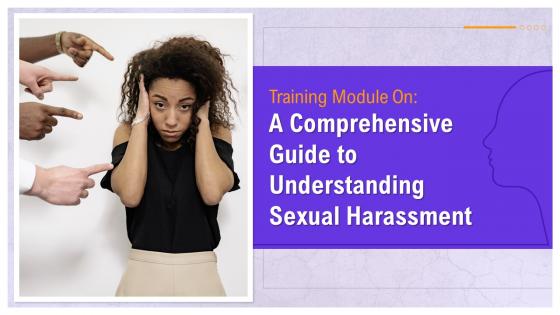
A Comprehensive Guide to Understanding Sexual Harassment Training Ppt




Try Before you Buy Download Free Sample Product
 Impress Your
 Audience
 100%
100% Editable
 Save Hours
 of Time


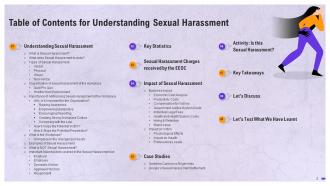
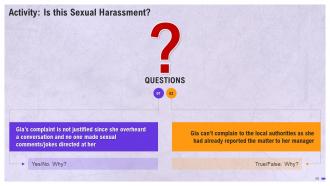
This PPT Training Module, A Comprehensive Guide to Understanding Sexual Harassment, aims to clear the often misunderstood aspects of sexual harassment, offering employees a broad spectrum of knowledge. The first section helps in Understanding Sexual Harassment, explaining its true definition and many facets. It also explores the Types of Sexual Harassment, highlighting the spectrum that ranges from verbal and physical harassment to visual and non-verbal cues. The PowerPoint Deck then transitions into the Classification of Sexual Harassment at the Workplace. It explores the difference between Quid Pro Quo and a Hostile Work Environment. The subsequent section on the Importance of Addressing Sexual Harassment at the Workplace, underscores why organizations should actively seek to address this issue. The focus is not only on the benefits for potential victims and the organization but also on how addressing this issue may deter potential perpetrators. The PPT Module also addresses sexual harassment in the unorganized sector and explores real-life Examples of Sexual Harassment, clarifying What is NOT Sexual Harassment to dispel common misconceptions. In addition, it explains the Important Stakeholders covered in the Sexual Harassment Act, elucidating the roles and responsibilities of employers, employees, domestic workers, aggrieved women, and respondents. Critical Key Statistics on sexual harassment charges received by the EEOC Equal Employment Opportunity Commission provide a factual basis for the pervasiveness of this issue. The Impact of Sexual Harassment section then delves into the business impact, including economic cost analysis, productivity costs, compensation for victims, and brand value and the impact on victims, such as psychological effects, health impacts, and professional losses. Case Studies bring to life real-world examples of sexual harassment incidents. The PowerPoint Resource concludes with an interactive Activity Is this Sexual Harassment. allowing viewers to apply their learned knowledge.
People who downloaded this PowerPoint presentation also viewed the following :
Content of this Powerpoint Presentation
Slide 4
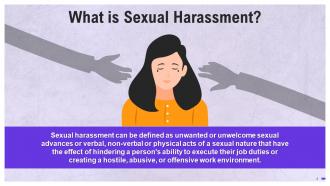
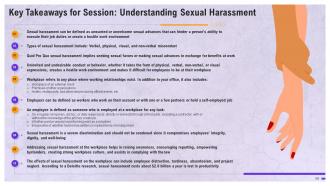
This slide gives an introduction to sexual harassment. Sexual harassment can be defined as unwanted or unwelcome sexual advances or verbal, non-verbal or physical acts of a sexual nature that have the effect of hindering a person's ability to execute their job duties.
Slide 5
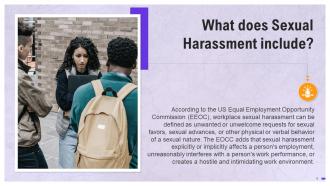
This slide lists types of unwelcomed acts and behavior that are considered as sexual harassment. These include: Physical contact and/or advances, demand or request for sexual favors, making sexual remarks/comments.
Slide 6
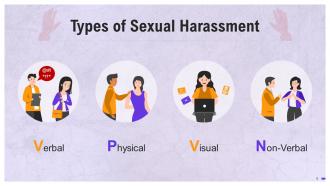
This slide lists types of sexual harassment. These include: Verbal, physical, visual, and non-verbal misconduct.
Slide 7
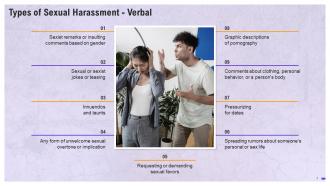
This slide shows examples of verbal harassment as a type of sexual harassment. These may include: Sexist remarks or insulting comments based on gender, sexual or sexist jokes or teasing, innuendos and taunts.
Slide 8
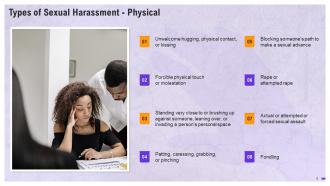
This slide discusses examples of physical harassment as a type of sexual harassment. These may include: Unwelcome hugging, physical contact, or kissing, forcible physical touch or molestation, standing very close to or brushing up against someone, leaning over, or invading a person's personal space.
Slide 9
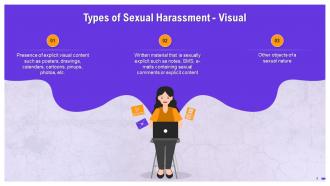
This slide talks about examples of visual harassment as a type of sexual harassment. These may include showing explicit visual content such as posters, drawings, calendars, cartoons, pinups, photos.
Slide 10
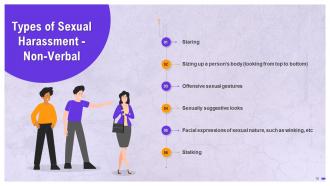
This slide discusses non-verbal harassment as a type of sexual harassment. The examples include staring, sizing up a person’s body (looking from top to bottom), offensive sexual gestures.
Slide 11
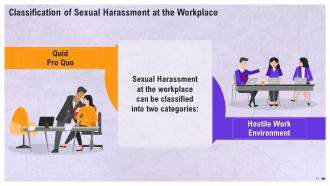
This slide gives an overview of the classification of sexual harassment at the workplace. There are two types of sexual harassment in the workplace: Quid pro quo and hostile work environment.
Slide 12
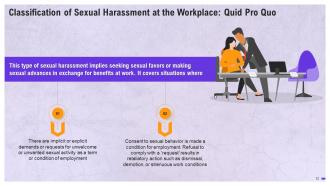
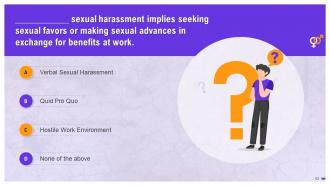
This slide gives information about Quid Pro Quo as sexual harassment at the workplace. This type of sexual harassment implies seeking sexual favors or making sexual advances in exchange for benefits at work.
Slide 13
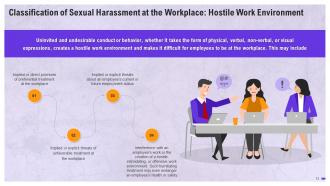
This slide gives information about hostile work environment as sexual harassment at the workplace. Uninvited and undesirable conduct or behavior, whether it takes the form of physical, verbal, non-verbal, or visual expressions, creates a hostile work environment and makes it difficult for employees to be at the workplace.
Slide 15
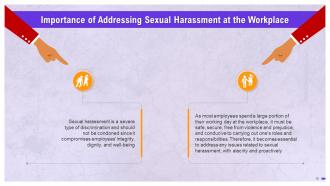
This slide discusses the importance of addressing sexual harassment in the workplace. Sexual harassment is a discriminatory practice and should not be condoned since it compromises employees' integrity, dignity, and well-being. Therefore, it becomes essential to address any issues related to sexual harassment.
Slide 16
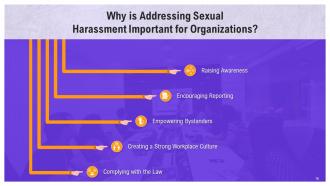
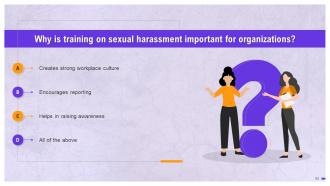
This slide highlights the importance of addressing sexual harassment at the workplace. It helps in raising awareness, encouraging reporting, empowering bystanders, creating a strong workplace culture, and assists in complying with the law.
Slide 17
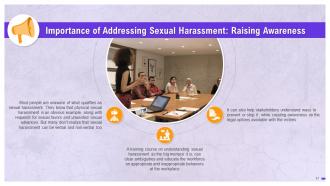
This slide discusses how addressing sexual harassment at the workplace helps in raising awareness. A training course on understanding sexual harassment as the big menace it is, clear all ambiguities and educate the workforce on appropriate and inappropriate behaviors at the workplace.
Slide 18
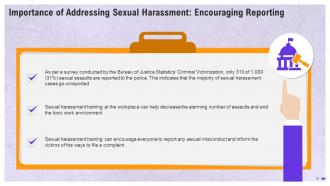
This slide talks about the importance of addressing sexual harassment in an organization and how it encourages reporting. Sexual harassment training can encourage everyone to report any sexual misconduct, as it informs them about different ways to file a complaint.
Instructor’s Notes: A zero-tolerance policy on sexual harassment can be established with adequate training, which will encourage reporting without the fear of retaliation or other consequences.
Slide 19
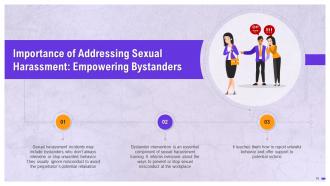
This slide discusses how addressing sexual harassment at the workplace encourages bystanders. Sexual harassment incidents may include bystanders who don’t always intervene or stop unwanted behaviors. Bystander intervention is a crucial part of sexual harassment training. It informs everyone on the ways to prevent or stop sexual misconduct at the workplace.
Slide 20
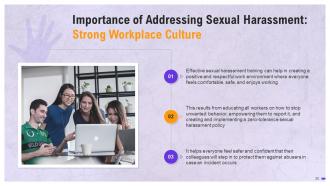
This slide discusses the importance of addressing sexual harassment in an organization and how it aids in creating a strong workplace culture.
Slide 21
This slide talks about the importance of addressing sexual harassment at the workplace as it helps in complying with the law.
Slide 22
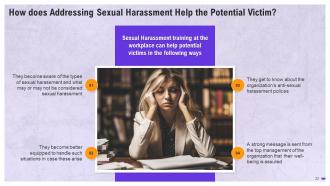
This slide discusses how addressing sexual harassment can help the potential victims. Sexual Harassment training at the workplace can help potential victims in many ways such as spreading awareness about the types of sexual harassment, assuring their well-being in the company.
Slide 23
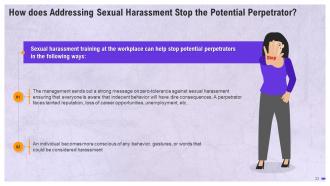
This slide discusses how addressing sexual harassment can help in stopping potential perpetrator(s). The management sends out a strong message on zero-tolerance against sexual harassment ensuring that everyone is aware that indecent behavior will have dire consequences like tainted reputation, loss of career opportunities, unemployment.
Slide 25
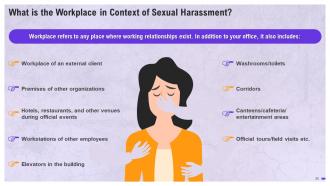
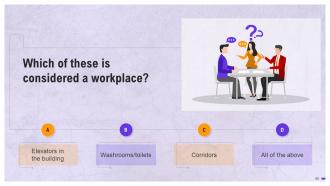
This slide gives the definition of the workplace in the context of sexual harassment. The workplace refers to any place where working relationships exist. In addition to your office, it also includes workplace of an external client, corridors, canteens.
Slide 26
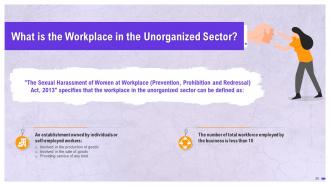
This slide discusses the workplace in the unorganized sector. In the organized sector, a workplace can be defined as an enterprise owned by individuals or self-employed workers or the total number of workforce employed by the business is less than 10.
Slide 27
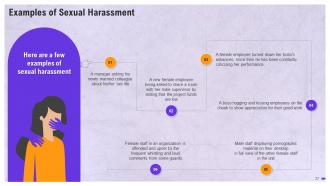
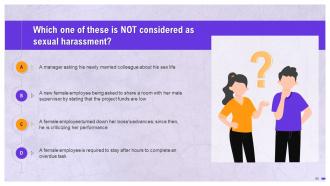
This slide lists examples of situations of sexual harassment such as a new female employee being asked to share a room with her male supervisor; the official reason given is that project funds are low.
Slide 28
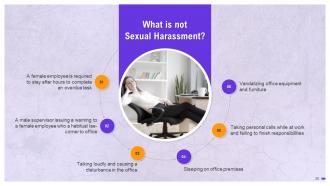
This slide lists examples of what is not sexual harassment. In a situation where a female employee is required to stay after hours to complete an overdue task is not sexual harassment, as are several other scenarios where the behavior may be wrong in other aspects, but is definitely not sexual harassment.
Slide 29
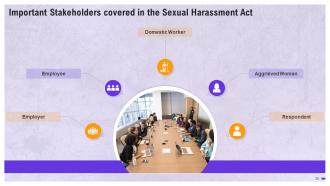
This slide lists stakeholders covered in the Sexual Harassment Act. These include: employer, employee, domestic worker, aggrieved woman, and respondent.
Slide 30
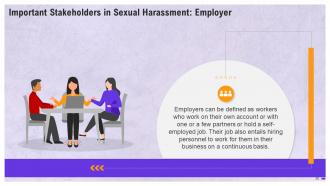
This slide gives the definition of the employer as an important stakeholder in sexual harassment cases. Employers can be defined as workers who work on their own account or with one or a few partners or hold a self-employed job.
Slide 31
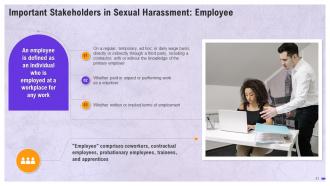
This slide gives the definition of an employee as an important stakeholder in case of sexual harassment. An employee is defined as a person who is employed at a workplace for any work on a regular, temporary, ad hoc, or daily wage basis; directly or indirectly through a third party, including a contractor; with or without the knowledge of the primary employer.
Slide 32
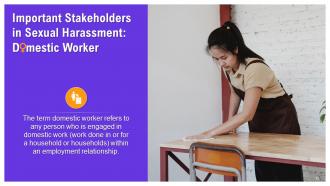
This slide gives the definition of a domestic worker as an important stakeholder in case of sexual harassment. The term domestic worker refers to any person who is engaged in domestic work (work done in or for a household or households) within an employment relationship.
Slide 33
This slide gives the definition of an aggrieved woman as an important stakeholder in case of sexual harassment. An aggrieved woman includes a woman of any age, regardless of her employment status, who claims to have been subjected to any act or behavior of sexual harassment by a respondent in relation to a workplace.
Slide 34
This slide gives the definition of the respondent as an important stakeholder in case of sexual harassment. Respondent refers to the individual against whom the aggrieved woman has filed a complaint with the Internal or Local Committee.
Slide 36
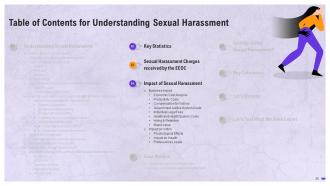
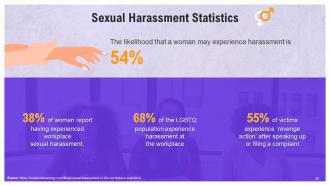
This slide highlights some key statistics regarding sexual harassment in the workplace.
Slide 37
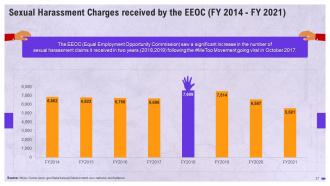
This slide depicts the number of sexual harassment charges that the U.S. Equal Employment Opportunity Commission received between the years 2014 and 2021.
Slide 38
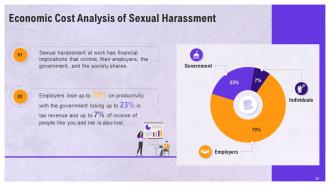
This slide illustrates the economic cost of sexual harassment at the workplace. Sexual harassment at work has financial implications that victims, their employers, the government, and the society shares.
Slide 39
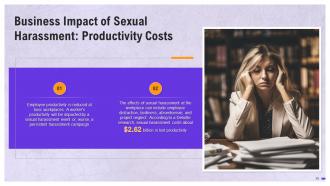
This slide talks about productivity costs that sexual harassment at the workplace leads to. Employee productivity is reduced in toxic workplaces. According to a Deloitte research, sexual harassment costs about $2.62 billion in lost productivity.
Slide 40
This slide discusses the compensation for victims of sexual harassment investigations at the workplace. In some circumstances, compensation may be given to the victim of workplace sexual harassment. The employer typically bears these costs; however, the perpetrator may be liable in some cases.
Slide 41
This slide discusses government justice system costs in cases of sexual harassment at the workplace. Some workplace sexual harassment cases go through the legal system, which can incur costs for legal counsel, court fees, police expenses, and incarceration expenses for serious offenses like sexual assault.
Slide 42
This slide talks about the individual legal fees in sexual harassment cases, if they arise, at the workplace. Employers are responsible for meeting legal costs and other relevant expenses when an employee accuses them of sexual harassment.
Instructors’ Notes: In 2019, the U.S. Equal Employment Opportunity Commission (EEOC) received over 7,500 claims of sexual harassment, resulting in a payout of $68 million in direct settlements.
Slide 43
This slide talks about the impact of sexual harassment on health and health system costs. Many health system costs can be attributed to workplace sexual harassment such as cost of GPs, medication.
Slide 44
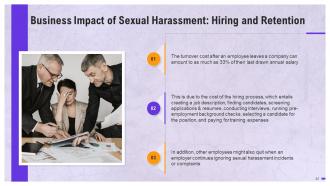
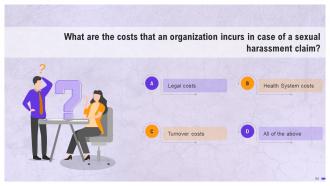
This slide discusses the cost of sexual harassment investigations at the workplace. The turnover cost after an employee leaves a company can amount to as much as 33% of their last drawn annual salary. This is due to the cost of the hiring process, which entails creating a job description, finding candidates, screening applications & resumes, training costs.
Slide 45
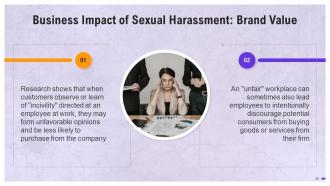
This slide discusses the business impact of sexual harassment on brand value of an organization. Research shows that when customers observe or learn of "incivility" directed at an employee at work, they may form unfavorable opinions and be less likely to purchase from such a company.
Slide 46
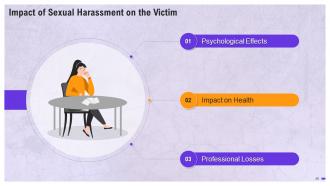
This slide talks about the impact of sexual harassment on the victim. It can negatively impact the psychological well-being, and health of the victim, with professional losses.
Slide 47
This slide lists the psychological effects of sexual harassment on the victims.
Slide 48
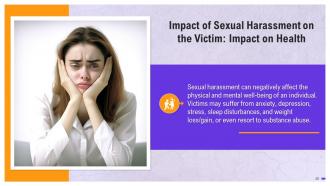
This slide talks about the negative impact of sexual harassment on victims’ health.
Slide 49
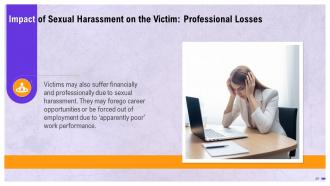
This slide discusses how sexual harassment can hit the victim’s professional growth.
Slide 51
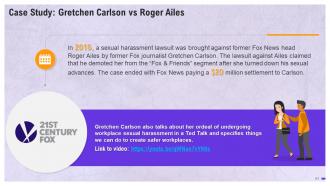
This slide gives information about a workplace sexual harassment lawsuit. In 2016, a sexual harassment lawsuit was brought against former Fox News head Roger Ailes by former Fox journalist Gretchen Carlson. The lawsuit against Ailes claimed that he demoted her from the “Fox & Friends” segment after she turned down his sexual advances.
Slide 52
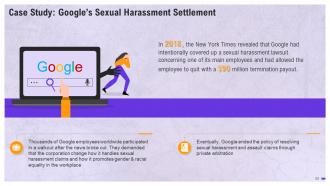
This slide tells us about Google’s Sexual Harassment Settlement. In 2018, the New York Times revealed that Google had intentionally covered up a sexual harassment lawsuit concerning one of its main employees and had allowed the employee to quit with a $90 million termination payout.
Slide 53 to 56
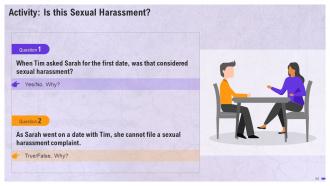
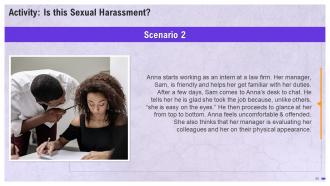
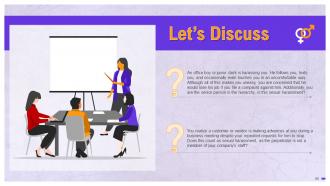
These slides present a scenario to get absolute clarity on what constitutes sexual harassment.
Slide 57 to 58
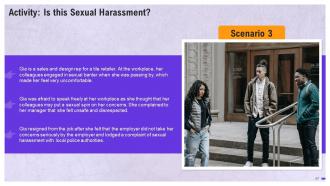
These slides present another scenario for an activity on sexual harassment.
Slide 78 to 93
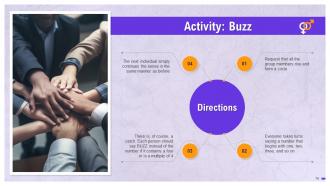
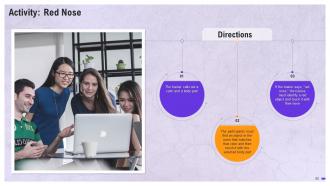
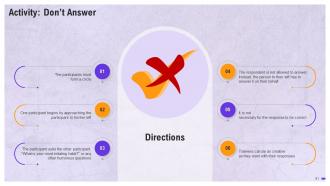
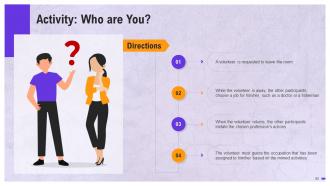
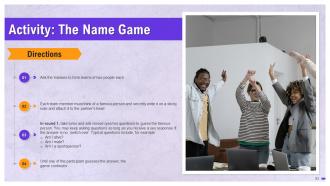
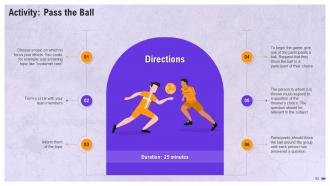
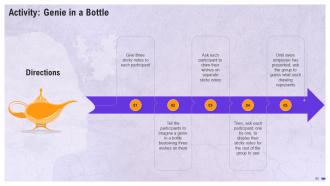
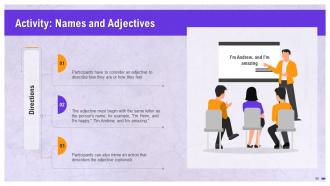
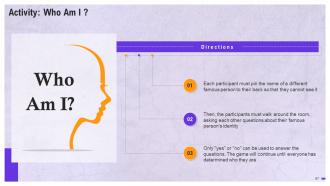
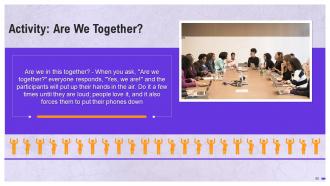
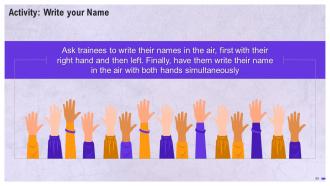
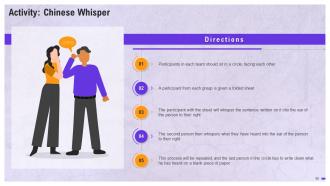
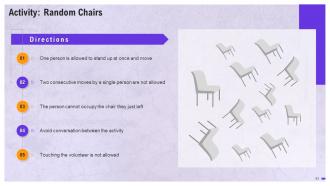
These slides contain energizer activities to engage the audience of the training session.
A Comprehensive Guide to Understanding Sexual Harassment Training Ppt with all 98 slides:
Use our A Comprehensive Guide to Understanding Sexual Harassment Training Ppt to effectively help you save your valuable time. They are readymade to fit into any presentation structure.







FAQs for A Comprehensive Guide to Understanding Sexual
Look, you really need four key pieces: clear definitions of harassment, your actual company reporting process, relatable scenarios (not boring hypotheticals), and ongoing training - not just yearly boxes to check. Interactive stuff works way better than slide decks nobody pays attention to. Oh, and bystander training is actually game-changing for workplace culture. The biggest thing though? Leadership has to genuinely participate. Employees can smell fake commitment from a mile away, and if executives just phone it in, your whole program falls apart.
Honestly, you'll want to hit this from a few angles. Anonymous surveys before and after work great - people actually tell the truth when they're not worried about backlash. Track your complaint numbers and how fast they get resolved, but give it months to see real change. Culture shifts are slow as hell. Have managers keep an eye on day-to-day stuff too - are people actually speaking up in meetings now? The surveys tell you what people think they learned, but watching behavior tells you what's really sticking. Look for whether folks call out bad behavior or if the workplace genuinely feels more inclusive.
Honestly, leadership makes or breaks this whole thing. When managers actually walk the walk - not just talk about respect but show it every day - harassment becomes way less likely. I've worked places where bosses just checked boxes with training and guess what happened? Same old problems. But good leaders? They shut down bad behavior fast, no matter who's doing it. Creates this culture where people feel safe speaking up. Your leaders basically design the whole workplace vibe, so they need to get that their actions matter way more than whatever's written in the handbook.
Honestly, ditch the generic examples nobody relates to. Use real stuff from your actual workplace instead. Interactive bits work so much better - case studies, role-playing, even just quick polls beat boring videos every time. I've sat through way too many trainings that were just legal mumbo jumbo! Make your examples reflect who actually works there. Short sessions are better too since people's attention spans are... well, you know. The goal is giving them skills they'll actually use, not just checking some compliance box. Oh, and bring in different viewpoints - makes it way more engaging.
So you'll want to hit the federal stuff like Title VII, but honestly your state laws are probably gonna be way stricter - that's where I'd start. California and New York are super picky about timing and what you cover. Your training needs harassment definitions, how to report stuff, retaliation protections, and bystander intervention basics. Don't forget both quid pro quo and hostile environment scenarios (learned that one the hard way). The EEOC sets the floor but states usually pile more on top. I'd grab your state's checklist and see where your current program's falling short.
Your training has to actually match what happens in your workplace - otherwise people will just zone out. Healthcare? Focus on the doctor-patient power dynamics and weird situations with colleagues. Tech companies deal with totally different stuff like inappropriate Slack convos and all that startup socializing drama. Retail's more about creepy customers and manager situations. Construction sites have their own hostile environment issues you don't see in an office. Honestly, generic corporate examples are useless. Survey your team first about what uncomfortable situations they've actually seen. Those real scenarios will hit way harder than some boring handbook example.
Honestly, most people think sexual harassment is just physical stuff or "sleep with me or you're fired" situations. But the real issue? It's usually hostile work environment stuff - gross jokes, comments about how someone looks, sexual innuendos that make work awkward. Here's what really gets me: people think their intent matters more than impact. You can say you're "just kidding" all you want, but if someone feels uncomfortable, that's what legally counts. Oh, and harassment happens between all gender combinations, not just the obvious ones. Train people on these messy gray areas since that's where most problems actually happen.
Definitely mix up your training formats - some people learn better with audio, others need written stuff. Captions on videos are huge, and honestly transcripts save everyone time anyway. Ask your team upfront what they need instead of guessing (learned this the hard way). Physical space matters too - wheelchair access, good lighting, all that. Different people process info at different speeds, so don't rush through everything. Oh and screen reader compatibility if you're doing digital materials. Basically just... ask people what works instead of assuming one approach fits everyone.
Honestly, the best approach is making it ongoing instead of just that one boring session everyone sits through. Try doing quick scenario discussions in team meetings - like 15 minutes talking through real workplace situations. Anonymous surveys are gold because people actually tell the truth when their name isn't attached. Also set up easy ways for people to ask questions later, maybe HR office hours or a chat channel? Those quarterly check-ins about workplace culture help too. The whole point is keeping it fresh in everyone's minds. I'd schedule something for next month - just a short team discussion to keep the concepts alive.
Multiple reporting channels are super important - people have different comfort levels. Anonymous hotlines work great, plus online portals and designated HR folks. Honestly, anonymous reporting is probably your best bet since retaliation fears are real. You've gotta actually follow up on reports though, or people will just stop bothering. Communication is key too - if nobody knows these options exist, what's the point? Oh, and third-party services can help if your workplace feels too "everyone knows everyone." Bottom line: give people choices and make it actually safe to speak up.
Oh man, people walk into these trainings carrying so much baggage - shame, trauma, you name it. Some shut down completely. Others get defensive or straight-up hostile, which honestly makes sense when you think about it. Your main goal? Create a safe space where they can actually learn instead of mentally checking out the whole time. I'd watch for discomfort and have backup plans ready. Focus on growth rather than calling people out. Use scenarios instead of making it personal, and tell them upfront they can step out if needed. It's about learning, not gotcha moments.
Honestly, diversity totally flips the script on harassment training. Different cultural backgrounds mean people communicate differently - what's obvious to one group might completely miss the mark with another. Use examples that actually match your workforce instead of generic scenarios. Marginalized employees deal with specific situations more often, so address those head-on. Oh and make sure everything's accessible too - seems basic but you'd be surprised how many companies skip that. Really though, it's about ditching the one-size-fits-all mentality. Tailor it to your actual team's reality.
So bystander intervention is basically teaching people how to step in when they see harassment happening. You don't have to be some kind of superhero about it - there are different approaches like directly saying something, creating a distraction, or getting someone else to help. What I like is that they actually give you multiple options depending on the situation. Sometimes you might just interrupt with "hey, didn't we have that meeting?" or whatever. Other times you check on the person afterward to make sure they're okay. The whole point is everyone can do something to make work less awful, not just leaving it all to HR.
Pull from real stuff that's happened at your company - just change names obviously. Skip those cheesy "office romance" examples everyone uses, they're so tired. Focus on the weird gray areas instead: someone making sketchy jokes in meetings, mentor relationships getting uncomfortable, coworkers being inappropriate on social media. Make it feel like your actual workplace too - same demographics, similar situations people would recognize. Honestly, the best scenarios are ones where people think "oh crap, I've seen this before" instead of rolling their eyes at fake examples.
Honestly, the biggest thing is making people feel safe to actually speak up - nobody's gonna ask questions if they think you'll judge them for it. Use real examples that people can relate to, not those awful training videos from like 20 years ago. I'd focus on actual behaviors instead of trying to guess what people were thinking. Then hit them with "what would you do if..." scenarios. Have your reporting process figured out beforehand though. Don't just ghost after the training either - check in later with a quick email or chat to see if anyone has lingering questions.
-
SlideTeam is my go-to resource for professional PPT templates. They have an exhaustive library, giving you the option to download the best slide!
-
Appreciate the research and its presentable format.