


Recognizing Sexual Harassment Types Training Ppt




Try Before you Buy Download Free Sample Product
 Impress Your
 Audience
 100%
100% Editable
 Save Hours
 of Time


This set of slides gives an overview of the types of sexual harassment. These include verbal, physical, visual, and non-verbal.
People who downloaded this PowerPoint presentation also viewed the following :
Content of this Powerpoint Presentation
Slide 1
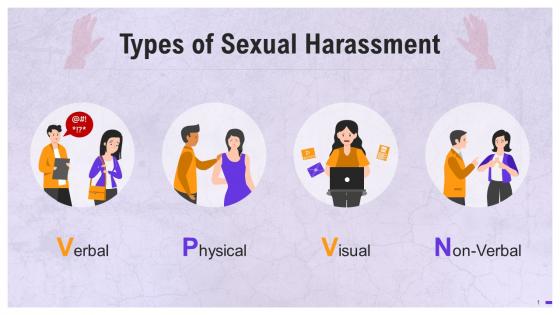
This slide lists types of sexual harassment. These include: Verbal, physical, visual, and non-verbal misconduct.
Slide 2
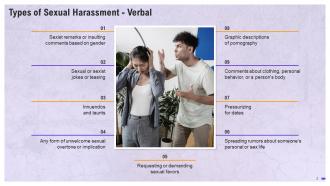
This slide shows examples of verbal harassment as a type of sexual harassment. These may include: Sexist remarks or insulting comments based on gender, sexual or sexist jokes or teasing, innuendos and taunts.
Slide 3
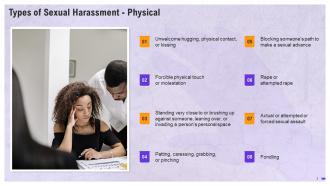
This slide discusses examples of physical harassment as a type of sexual harassment. These may include: Unwelcome hugging, physical contact, or kissing, forcible physical touch or molestation, standing very close to or brushing up against someone, leaning over, or invading a person's personal space.
Slide 4
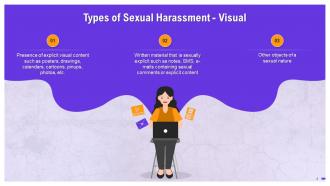
This slide talks about examples of visual harassment as a type of sexual harassment. These may include showing explicit visual content such as posters, drawings, calendars, cartoons, pinups, photos, etc.
Slide 5
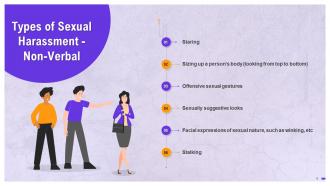
This slide discusses non-verbal harassment as a type of sexual harassment. The examples include staring, sizing up a person’s body (looking from top to bottom), offensive sexual gestures, etc.
Recognizing Sexual Harassment Types Training Ppt with all 21 slides:
Use our Recognizing Sexual Harassment Types Training Ppt to effectively help you save your valuable time. They are readymade to fit into any presentation structure.






FAQs for Recognizing Sexual Harassment
Look, you want interactive stuff - scenarios work way better than boring lectures. Cover the basics like what counts as harassment and your company's reporting process. Don't forget legal consequences either. I'd definitely include bystander intervention training because honestly, most people freeze up when they witness something. Make it mandatory for everyone, not just managers. The investigation process should be crystal clear too. Oh, and leadership accountability is huge - if executives don't buy in, nobody takes it seriously. Keep updating the content regularly since laws change. One-time training is pretty much useless; ongoing programs actually stick.
Ditch the boring PowerPoint lectures - nobody learns from those anyway. Try interactive scenarios with real workplace situations people actually deal with. Role-playing works great too. Get diverse facilitators involved and make sure leadership shows up, not just demands everyone else attend. I'd also set up multiple ways for people to report issues afterward so they feel safe speaking up. Oh, and follow up with refresher sessions! Those pulse surveys help you see what's actually sticking. The whole point is getting people talking and sharing experiences in a space where they won't get judged.
Ugh, this stuff is such a mess - every state does it differently. California and New York require annual training if you've got 5+ employees. Federal contractors have their own rules too. Healthcare and education usually have way stricter requirements, which makes sense I guess. Honestly, the whole system is pretty confusing since there's no single standard. Your best move is probably just assuming you need yearly training and keeping good records of everything. Check your state's labor department site or talk to someone in HR who actually knows this stuff inside and out.
Most places do it once a year, but check what your state actually requires - California and New York are way more strict about this stuff. I'd say annual training during onboarding, then yearly refreshers for everyone else. Sounds boring, I know, but it really does help set clear boundaries. New hires should get trained in their first 90 days or so. Honestly, just pick a date and put it on repeat in your calendar because it's easy to forget. The repetitive part is annoying but it keeps everyone aligned on what's acceptable.
Your managers totally set the vibe for this stuff. If they're scrolling through emails or cracking inappropriate jokes during training, everyone picks up on that energy – and honestly, it's super awkward. The good leaders I've seen actually jump in with real questions and share examples from their own work. They'll kick things off by explaining why respect matters for the team's success, then stay tuned in the whole time. You don't want them just phoning it in because people notice when leadership doesn't give a damn.
Definitely need interactive stuff - videos where people actually have to choose what they'd do, not just click through boring slides. Role-playing helps too, even online. The trick is making scenarios feel real to your specific workplace. TBH, some people will zone out no matter what format you use. But online can work better since they can go back to confusing parts later. Just make sure you're checking if people are actually engaged (not just letting it run in the background while they answer emails lol). Follow up with group discussions afterward - that's when it clicks.
Oh man, the worst myth is thinking harassment has to be super serious or happen multiple times. Wrong! Even one gross comment can mess up someone's whole work vibe. People always assume it's just the obvious stuff like "sleep with me for a promotion," but honestly most harassment is way more subtle - just unwelcome behavior that makes people uncomfortable. And here's what really bugs me: saying "I was kidding!" doesn't magically erase the impact on someone else. Intent vs. impact, you know? Your training definitely needs to hit these murky situations because that's where most workplace drama actually happens.
Honestly, start with baseline numbers before you do anything - that's key. Pre/post surveys work great for checking if people actually retained stuff. Incident reports might spike at first (which is actually good since it means awareness is up). I'd do anonymous pulse surveys every few months to see if the culture's shifting. Don't just track completion rates though - that's pretty meaningless. Look for real behavioral changes like people stepping up as bystanders or actually using those reporting systems. Employee feedback on the training quality matters too. Compare everything quarterly and you'll spot what's working versus what isn't. The whole point is seeing if your workplace genuinely gets better over time.
Honestly, just mix it up based on how your people actually learn. Some need videos to get it, others want to jump right into scenarios and mess around with stuff. Audio works for people who learn by listening, but skip the giant text blocks - nobody reads those anymore lol. Real workplace examples are clutch though. People need to see how this connects to their actual job. Self-paced stuff is great for introverts. Group discussions work better for the social types. I'd probably survey your team first to see what they prefer, then build from there. Way easier than guessing.
Honestly, case studies are way better than just reading through boring policy manuals. Your team gets to dig into real scenarios - like figuring out when office jokes cross the line or how someone's position affects workplace dynamics. People remember this stuff because it's messy and real, you know? Pick situations that actually match what happens at your company, then let everyone hash out what went sideways and brainstorm better approaches. Oh, and make sure everyone jumps into the conversation - that's where the good insights come from. Way more engaging than lectures.
Oh man, manager training is way more intense! You'll get all the same stuff about recognizing harassment and reporting, but they pile on legal liability stuff too. Like, you become responsible for spotting warning signs and doing preliminary investigations without screwing things up legally. They hit you with tons of "what would you do if..." scenarios - honestly some are pretty wild. The big thing is once you know about potential harassment, even informally, you have a legal duty to act. Can't just ignore it. So yeah, way more complexity when you move up. Fun times, right?
Honestly, you've gotta give people multiple ways to report stuff - anonymous hotlines, online forms, whatever works. Sometimes their direct boss IS the problem, so they need other options. Train your managers not to get all defensive when someone comes forward. That's the worst response ever. Here's the thing though - you absolutely have to follow up and show people that reporting actually changes things. Don't give details obviously, but let folks know action was taken. If employees think nothing happens, they'll just stop bothering to speak up. Oh, and make it super clear that retaliation won't fly.
Oh nice timing! Start with EEOC stuff - their free materials are actually pretty decent as a base. SHRM has this toolkit with scenario exercises that work way better than boring corporate examples. BambooHR and Workday have templates you can mess around with too. Honestly, the generic scenarios most companies use are so stale. Try to get some real cases from your legal team if they'll share - makes it way more relevant. Industry-specific examples hit different than the usual "Bob said something inappropriate in the break room" stuff. Build from EEOC guidelines, then add your company policies and situations people might actually deal with.
Send out anonymous surveys right after each session, then do a follow-up 3-6 months later - that's the part most companies totally blow off but it's where the real insights are. You'll see if people actually use what they learned or if it just disappeared into the void. Watch for patterns in responses too. Multiple people saying scenarios feel outdated? Time to refresh them. Track stuff like incident reports and how confident employees feel over time. Oh, and here's something I learned the hard way - when you make changes based on their feedback, actually tell them what you fixed and why. People notice when you're listening.
Ugh, remote harassment training is tricky. People think since everyone's working from home, inappropriate behavior just... doesn't happen? Wrong. It's actually harder to catch because you can't see those weird looks or uncomfortable body language on video calls. Plus nobody talks casually anymore - like, where are people supposed to vent about creepy messages? Your team needs super clear ways to report stuff. The isolation makes people way less likely to speak up when someone's being gross in Slack or whatever. Honestly, half the battle is just getting everyone to realize virtual harassment is totally real.
-
Wonderful ideas and visuals. I'm really pleased with the templates, which are unique and up to date.
-
The information is visually stunning and easy to understand, making it perfect for any business person. So I would highly recommend you purchase this PPT design now!