


Understanding Technology Stack Of Generative Ai Model Generative Ai Artificial Intelligence AI SS




Try Before you Buy Download Free Sample Product
 Impress Your
 Audience
 100%
100% Editable
 Save Hours
 of Time


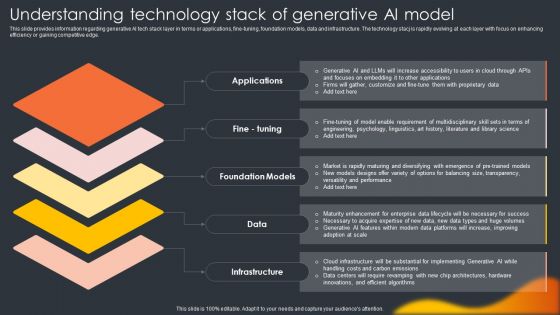
This slide provides information regarding generative AI tech stack layer in terms or applications, fine-tuning, foundation models, data and infrastructure. The technology stacj is rapidly evolving at each layer with focus on enhancing efficiency or gaining competitive edge.
People who downloaded this PowerPoint presentation also viewed the following :
Understanding Technology Stack Of Generative Ai Model Generative Ai Artificial Intelligence AI SS with all 9 slides:
Use our Understanding Technology Stack Of Generative Ai Model Generative Ai Artificial Intelligence AI SS to effectively help you save your valuable time. They are readymade to fit into any presentation structure.








FAQs for Understanding Technology Stack Of Generative Ai Model Generative Ai Artificial
So basically, traditional AI is like a super smart sorter - it looks at data and makes decisions or predictions. Like flagging spam emails or recognizing your face in photos. Generative AI actually creates stuff from nothing though. It'll write stories, make images, compose music, whatever you ask for. One analyzes what already exists, the other builds new things. Honestly, the generative stuff feels way more futuristic to me. If you want to automate any creative work or need help brainstorming, that's when you'd use the generative tools.
Generative AI is perfect for cranking out personalized content - custom emails, social posts, product descriptions for different audiences. I've seen it work really well for A/B testing too since you can pump out tons of ad variations quickly. Chatbots are another solid use case. Honestly, where it really shines is when your team's stuck and needs fresh campaign ideas. Just don't let it replace your actual creative thinking, you know? Use it to boost what you're already doing. I'd start with one content type first - maybe email campaigns? - then expand from there once you see how it performs.
Oh man, bias is the big one - these models just spit back whatever stereotypes were in their training data, so you'll want to test outputs constantly. Privacy gets messy too since sensitive stuff can leak through prompts or responses. The whole black box thing drives me nuts honestly. Be upfront with users that they're talking to AI, not people. Also don't forget the limitations talk. I'd definitely start with solid usage policies and regular bias checks - trust me, it's way easier than fixing problems later.
Honestly, AI is pretty clutch for getting past the blank page problem. I use it to spit out rough concept sketches or color combos when I'm stuck. For music stuff, it's decent at chord progressions - saves me from staring at my DAW for an hour. The trick is treating it like a really fast brainstorming buddy, not your final product. It'll throw random ideas at you that you'd never think of. Sometimes they're garbage, but occasionally you get something cool to work with. Just don't let it do all the heavy lifting - that's where your actual style comes in.
Honestly, data quality is your worst enemy - you'll spend forever cleaning datasets that cost a fortune. GPU costs are insane too, like genuinely painful. Bias keeps sneaking in because your training data probably has the same prejudices people do, so you're always double-checking outputs. Technical stuff like mode collapse and hyperparameter tuning will drive you nuts. Training gets unstable for no reason sometimes. My take? Pick something small first. Seriously budget like 3x more time for data prep than seems reasonable - I always underestimate this part and regret it.
So basically you can use generative AI to analyze customer data and spit out super personalized stuff - like custom product recs, email content, even product descriptions tailored to each person. Pretty crazy how good it's gotten, honestly. You could create different landing pages for customer segments or make product bundles based on what they've bought before. The trick is having good data about how your customers actually behave. I'd probably start small though - maybe just personalized email subject lines first, then work your way up to bigger stuff.
Dude, generative AI is like having a writing buddy on steroids. You can crank out first drafts and brainstorm ideas in minutes now - it's actually insane how much faster things go. For journalism stuff, I've seen people use it for research help and testing different headlines. But here's the thing - you can't just trust it blindly. Still gotta fact-check everything and make sure it's not being weird about ethics or whatever. Think of it more like a really good brainstorming partner than someone who'll do your job for you. Definitely worth playing around with though, just don't get lazy about editing your own work.
So AI can design new drug compounds and predict how they'll hit target proteins - basically skipping years of actual lab work. Pretty crazy when you think about it. It's also really good at digging through huge datasets to find drug candidates researchers might totally miss. Oh, and it helps with personalized treatment too by looking at someone's genetic profile and medical history. The whole process just moves way faster now. If you're in pharma or healthcare, definitely check out AI tools for molecular modeling and patient analysis. The time you'll save is honestly insane.
Honestly, generative AI is gonna flip personalized learning on its head. Picture having AI tutors that actually adjust to how each kid learns best - some need more time, others race ahead. Teachers can't give that kind of individual attention with huge class sizes (which is totally understandable). The AI will pump out custom practice problems targeting exactly where students struggle. Plus instant, detailed feedback instead of waiting days for graded papers. It'll handle the boring stuff too - making lesson plans, grading, all that admin work teachers hate. Seriously, start playing around with these tools now before you're scrambling to catch up later.
Honestly, start with figuring out what data you're actually using and where it all lives - that's your foundation. Three big things to nail down: data governance, access controls, and encryption. Only use the most sensitive stuff you absolutely need (less = safer), then lock down who can touch your training datasets. Encrypt everything - stored data, data moving around, all of it. Oh and synthetic data is a game changer if you can swing it instead of real customer info. Trust me on that one, it'll save you from so many potential disasters down the road. Classification by sensitivity levels helps too. Some data just doesn't need the same protection as the really critical stuff.
So generative AI is pretty much what's powering all the cool content in VR/AR now. It automatically creates 3D environments, textures, character models - saves you from designing everything by hand. Total game-changer for dev time and budgets, honestly. The really cool part? It makes environments that actually respond to what users do in real-time. Way more immersive that way. Oh, and it can personalize stuff based on how people behave in the experience. You should definitely check out NVIDIA's Omniverse or Unity's AI tools - they'll do so much of the heavy lifting for you.
Honestly, just start with GitHub Copilot or similar code completion stuff - that's where most people begin anyway. It'll handle the boring boilerplate work that nobody wants to do. From there you can add AI testing tools and maybe some automated documentation generators. Don't try to revolutionize your whole setup at once though, that's a recipe for chaos. Pick one thing, get your team used to it, then slowly branch out. Code reviews with AI are pretty solid too once you're ready. I mean, anything that saves time on repetitive tasks is worth trying, right?
Yeah, so basically AI picks up biases from whatever data it was trained on. You'll see hiring tools that favor certain groups, or image generators churning out super stereotypical stuff. It's honestly wild how common this is once you notice it. Best thing you can do is mix up your training data and actually test outputs across different user groups. Human oversight helps too - don't just let it run wild. Oh, and there are bias detection tools you can use during development. Just don't wait until after launch to deal with this stuff, ya know?
Dude, AI is seriously changing everything in gaming right now. Studios are using it to pump out textures, dialogue, even code way faster than before. The coolest part? NPCs that actually hold real conversations instead of just spouting the same boring lines over and over. Plus you get procedural worlds and stories that shift based on your choices. Honestly, the personalized difficulty stuff is pretty neat too - games adapt to how you actually play. If you're thinking about getting into this space, start messing around with AI tools now. The early adopters are crushing it.
Mix automated metrics with human reviews - can't just pick one. Check fluency and accuracy for text stuff. Other outputs? Judge them against what you actually need them to do. Human evaluation is honestly still the gold standard, even though it takes forever. Get domain experts to do regular spot checks and make rubrics so everyone's consistent. Oh, and test the weird edge cases too - that's where things usually break. The key thing (learned this the hard way) is deciding your criteria upfront, not when you're drowning in outputs later.
-
SlideTeam is the way to go when you are in a time crunch. Their templates have saved me many times in the past three months.
-
I joined SlideTeam last month and there’s no doubt that I tend to find our bond only strengthening over time. Best place to find world-class themes, templates, and icons.