


Comparative Of Neural Networks Rnn Cnn And Ann Generative Ai Artificial Intelligence AI SS





Try Before you Buy Download Free Sample Product
 Impress Your
 Audience
 100%
100% Editable
 Save Hours
 of Time


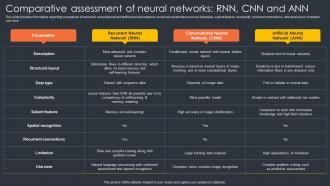
This slide provides information regarding comparison of recurrent, convolutional and artificial neural networks on various parameters such as data types, salient feature, complexity, recurrent connections, structural layout, limitation, use case.
People who downloaded this PowerPoint presentation also viewed the following :
Comparative Of Neural Networks Rnn Cnn And Ann Generative Ai Artificial Intelligence AI SS with all 9 slides:
Use our Comparative Of Neural Networks Rnn Cnn And Ann Generative Ai Artificial Intelligence AI SS to effectively help you save your valuable time. They are readymade to fit into any presentation structure.








FAQs for Comparative Of Neural Networks Rnn Cnn And Ann Generative Ai Artificial
So neural networks have these main pieces: neurons (basically nodes that crunch data), weights that connect them, and activation functions that decide when neurons should activate. Data flows through layers - input, hidden, output. The cool thing is during training, it adjusts all those weights based on how wrong its guesses are. Think of it like tweaking a million tiny knobs until you get the right answer. Without activation functions though, you'd only get boring straight-line patterns instead of complex stuff. Definitely look into backpropagation first - that's how it actually learns from mistakes.
So activation functions are what make neurons decide to "fire" or stay quiet - that's how your network learns patterns. Without them you'd just have linear regression in disguise, which is pretty useless tbh. ReLU is usually your best bet to start with since it trains fast. But watch out for dead neurons! Sigmoid and tanh can be tricky in deep networks because of vanishing gradients. I learned that one the hard way. If ReLU isn't working, try Leaky ReLU or ELU. They basically add non-linearity so your model can actually handle complex stuff instead of just straight lines.
So basically it's all about the data you're working with. Supervised learning means you feed the network examples that are already labeled - like thousands of cat pics marked "cat." Pretty straightforward. Unsupervised is messier since you just throw unlabeled data at it and hope it finds patterns. Reinforcement learning works more like training a dog - rewards and punishments until it figures things out. I'd probably go with supervised first if you've got labeled data, since honestly the other two can be a pain to get right. Most people I know started there anyway.
So basically CNNs have these special convolution layers that slide filters across your data, while regular neural networks just connect everything to everything. For images, CNNs are way smarter - they share weights so you don't have to learn the same edge detector a million times. Regular networks would be absolutely terrible for image stuff, honestly. CNNs naturally pick up on spatial patterns and textures. Way more efficient too since they're built for that kind of data. If you're doing anything with images, CNN is definitely the way to go.
So backpropagation is how neural networks actually learn from screwing up. Your network makes a prediction, compares it to the right answer, then works backwards through each layer figuring out which weights caused the error. It's kinda like retracing your steps when you burn dinner - what went wrong where? Then it tweaks those weights so hopefully next time it'll do better. Honestly, without this your network would just keep guessing randomly forever. Oh, and when your model isn't training right? Nine times out of ten it's because gradients aren't flowing properly through backprop.
Honestly, dropout layers are clutch - super easy to add and they work great. Early stopping is another solid move; just watch your validation loss and bail when it starts going up while training loss keeps dropping. L1/L2 regularization helps too, though I find dropout more intuitive. Cross-validation catches overfitting early if you set it up right. Oh, and if you're doing image stuff, data augmentation can work wonders. More training data obviously helps but isn't always realistic. Start with dropout and early stopping - that combo will handle most cases you'll run into.
So there are three main types you'll see: vanilla RNNs, LSTMs, and GRUs. Vanilla ones are pretty basic and honestly kinda suck with longer sequences because of vanishing gradients. LSTMs fixed that problem with memory gates - they're solid for language stuff, speech recognition, time series prediction. GRUs are basically simplified LSTMs but train faster while still handling long-term patterns well. Oh, and I always forget this but GRUs have fewer parameters too. If you need speed, go with GRUs. Complex sequential stuff? LSTM's your best bet.
Honestly, the optimizer you pick can totally mess up your training if you're not careful. Adam's usually my first choice - it adjusts learning rates on its own and just works most of the time without much tweaking. SGD takes longer but sometimes finds better solutions in the end. Different optimizers handle gradient updates in their own way, which changes how fast your network actually learns. If you pick a bad one, your loss will either get stuck or bounce around like crazy. I'd start with Adam's default settings, then maybe try something else if it's not working out.
Okay so transfer learning is when you grab a neural network that's already been trained on huge datasets and just adapt the last few layers for your specific problem. Way smarter than starting from zero. Models like ResNet or BERT have already figured out tons of useful patterns from ImageNet or whatever, so you're basically getting a head start. Honestly saves you so much time and money - no need for those insane GPU costs. You'll get better results with less data too. There's a bunch of pre-trained models out there depending on what you're working on. Pretty much changed everything tbh.
So dropout randomly shuts off neurons during training - sounds weird but it actually works. Your network can't just memorize stuff because it never knows which parts will be available. Kind of like if you had to do your job with random coworkers missing each day, you'd get more flexible. L1/L2 regularization does something similar by penalizing overly complicated models. I usually start with dropout around 0.2 to 0.5 and see how validation looks. The whole thing felt backwards to me at first - why make training harder? But it really does stop overfitting.
So the big ones you'll run into are vanishing gradients, exploding gradients, and overfitting - plus getting trapped in local minima which is annoying as hell. Batch normalization helps with the gradient issues. Dropout's your friend for overfitting. Xavier or He initialization will save you headaches with weight setup. I'd definitely switch from SGD to Adam optimizer too, makes a huge difference. Learning rate scheduling is clutch. Oh and watch your training curves like a hawk - catching problems early beats debugging later when everything's gone sideways. These basics should get you pretty far honestly.
Honestly, neural networks crush it on messy stuff like images and text - they find patterns traditional algorithms just miss. But man, they're resource hogs. Random forests or SVMs? Way faster to train, need way less data, and you can actually see what's happening inside them. Super useful when things go wrong. Neural networks are basically magic black boxes that work amazing but eat up your GPU budget. Oh, and they're hungry for data too. My advice? Start simple with traditional stuff to see what's possible, then maybe jump to neural networks if you've got the data and don't mind the extra complexity.
Dude, neural networks basically run everything in NLP now. Translation apps, chatbots, spam filters - all that stuff uses them. They're crazy good at picking up language patterns instead of needing someone to manually code every rule. RNNs and transformers especially kill it since they actually get context and word order. Way better than the old-school methods honestly. You can use them for sentiment analysis, question answering, text generation - pretty much anything. Oh and if you're just getting started? Definitely try BERT first. It's pre-trained so you won't have to start from scratch.
Bias is the big one - your model will just amplify whatever unfairness was baked into the training data. Privacy's another headache, especially if you're dealing with personal info. Can you actually explain why the model made a decision? That matters more than you'd think. Oh, and don't forget you might be automating someone's job away, which is... awkward. I've seen teams get so excited about the tech they completely skip these conversations until it's too late. Set up ethical guidelines with your team first - way easier than trying to fix things after you've already shipped something problematic.
Okay so neural networks get interpretable through stuff like attention maps, LIME, SHAP, and feature visualization - they're basically ways to see what your model is actually doing under the hood. You really need this for high-stakes stuff like healthcare or finance where trust matters. Stakeholders and regulators want explanations too, obviously. Without it you're just throwing a black box into production that might be making decisions for completely random reasons. Honestly, I'd pick one method that works for your specific problem and bake it into your process right from the start. Don't wait until later.
-
“I required a slide for a board meeting and was so satisfied with the final result !! So much went into designing the slide and the communication was amazing! Can’t wait to have my next slide!”
-
Use of different colors is good. It's simple and attractive.