


Vehicular Ad Hoc Networks Powerpoint Ppt Template Bundles




Try Before you Buy Download Free Sample Product
 Impress Your
 Audience
 100%
100% Editable
 Save Hours
 of Time


Unlock the future of connected mobility with our comprehensive PowerPoint presentation on Vehicular Ad Hoc Networks VANETs. Explore the dynamics of Vehicular Communication Systems, the backbone of connected vehicles networks, and delve into the transformative realm of Intelligent Transportation Systems ITS. Our PPT navigates the intricacies of wireless communication in vehicles, elucidating the role of VANET security protocols in ensuring robust data protection. From the essentials of VANET architecture to the nuances of VANET security, this presentation is a valuable resource for professionals and enthusiasts keen on understanding the seamless integration of technology in modern transportation. Stay ahead in the era of smart mobility with our in-depth VANET PowerPoint presentation.
People who downloaded this PowerPoint presentation also viewed the following :
Content of this Powerpoint Presentation
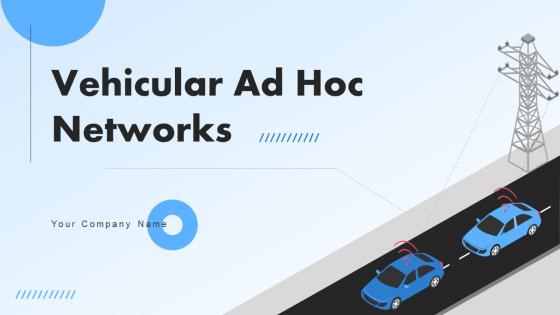
Slide 1: This slide introduces Vehicular Ad Hoc Networks. State your company name and begin.
Slide 2: This slide illustrates practical applications of vehicular ad hoc networks to enhance effectiveness.
Slide 3: This slide underscores essential elements like network topology, network scalability, frequent data exchange, storage, and onboard sensors within vehicular ad hoc networks.
Slide 4: This slide elucidates critical elements like mobile and infrastructure components, the generic domain, and data flow to illustrate the architecture of vehicular ad hoc networks etc.
Slide 5: This slide highlights key points such as V2V, V2I, and C2C to illustrate the various types of communications within vehicular ad hoc networks.
Slide 6: This slide outlines essential elements like topology, position, cluster, geo-cast, and broadcast routing protocols to depict the variety of routing protocols in vehicular ad-hoc networks.
Slide 7: This slide focuses on important points such as keeping information private, making sure data is real, verifying who sends it, delivering it on time, and being eco-friendly i networks.
Slide 8: This slide showcases how Vehicular ad-hoc networks are used in various ways, from safety and non-safety applications to improving efficiency and enhancing comfort.
Slide 9: This slide emphasizes essential factors like sporadic connections, fast-moving vehicles, diverse vehicle types, security, and smart network management.
Slide 10: This slide focuses on critical aspects like understanding mobility patterns, city block sizes, traffic control systems, and how vehicles' movements are interconnected.
Slide 11: This slide highlights various routing modes and protocols in vehicular networks, including topology-based, reactive, geographic, and opportunistic approaches.
Slide 12: This slide presents Vehicular ad hoc network with IoT icon.
Slide 13: This slide highlights Vehicle ad hoc network application icon.
Slide 14: This slide displays Mobile vehicle ad hoc network icon.
Slide 15: This is a Thank You slide with address, contact numbers and email address.
Vehicular Ad Hoc Networks Powerpoint Ppt Template Bundles with all 23 slides:
Use our Vehicular Ad Hoc Networks Powerpoint Ppt Template Bundles to effectively help you save your valuable time. They are readymade to fit into any presentation structure.










FAQs for Vehicular Ad Hoc Networks Powerpoint
So VANETs are basically souped-up MANETs but with cars instead of people. The mobility is insane - cars fly down highways way faster than someone walking with their phone. But here's the thing, movement patterns are actually predictable since vehicles stick to roads. You can also tap into roadside infrastructure which is nice. Power's not a problem like it is with regular mobile devices since cars have their own juice. The real pain point? Connection times between vehicles are super short. My professor always harped on this - you need protocols that exchange data lightning fast and work with those predictable movement patterns.
So basically, cars moving around constantly mess up VANET networks because the connections keep breaking. Highway speeds are brutal - you'll only have seconds to swap data before losing contact. City driving's more manageable since traffic patterns are predictable, but rural highways? Forget about it. The real trick is building protocols that can handle all this chaos. You need fast handoff systems and store-and-forward tech for when connections drop. It's honestly one of those problems that sounds simple until you realize how fast everything changes. Short contact windows make it super challenging to maintain any kind of stable communication.
So DSRC is basically what makes VANETs actually function in the real world. It runs on dedicated 5.9 GHz spectrum, which is nice because you won't get interference from WiFi or whatever else. The thing handles all that crazy network topology stuff - cars flying past each other at 70mph and constantly disconnecting/reconnecting. Low latency is huge here since safety messages like collision warnings need to get through immediately. Honestly, if you're diving into VANET work, I'd start with the DSRC specs first. Makes everything else way easier to understand.
So basically your car becomes like a safety messenger - it talks to other cars and road sensors about hazards, traffic, accidents, all that stuff in real time. You'll get warnings about crashes ahead or ice patches before you can even see them. Pretty neat, right? If you crash, it automatically calls emergency services too, which could save your life honestly. The whole thing creates this protective network around you. Oh and for your fleet stuff - this isn't some futuristic thing anymore, it's actually happening now. Worth looking into how it'd work with what you've got going.
VANETs are honestly a pain security-wise. You're dealing with message authentication, privacy issues, and malicious attacks like jamming or fake data. Think of it like securing a conversation where people constantly walk in and out of the room. Digital certificates work well for vehicle authentication. Pseudonym schemes help protect driver privacy - which is huge these days. Intrusion detection catches the bad guys too. Really though, you need solid PKI that handles high mobility and real-time demands. I'd start by figuring out which security features actually matter for your specific setup first.
So basically, peer-to-peer gives you way better coverage since cars can just pass messages along to each other. But it's pretty unreliable because, well, cars are moving constantly and connections drop all the time. Infrastructure-based is the opposite - super reliable through those fixed roadside units, but you'll hit dead zones between stations. It's like cell towers for vehicles, I guess. Most places end up doing hybrid because pure P2P gets messy when traffic's heavy, and building out full infrastructure costs a fortune. For critical safety stuff, I'd definitely start with infrastructure first, then add P2P later for the extra reach.
Oh man, VANETs are way cooler than just traffic alerts! Cars can basically become mobile hotspots - passengers streaming movies or gaming with people in other vehicles. City planners are obsessed with this because they get real-time data on everything: traffic flow, where parking spots are, how people move around. Plus there's location ads, emergency response coordination, environmental monitoring since cars turn into sensors on wheels. I mean, think about it - your car's collecting data while you're just driving to Starbucks. It's pretty wild when you realize vehicles aren't just transport anymore, they're mobile data hubs.
So IoT integration makes your VANET way smarter - now vehicles can talk to everything, not just other cars. Sensors in traffic lights, roads, even people's phones feed real-time data back to the system. Traffic management gets much better, collision warnings are more accurate, and route optimization actually works. Weather conditions, air quality - all that stuff gets factored into driving decisions too. Honestly, the sensor coverage is pretty impressive when you think about it. Your network can basically solve traffic problems by having vehicles communicate with the entire environment around them. Definitely worth considering for your design.
Yeah, those standards are actually pretty critical for VANETs. Without stuff like IEEE 802.11p, you'd end up with total chaos - like Ford cars that can't talk to Toyota infrastructure. Complete mess. Standards basically set up the common language so everything can scale properly from city to nationwide. They handle frequency allocation, message formats, all that technical stuff. Oh and definitely build them into your design from day one - retrofitting sucks and costs way more. It's kinda like early smartphone days when carriers couldn't talk to each other. Nobody wants that headache again.
So VANET routing is all about position-based stuff like GPSR - way better than those old table methods that can't keep up with cars zooming around. GPS coordinates work great here since you're routing toward where the destination actually is instead of trying to maintain routing tables that go stale in like 2 seconds. Road topology awareness helps too, following actual streets rather than straight-line distances (which obviously makes more sense). Predictive routing tries to guess where vehicles will go next, plus you need backup plans when connections drop. Honestly, I'd check out hybrid approaches mixing geographic routing with opportunistic forwarding - seems to handle city driving better.
So VANET performance gets wrecked by environmental stuff in weird ways. Buildings mess up signals through shadowing and multipath problems. Rain and fog actually weaken RF signals - can drop your range by 20-30% which sucks when cars are constantly moving. Trees are sneaky too, they block way more than you'd think. The tricky part isn't just signal strength though. VANETs have to constantly adapt to all these changing conditions on the fly. Best approach is adaptive power control plus multiple protocols that can switch automatically based on what the system's sensing. Pretty complex stuff honestly.
5G's gonna be massive for VANETs - the ultra-low latency finally makes real-time vehicle coordination work. Machine learning lets cars predict traffic and adapt routes on the fly, which is pretty cool. You can't rely on cloud connectivity when you're flying down the highway at 70mph, so edge computing becomes crucial. AI security will matter more as these networks get complex. Oh, and don't look at these as separate tech - they work way better integrated together. That's where the real innovation happens.
For testing V2X stuff, I'd start with controlled field trials using real test vehicles. Put them through different scenarios - city intersections, highways, parking areas. Weather's gonna screw with your data big time, so test rain, snow, whatever. Track the basics like message delivery, latency, range. Safety apps are where it gets interesting though - collision warnings, emergency braking, that kind of thing. Once multiple vehicles start talking at once, you'll see network congestion issues pop up. Honestly, simulation studies help too before you go full real-world. Build complexity gradually or you'll be drowning in variables.
VANET data is tricky stuff - you're dealing with tons of privacy issues since cars are basically broadcasting where people go, how fast they drive, their whole daily routine really. Who owns all that info? How long do companies keep it? Most drivers probably don't realize what they're signing up for either. Plus there's the whole Big Brother thing - governments love using "traffic safety" as an excuse to monitor everyone. Honestly, I'd go with privacy-first design from day one and just be super upfront about what data you're collecting. People appreciate honesty way more than finding out later they've been tracked.
So there's been some really solid pilot projects that prove VANETs actually work. Michigan's Safety Pilot was massive - they put thousands of connected cars in Ann Arbor and got tons of data. Japan's ITS Spot system is probably your best bet to see it working for real since it's actually commercial on their highways now. Europe did this huge DRIVE C2X thing across multiple countries. NYC focused on pedestrian safety, which honestly is brilliant given how crazy that city is. Singapore and South Korea ran highway trials too. Oh, and definitely check out Michigan's reports if you're serious about this - they don't sugarcoat the challenges.
-
Fantastic collection of visually appealing PowerPoint templates. They certainly uplift the look of the presentation.
-
SlideTeam’s readymade presentations have landed my unique images with my bosses in the past and it continues to reward me.