

Self Driving Car Powerpoint Ppt Template Bundles





Try Before you Buy Download Free Sample Product
 Impress Your
Audience
 100%
Editable
 Save Hours
of Time


Self-driving cars, or autonomous vehicles AVs, represent a paradigm shift in transportation. By integrating cutting-edge technologies like artificial intelligence, sensor fusion, and advanced robotics, these vehicles operate without human intervention, promising safer and more efficient travel. They utilize a network of sensors such as Lidar, radar, and cameras coupled with AI algorithms for real-time decision-making on roads. Their development demands rigorous safety testing, ethical considerations, and regulatory frameworks to ensure public trust and safety. As AVs evolve, they hold the potential to revolutionize urban mobility, reduce accidents, ease traffic congestion, and enhance accessibility for diverse populations, fostering a future where transportation is not just autonomous but also sustainable and interconnected.
People who downloaded this PowerPoint presentation also viewed the following :
Self Driving Car Powerpoint Ppt Template Bundles with all 32 slides:
Use our Self Driving Car Powerpoint Ppt Template Bundles to effectively help you save your valuable time. They are readymade to fit into any presentation structure.
-

Self Driving Car
-

Key technologies used in self driving cars
-

Decision enabled features in self driving cars
-

Automation levels in self driving cars
-
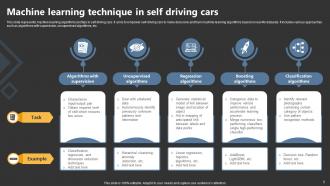
Machine learning technique in self driving cars
-

Operating systems used in self driving cars
-
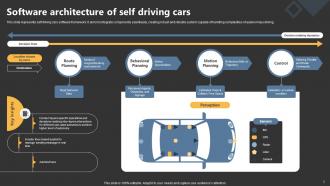
Software architecture of self driving cars
-

Autonomous features in self driving cars
-
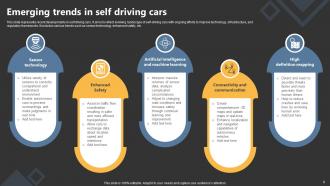
Emerging trends in self driving cars
-

Use cases of AI in self driving cars
-
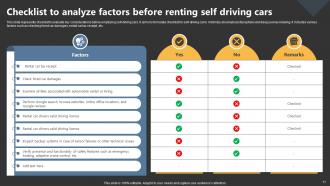
Checklist to analyze factors before renting self driving cars
-

Factors affecting purchase decision of self driving cars
-

Statistics highlighting consumer concerns for self driving cars
-

Solutions to overcome challenges involved in operating self driving cars
-

Key metrics to identify economic and fiscal impact of self driving cars
-
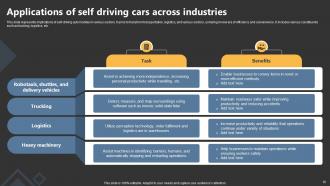
Applications of self driving cars across industries
-

Major players in self driving cars space
-
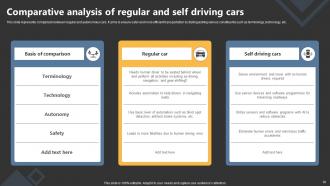
Comparative analysis of regular and self driving cars
-

Comprehensive differentiation of self driving cars sensor types
-

Overview of national legislation on self driving cars
-

Self driving cars icon to enable contactless delivery real time communication
-

Icon for artificial intelligence in self driving cars
-

Self driving cars icon for disabled persons
-

Thanks for watching
-

-

-

-

-

-

-

-

FAQs for Self Driving Car Powerpoint
So basically, self-driving cars use three key things to work. LiDAR sensors (those spinning dome things you see on test cars), cameras, and radar help them "see" everything around them. Then AI processes all that info super fast to decide when to brake, turn, whatever. High-def mapping is the third piece - gives cars crazy precise location data. Like, down to centimeters which honestly blows my mind. The wild part is how it all happens at once in real-time. If you want to dig deeper, Waymo publishes some cool stuff about their sensor tech that's actually readable.
Oh dude, it's actually pretty cool - they train the AI on like millions of photos to recognize shapes, colors, and text. Your car's cameras are constantly filming everything, then algorithms figure out what they're seeing (red light means stop, speed limit sign means slow down, etc). Honestly, it freaks me out sometimes how well they spot faded signs I can barely read. They use multiple camera angles plus other sensors too, not just one view. The crazy part? Your car will start braking for a stop sign before you even see it coming.
Honestly, the whole legal landscape is a mess right now. Every state has different rules for testing and deployment - there's no federal standard whatsoever. Liability is probably the biggest nightmare though. When accidents happen, who pays? The car company or the person who bought it? Insurance companies are scrambling to figure out new coverage models too. Oh, and don't get me started on how slow regulators move - it's brutal. Privacy's another headache since these cars basically spy on where you go and how you drive. My advice? Stay glued to your legal team and track what each state's doing. Things change fast but inconsistently across the board.
So basically they've got like 3-4 backup systems running at once. Main computer craps out? Backup processors jump in to handle braking and steering. You'll get an alert to take over manually, and if you're not paying attention (or scrolling Instagram lol), the car just pulls itself over safely. I've seen videos of this happening and it's actually wild how smooth it is. The whole thing is built around "failing safe" - so instead of just dying completely, it defaults to whatever keeps everyone alive. Pretty smart design honestly.
Dude, cities are gonna look totally different once self-driving cars take off. Parking eats up like 30% of urban space right now - that's insane when you think about it. All those lots could become mixed-use developments instead. Roads can get narrower too since autonomous cars don't need as much space between them. Traffic lights? Probably gone - cars will just talk to each other directly. Oh and city planners will finally focus on making spaces actually walkable and building better transit hubs. If you're working on any long-term projects, I'd definitely plan for way less parking demand in the next decade or so.
So basically these cars use AI to crunch all the sensor data coming in - cameras, radar, lidar, the whole deal. Machine learning lets them get better over time by training on millions of scenarios. Pretty crazy when you think about it. The AI spots objects, tries to predict what other drivers will do (good luck with that lol), then picks the safest route. It's like having a driver who's seen every possible road situation. If you're building this stuff, data quality is everything - garbage in, garbage out.
Ugh, it's basically that trolley problem but with actual cars. When a crash can't be avoided, does the car save its passenger or the pedestrian? And what about age - hit one old person or three kids? Honestly, the whole thing makes my head spin. Plus who gets sued when the algorithm decides someone dies? Companies are programming literal life-or-death choices into code, which feels insane when you think about it. Most of them are just trying to dodge the issue entirely by making better sensors and prevention tech instead.
Honestly, self-driving cars are gonna mess with insurance big time. Instead of blaming you for crashes, we'll probably blame the car companies when their software screws up. Premiums might drop though - fewer drunk drivers plowing into things, you know? But you'll need weird new coverage for hackers and glitchy code. The whole "who's fault is it" thing becomes super complicated when a computer's driving. I'd start checking if your insurance company has plans for this stuff. Some are already testing it out, so might as well get ahead of the curve.
So self-driving cars basically use sensors like LiDAR and cameras to see what's around them. LiDAR shoots out laser pulses to map everything in 3D, which is pretty cool honestly. Cameras pick up the visual stuff - signs, lane lines, people walking around. They throw in radar and ultrasonic sensors too for backup. It's kinda like giving your car way better eyesight than you have! Oh, and if you're shopping for one, definitely go for cars with multiple sensor types. More redundancy means you're less likely to have issues.
Honestly, self-driving tech could totally revolutionize public transit. Buses would hit their routes way more precisely with fewer random delays. Plus you'd get those cool on-demand shuttles picking you up closer to home - no more standing in the rain for 20 minutes! Cities could run smaller vehicles more often during slow hours instead of those massive empty buses rolling around. Different transit modes would coordinate better too. Oh, and definitely check if your city's doing any pilot programs - some places are already testing autonomous shuttles and the results look pretty promising so far.
Honestly, self-driving cars could be great for the environment - or terrible, depending on how we handle it. They'll optimize routes and cut down on traffic jams, which means lower emissions. Plus most will probably be electric anyway. The real game-changer is car-sharing though - why own one when you can just summon a ride? But here's where it gets tricky. If they're super convenient, people might start taking way more trips than they do now. Like, why walk to the store when your robo-car can take you? We'd need good urban planning to make sure we don't shoot ourselves in the foot.
Honestly, it's all about trust issues. People freak out about giving up control to a computer - can't really blame them. The media doesn't help either, making every crash sound like robots are taking over. Older generations are way more skeptical than younger ones, which creates this weird divide. Drivers worry about losing jobs, and everyone's just generally anxious about the whole thing. Here's the kicker though - regulators basically wait to see how the public feels before making moves. So all that negativity actually slows everything down. If you're in this field, forget pushing tech specs. Focus on making people comfortable first.
So the main players are automakers teaming up with tech companies - GM's got Cruise, Ford was with Argo AI, Toyota's working with Aurora. Uber actually sold their self-driving division to Aurora which was probably the right move tbh. NVIDIA's huge too since they make all the chips that power this stuff. What's crazy is how much these partnerships change - companies are constantly buying each other out or switching deals. I'd watch who's partnering with who because it usually shows where the tech is going next. The whole space moves fast.
Honestly, the amount of data these cars collect is kinda scary - your routes, location, sometimes even biometrics. But there are ways to protect yourself. Look for manufacturers that use encryption and let you opt out of sharing non-essential stuff. Anonymized data is better than raw personal info getting passed around. Ask about their data retention policies when you're shopping around - can you actually delete your driving history? Also, cars that process data locally instead of uploading everything to the cloud are way better for privacy. Some companies are more transparent than others about what they're collecting.
Car companies are getting pretty serious about this stuff. They encrypt all the communication between systems and keep your brakes totally separate from anything connected to the internet - which honestly makes me feel way better about it. They hire hackers to test for weak spots before the bad guys find them, plus they work with security companies to watch for new threats. Over-the-air updates get secured too. The thing is, it's not a one-and-done deal. New threats pop up constantly, so you've gotta actually install those software updates when they come through or you're basically leaving the door open.
-
Excellent products for quick understanding.
-
Incredibly beautiful designs that will help you get noticed! These eye-catching templates are perfect for corporate presentations that can be altered to fit any occasion or taste.