


 0 Comment
 Customer Reviews

Automated Guided Vehicles (AGVs) are revolutionizing how industries approach material handling by revolutionizing how goods are transported through factories and warehouses. These self-guiding vehicles, or autonomous mobile robots (AMRs) or robotic-guided vehicles, are designed to transport objects with minimal human help. Unlike traditional cars, they operate independently and employ advanced navigation technologies, including laser guidance and sensors, to dynamically navigate preset routes or alter their current routes in real-time. Because of this, they are instrumental in environments where efficiency, precision, and security are essential, such as automated warehouses and extensive production facilities. With automated logistics, companies can achieve higher throughput while maintaining safety standards. AGVs are also key in fleet management systems, where they can be monitored and coordinated for optimal efficiency, ensuring that each vehicle operates harmoniously with others.
It could be revolutionary to integrate these self-guided vehicles with the current infrastructure. They provide a scalable solution for companies wishing to enhance their operations with cutting-edge automation and robotics. Because AGVs can easily maneuver through small spaces and corners that would be challenging for conventional vehicles to handle, they help to streamline operations, particularly in extensive facilities. When AGVs are integrated with warehouse automation technology, picking, packaging, and sorting may be done with less human involvement, freeing up staff members for higher-value jobs. AGVs are the future of operational excellence, whether used in a fleet of autonomous transport vehicles overseeing a whole warehouse or in an automated transport system transporting bulky items in a plant.
Template 1 - Difference Between Autonomous Mobile Robots and AGVs Template
Automated guided vehicles (AGVs) and autonomous mobile robots (AMRs) are revolutionary developments in warehouse automation and material handling. They have different functions, uses, and overall effects despite their frequent interchangeability. Optimizing automated logistics systems requires an understanding of these distinctions. This template showcases the difference between autonomous mobile robots and automated guided transport based on the navigation system, restrictions, interaction with humans, route expansion, human security, and depots. This template will help you understand their contribution to developing intelligent, effective transportation systems, solidifying their significance in promoting innovation in various global industries.

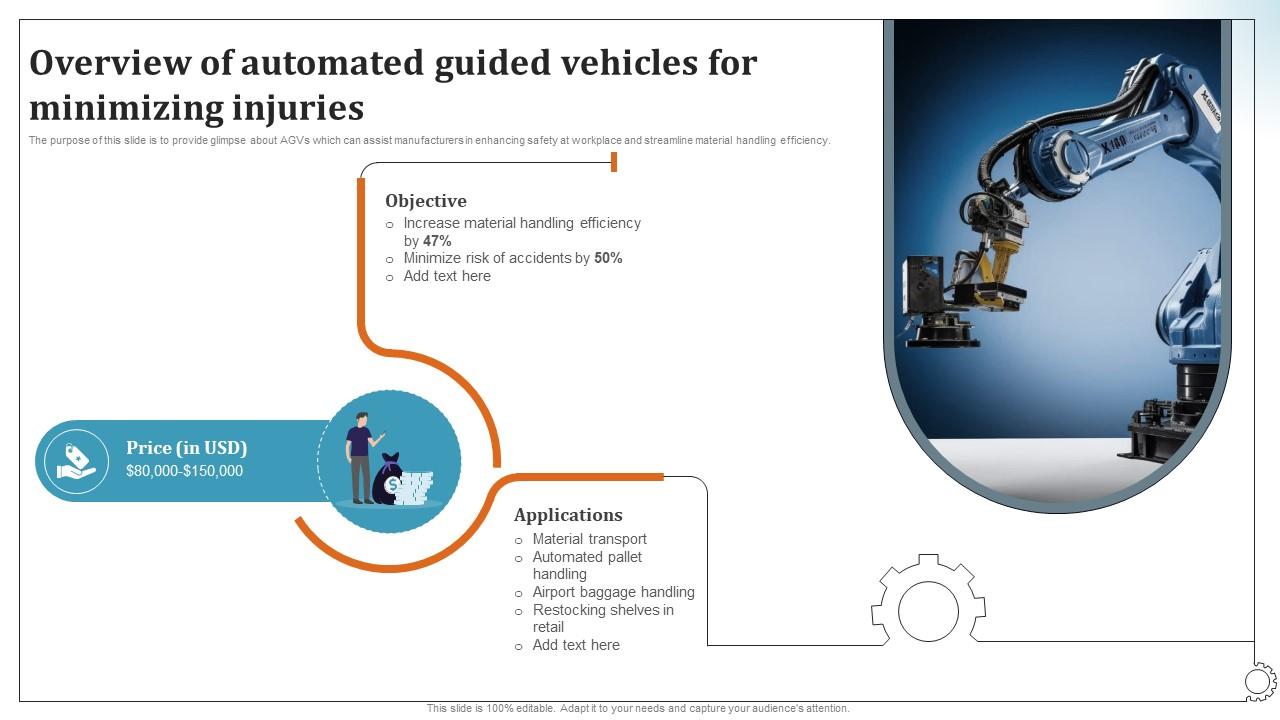
Template 2 - Overview of Automated Guided Vehicles for Minimizing Injuries Template
Several industries are changing as automated guided vehicles, or AGVs, provide a smooth way to reduce workplace accidents and improve operational effectiveness. These cutting-edge devices are essential to warehouse automation and contemporary material handling since they function without human drivers. Vehicles that are self-directed and robotically guided are examples of these systems. An overview of AGVs, which can assist manufacturers in increasing worker safety and accelerating the efficiency of material handling, was provided in this template. Automated guided vehicles are not merely an option; they are a necessary part of a contemporary, injury-free workplace at a time when efficiency and safety are intimately linked.
Template 3 - Essential Elements of AGV Robotic System Template
AGVs are essential to changing conventional methods in a world where efficiency and sustainability are becoming increasingly important. Their use in self-guiding transportation systems highlights their versatility across various sectors. Automating indoor transportation lessens reliance on physical labor and frees workers' time to concentrate on higher-value tasks. This template outlines elements of automated guided vehicles aimed at speeding up the movements of goods in a warehouse and production centre without operators. It covers navigation systems, safety, power, motion, and vehicles. The use of these autonomous cars will be essential in creating a more intelligent and flexible future as industries continue to change.

Template 4 - Challenges in Implementing RGVs Template
Thanks to their accuracy, effectiveness, and versatility, robotic-guided vehicles (RGVs) are transforming industries. However, implementing these wonders of contemporary technology presents challenges. RGVs, also known as autonomous mobile robots (AMRs) or driverless transport vehicles, are revolutionizing warehouse automation and material handling. Yet, their implementation necessitates carefully balancing infrastructure, technology, and human flexibility. As we approach a robotic revolution, RGVs are more than tools; they are signs of a more intelligent and effective future.

Template 5 - Technological Innovations in RGVs Template
RGVs stand for dedication to sustainability and innovation and their functional excellence. They support more environmentally friendly supply chain and logistics management techniques by cutting waste and improving energy use. At the core of this change is robotics, pushing the envelope to develop intelligent and intuitive systems. The potential of RGVs keeps expanding as we welcome this new era of automation, changing sectors, and establishing standards for innovation. Their contribution to the automation of warehouses and the revolution in material handling is only the beginning. RGVs are more than tools in a world dominated by robots and technology; they demonstrate what can be achieved when human creativity and state-of-the-art innovation come together.

Template 6 - Key Applications of AGV Robotic System Template
The development of the AGV robotic system, which offers unparalleled accuracy and efficiency in various applications, has revolutionized industries. These systems, which include Autonomous Mobile Robots (AMR), Self-Guided Vehicles, and Automated Transport Systems, are the foundation of contemporary industrial logistics and warehouse automation. These wonders are made to navigate environments independently, remove human mistakes, and offer smooth, reliable material handling solutions. This deck underlines the key applications of automated guided vehicle robots aimed at effectively carrying out logistic operations of stock distribution. It covers truck loading and unloading, product storage and retrieval, connection with the production center, and distribution for kitting. These clever solutions promise to be essential to solving tomorrow's problems today as companies continue to grow.

Template 7 - Command and Control Mechanisms Template
Modern automation systems are built on command and control mechanisms, allowing smooth operations in various industries. These systems are essential for coordinating intricate tasks, particularly in factories, warehouses, and distribution centers that significantly depend on autonomous vehicles. Command and control systems guarantee accuracy, effectiveness, and safety in daily operations, whether operating an automated transport system or coordinating a driverless transport vehicle. Command and control systems ensure everything goes according to plan, whether an autonomous guided transport system in a warehouse or a driverless vehicle in a factory. One effective operation at a time, these systems are revolutionizing entire industries.

Template 8 - Strategic Benefits of AGV for Warehouses Template
The introduction of Automated Guided Vehicles (AGVs) has completely changed how warehouses function and raised the bar for productivity and efficiency. These self-driving cars are an efficient way to handle materials and streamline operations, and they blend in perfectly with contemporary warehouse automation systems. AGVs improve safety by eliminating labor-intensive, traditional operations, reducing errors, and fostering a work environment where accuracy and dependability are critical. The following slide outlines the benefits of automated guided vehicles that perform tasks simply by reducing labor costs and eliminating damages. It covers reduced labor costs, increased safety, increased accuracy, and productivity with modularity. Purchasing AGVs is a calculated step toward a more inventive and compelling future, not merely an upgrade.

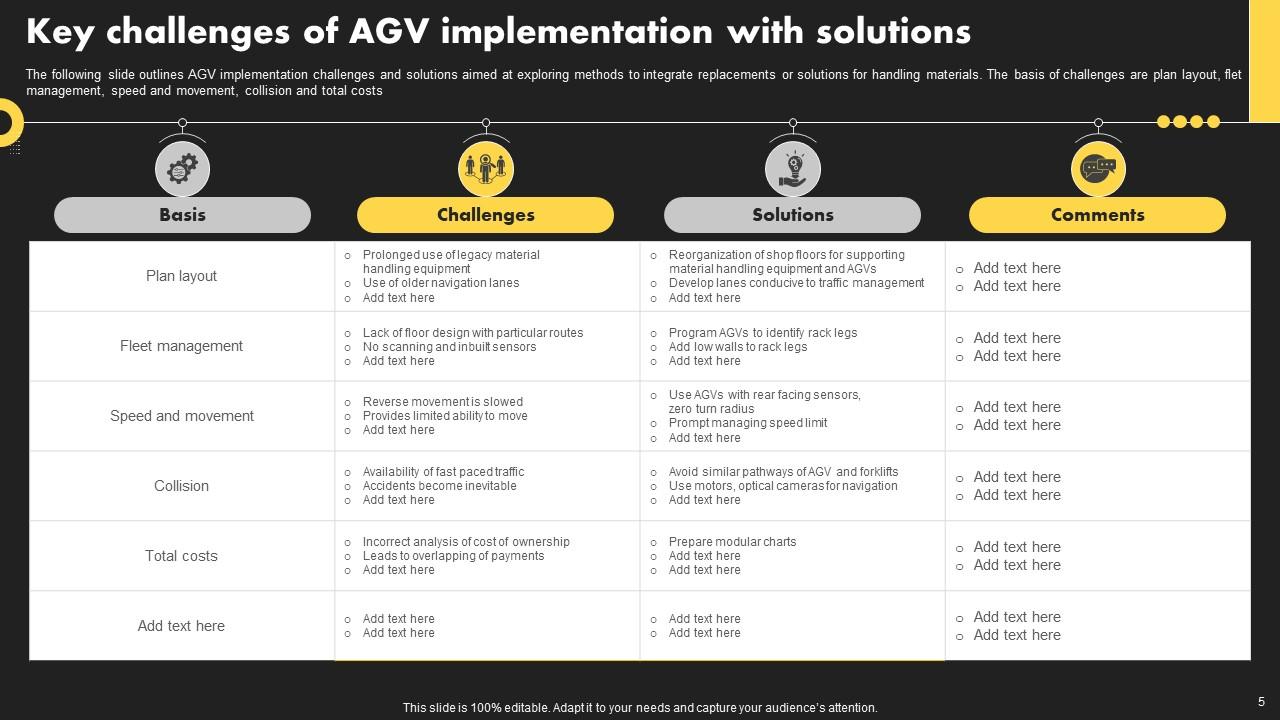
Template 9 - Key Challenges of AGV Implementation with Solutions Template
Automated guided vehicles (AGVs) have revolutionized industries by increasing productivity and simplifying processes. Adopting these cutting-edge technologies, such as autonomous mobile robots (AMRs) and self-guided vehicles, is not difficult. Leveraging the full potential of AGVs requires acknowledging these challenges and coming up with workable solutions. This deck outlines AGV implementation challenges and solutions aimed at exploring methods to integrate replacements or solutions for handling materials. The challenges are plan layout, fleet management, speed and movement, collision and total costs. Businesses may use autonomous cars to transform operations and maintain their competitive edge in an increasingly automated world with careful preparation.
Template 10 - Key Applications of AGV in Various Industries Template
Automated Guided Vehicles (AGVs) are transforming businesses by providing dependable and effective material handling and transportation solutions. These self-guiding vehicles are crucial to contemporary warehouse automation and logistics since sophisticated robotics, navigation systems, and laser guidance technology drive them. AGVs are autonomous mobile robots (AMRs) that move without human assistance, guaranteeing safer, quicker, and more seamless operations in settings like factories, warehouses, and distribution centers that demand high precision. The template talks about the applications of AGV in various industries aimed at jobs to be handled by conveyor systems, forklifts, and manual carts with repetitive movement of materials. It covers five industries with main applications. The opportunities for AGVs in various industries will only grow as companies adopt these breakthroughs, increasing productivity and changing industries as we know them.

Conclusion
Automated Guided Vehicles (AGVs) are transforming how companies transport materials and are essential to increasing safety and efficiency in several industries. These self-guided vehicles can independently navigate warehouses, factories, and distribution centers by combining sophisticated robotics, navigation systems, and AGV software. AGVs simplify moving components, finished goods, or raw materials by removing the need for manual labor and lowering the possibility of human error. Instead of merely replacing drivers, this move to automated systems aims to change how we think about warehouse automation and material handling. In conclusion, automated guided vehicles are revolutionizing industrial logistics and influencing robotic systems, material handling, and warehouse automation. AGVs are not simply a fad; they are a vital component of contemporary production and distribution operations because they increase productivity, safety, and cost-effectiveness. The full potential of AGVs will continue to be realized as industries adopt this technology, opening the door for more intelligent and effective operations worldwide.