


Self Service Technology Powerpoint Ppt Template Bundles




Try Before you Buy Download Free Sample Product
 Impress Your
 Audience
 100%
100% Editable
 Save Hours
 of Time


Our Self Service Technology Powerpoint Ppt Template Bundles are topically designed to provide an attractive backdrop to any subject. Use them to look like a presentation pro.
People who downloaded this PowerPoint presentation also viewed the following :
Self Service Technology Powerpoint Ppt Template Bundles with all 22 slides:
Use our Self Service Technology Powerpoint Ppt Template Bundles to effectively help you save your valuable time. They are readymade to fit into any presentation structure.













FAQs for Self Service Technology Powerpoint
Effective self-service technology includes intuitive user interfaces, robust knowledge bases, AI-powered chatbots, mobile accessibility, and seamless integration with existing systems. These components streamline customer interactions by reducing wait times, enabling 24/7 support availability, and automating routine inquiries, with many retail and financial services organizations finding significant cost reductions and enhanced customer satisfaction.
Self-service technology enhances customer experience by providing 24/7 accessibility, reducing wait times, and enabling personalized interactions across multiple touchpoints. Banks deploy ATMs and mobile banking, while retailers use self-checkout kiosks and hospitals implement patient portals, ultimately delivering faster service resolution and greater convenience, with many organizations finding that customers appreciate the control and efficiency these solutions provide.
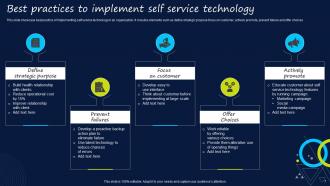
Organizations face implementation challenges including high upfront costs, complex system integration, user adoption resistance, ongoing maintenance requirements, and ensuring accessibility compliance. While these obstacles can seem daunting, many businesses find that strategic planning, phased rollouts, and comprehensive user training significantly minimize disruptions, ultimately delivering enhanced customer experiences and operational efficiency gains.
Self-service technology significantly enhances operational efficiency by automating routine transactions, reducing wait times, and minimizing human resource requirements across customer-facing processes. Banks implementing self-service kiosks, retailers using automated checkout systems, and hospitals deploying patient registration terminals consistently achieve 30-40% cost reductions while delivering faster services and improved customer experiences.
User interface design plays a critical role in self-service success by ensuring intuitive navigation, clear visual hierarchy, and accessible functionality across diverse user groups. Well-designed interfaces streamline customer interactions, reduce abandonment rates, and minimize support costs, with retail kiosks and banking ATMs demonstrating that intuitive design ultimately delivers higher adoption rates and enhanced customer satisfaction.
Companies measure self-service technology success through customer satisfaction scores, usage adoption rates, cost per transaction reductions, and resolution time improvements. These metrics enable organizations to track operational efficiency gains, customer experience enhancements, and resource optimization, with many financial services and retail companies finding that comprehensive analytics ultimately deliver measurable ROI and competitive advantage.
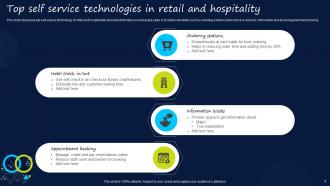
Successful retail self-service implementations include Walmart's self-checkout stations, McDonald's digital kiosks, Amazon Go's cashier-less stores, CVS's prescription pickup kiosks, and Home Depot's product locator systems. These technologies streamline operations by reducing wait times, minimizing labor costs, and enhancing customer convenience, with many retailers finding that self-service options ultimately deliver faster throughput and improved customer satisfaction.
Self-service technology integrates with existing systems through APIs, middleware platforms, cloud-based solutions, and enterprise service buses that enable seamless data exchange. Financial institutions and healthcare providers streamline operations by connecting self-service kiosks with CRM systems, payment processors, and databases, ultimately delivering enhanced customer experiences while reducing operational costs and improving service efficiency.
Self-service technology presents both security challenges and opportunities for customer data protection, including authentication vulnerabilities, data encryption requirements, privacy compliance considerations, and system access controls. While these systems require robust cybersecurity measures like multi-factor authentication and end-to-end encryption, many organizations find that properly implemented self-service platforms actually enhance data security through reduced human touchpoints and automated compliance monitoring.
Self-service technology empowers customers by providing 24/7 access to services, reducing wait times, and enabling instant problem resolution through automated platforms, mobile apps, and digital interfaces. These solutions streamline customer interactions across sectors like banking, retail, and healthcare, with many organizations finding that customers prefer controlling their service experience, ultimately delivering enhanced satisfaction and operational efficiency.
**INPUT**: What trends are shaping the future of self-service technology? **OUTPUT**: Future self-service technology trends include AI-powered conversational interfaces, voice-activated systems, biometric authentication, predictive analytics, and seamless omnichannel integration. These advancements streamline customer interactions by delivering personalized experiences, reducing wait times, and enabling 24/7 accessibility, with many retailers and financial institutions finding that intelligent self-service ultimately enhances satisfaction while significantly reducing operational costs. [Word count: 60 words]
Self-service kiosks improve accessibility by incorporating voice commands, adjustable screen heights, multilingual interfaces, tactile feedback systems, and high-contrast displays for visually impaired users. These technologies enable airports, government offices, and retail spaces to serve diverse populations more effectively, reducing wait times while ensuring equal access to services, ultimately delivering enhanced customer experiences and operational efficiency.
Effective customer adoption requires intuitive interface design, comprehensive tutorials, multi-channel support resources, and progressive onboarding experiences that gradually introduce features. Organizations achieve success through video guides, in-app assistance, FAQ sections, and live chat backup, with many retail and banking institutions finding that layered support approaches significantly reduce abandonment rates while enhancing user confidence and long-term engagement.
Cultural differences significantly affect self-service technology acceptance through varying comfort levels with automation, personal interaction preferences, and technology adoption rates across regions. While individualistic cultures like the US and Northern Europe readily embrace automated banking and retail systems, collectivistic societies often prefer human interaction, though younger demographics increasingly drive acceptance, ultimately creating opportunities for culturally adaptive implementations.
COVID-19 has accelerated innovations like contactless payment systems, voice-activated kiosks, mobile app integrations, AI-powered virtual assistants, and touchless check-in solutions across retail, hospitality, and healthcare sectors. These technologies streamline customer interactions while minimizing physical contact, with many organizations finding that contactless self-service delivers enhanced safety, reduced operational costs, and improved customer experiences in an increasingly health-conscious marketplace.
-
Crisp and neat slides. Makes it fun and easier to curate presentations.
-
You know what? I'm so glad I opted for this PPT design. It has been a total game-changer for me and my presentations. Thank you!