


Construction Technology Powerpoint Ppt Template Bundles




Try Before you Buy Download Free Sample Product
 Impress Your
 Audience
 100%
100% Editable
 Save Hours
 of Time


Our Construction Technology Powerpoint Ppt Template Bundles are topically designed to provide an attractive backdrop to any subject. Use them to look like a presentation pro.
People who downloaded this PowerPoint presentation also viewed the following :
Construction Technology Powerpoint Ppt Template Bundles with all 22 slides:
Use our Construction Technology Powerpoint Ppt Template Bundles to effectively help you save your valuable time. They are readymade to fit into any presentation structure.







FAQs for Construction Technology Powerpoint
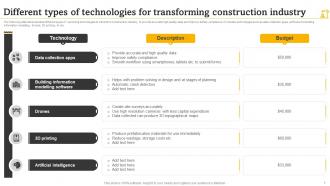
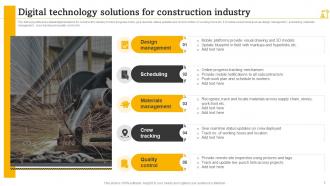
Latest construction innovations include Building Information Modeling (BIM), 3D printing, drones, robotics, and IoT sensors for real-time monitoring. These technologies streamline project management, enhance safety protocols, and minimize material waste, with many construction firms finding that automated systems deliver faster project completion, reduced labor costs, and improved quality control across large-scale developments.
Building Information Modeling (BIM) improves project collaboration by creating centralized digital models that architects, engineers, and contractors can access simultaneously, enabling real-time updates, clash detection, and coordinated planning. Through integrated workflows, construction teams streamline communication, reduce errors, and accelerate project timelines, with many firms finding that BIM ultimately delivers cost savings and enhanced project outcomes.
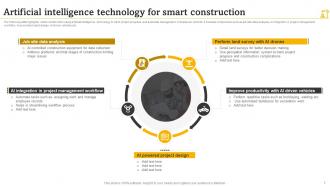
Artificial intelligence optimizes construction processes by automating project scheduling, predicting equipment maintenance needs, analyzing site safety risks, and enhancing resource allocation efficiency. Through machine learning algorithms, construction companies streamline workflow management, reduce material waste, and accelerate project timelines, while AI-powered analytics enable better decision-making, ultimately delivering cost savings and competitive advantage.
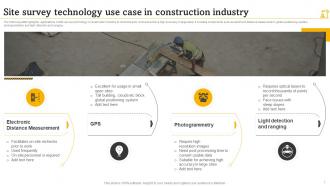
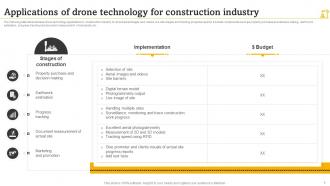
Drones revolutionize construction project management through real-time site monitoring, progress tracking, aerial surveying, safety inspections, and volumetric measurements. These technologies streamline operations by providing accurate topographical data, identifying potential hazards, and enabling remote project oversight, with many construction firms finding that drone integration reduces surveying costs while accelerating project timelines.
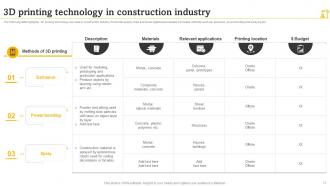
3D printing in construction delivers faster build times, reduced material waste, lower labor costs, enhanced design flexibility, and improved precision in complex geometries. Through automated concrete extrusion and robotic assembly, construction companies streamline project timelines, minimize resource consumption, and create intricate architectural features, with many finding that this technology significantly reduces overall project costs while enabling innovative structural designs.
IoT enhances building maintenance by enabling predictive maintenance through sensor monitoring, automated system adjustments, and real-time performance tracking across HVAC, lighting, and security systems. Through connected devices, facility managers streamline energy consumption, reduce operational costs, and minimize equipment downtime, while delivering improved occupant comfort and safety, ultimately providing significant competitive advantage in increasingly smart building environments.
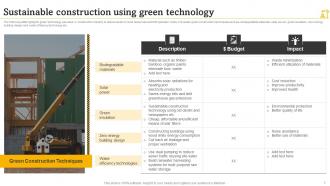
Sustainable construction technologies gaining traction include green building materials, energy-efficient HVAC systems, solar integration, water recycling systems, and smart building automation. These technologies streamline resource consumption while reducing environmental impact, with many construction firms finding that projects incorporating sustainable elements deliver lower operational costs, enhanced building performance, and significant competitive advantages in an increasingly eco-conscious market.
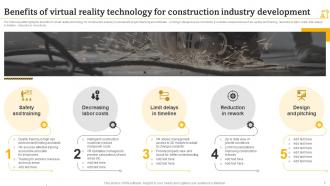
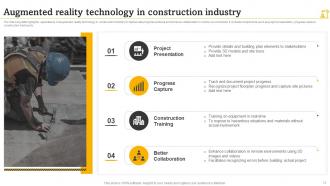
Augmented and virtual reality revolutionize construction safety training by creating immersive simulations of hazardous scenarios, enabling workers to practice emergency responses, and providing real-time safety guidance without physical risk. These technologies deliver enhanced learning retention, reduced accident rates, and standardized training protocols across construction companies, with many organizations finding that VR-trained workers demonstrate significantly better hazard recognition and safety compliance on actual job sites.
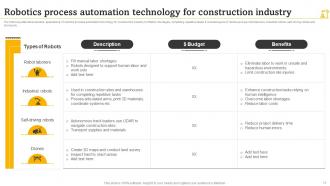
Construction automation and robotics significantly reduce labor costs by minimizing manual workforce requirements, accelerating project timelines, and enhancing operational efficiency through precision work. While initial technology investments present challenges, many construction firms find that automated systems ultimately deliver substantial cost savings, reduced overtime expenses, and improved safety compliance, creating competitive advantages in an increasingly cost-conscious industry.
Smart buildings utilize IoT sensors, AI-powered systems, automated HVAC controls, smart lighting solutions, and predictive analytics to optimize energy consumption. These technologies streamline operations by monitoring real-time usage patterns, automatically adjusting environmental controls, and identifying inefficiencies before they escalate, ultimately delivering significant cost reductions and enhanced sustainability performance.
Key challenges in adopting new construction technologies include workforce training requirements, initial investment costs, integration with existing systems, safety compliance concerns, and resistance to change from experienced workers. These obstacles can significantly impact project timelines and budgets, with many construction firms finding that phased implementation approaches, comprehensive training programs, and stakeholder buy-in ultimately deliver smoother transitions and competitive advantages.
Prefabrication and modular construction accelerate project timelines by enabling simultaneous on-site and off-site work, reducing weather delays, and streamlining quality control processes. Through factory-controlled environments, construction companies achieve faster assembly, minimize material waste, and deliver projects up to 50% quicker than traditional methods, while maintaining structural integrity and cost efficiency.
Big data analytics revolutionizes construction project planning by optimizing resource allocation, predicting potential delays, identifying cost overruns, and enhancing risk assessment through historical project data analysis. These insights enable construction firms to streamline scheduling, minimize material waste, and improve decision-making accuracy, with many organizations finding that data-driven planning delivers significantly faster project completion and enhanced profitability.
Blockchain technology streamlines construction contracts through smart contracts, transparent payment systems, automated milestone tracking, and immutable record-keeping for project documentation. These digital frameworks enhance trust between contractors, suppliers, and clients by enabling automatic payments upon completion verification, reducing disputes over project deliverables, and ultimately delivering faster transaction processing with significantly improved accountability across complex construction projects.
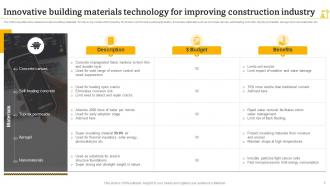
Using environmentally-friendly materials in modern construction presents both significant cost considerations and long-term competitive advantages, including reduced environmental impact, enhanced energy efficiency, improved indoor air quality, and stronger regulatory compliance. While initial investments can be higher, many construction firms find that sustainable materials ultimately deliver lower operational costs, faster project approvals, and increased property values in an increasingly eco-conscious market.
-
They had the topic I was looking for in a readymade presentation…helped me meet my deadline.
-
The best and engaging collection of PPTs I’ve seen so far. Great work!