

Waste water treatment process simplified advanced ppt ideas




Try Before you Buy Download Free Sample Product
 Impress Your
 Audience
 100%
100% Editable
 Save Hours
 of Time


Our Waste Water Treatment Process Simplified Advanced Ppt Ideas are topically designed to provide an attractive backdrop to any subject. Use them to look like a presentation pro.
People who downloaded this PowerPoint presentation also viewed the following :
Content of this Powerpoint Presentation
Description:
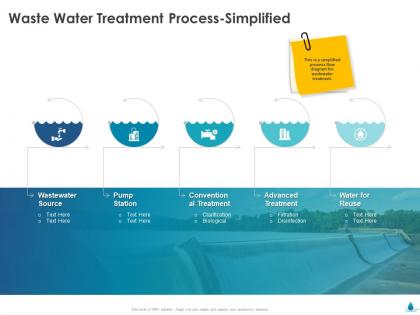
The image provides a simplified overview of the wastewater treatment process, delineating a sequence of steps visually represented and supplemented by brief descriptors. It commences with the ""Wastewater Source,"" where users can input additional information. Subsequently, the process moves to the ""Pump Station,"" indicating the necessity to transport wastewater from its source to the treatment facility. The ""Conventional Treatment"" stage incorporates options for clarification and biological treatment, suggesting the discussion of various methods within this phase. Following this is the ""Advanced Treatment,"" which pertains to additional processes like filtration and disinfection, potentially required for further purification. Finally, ""Water for Reuse"" symbolizes the end goal of this treatment cycle, once again with space for specific details to be included.
Use Cases:
Given the insights from the image, here are seven industries where this slide could be pertinent:
1. Environmental Services:
Use: Illustrating wastewater treatment processes.
Presenter: Environmental Engineer.
Audience: Policy Makers and Environmental Officials.
2. Municipal Government:
Use: Training for municipal wastewater facility operations.
Presenter: Director of Public Works.
Audience: Municipal Employees and Water Treatment Plant Operators.
3. Water Treatment Equipment Manufacturing:
Use: Demonstrating how their equipment integrates into the treatment process.
Presenter: Sales Representative.
Audience: Potential Clients and Investors.
4. Civil Engineering:
Use: Education on infrastructure design related to wastewater management.
Presenter: Civil Engineering Educator.
Audience: Engineering Students and Interns.
5. Public Health:
Use: Explaining the significance of water treatment for public health.
Presenter: Public Health Official.
Audience: Community Health Workers and Local Community Members.
6. Education:
Use: Teaching materials for environmental science courses.
Presenter: Educator/Professor.
Audience: Students in Ecology or Environmental Science Programs.
7. Non-Governmental Organizations (NGOs):
Use: Presenting environmental conservation and sanitation projects.
Presenter: Environmental Program Coordinator.
Audience: NGO Volunteers, Local Community Leaders, and International Donors.
Waste water treatment process simplified advanced ppt ideas with all 2 slides:
Use our Waste Water Treatment Process Simplified Advanced Ppt Ideas to effectively help you save your valuable time. They are readymade to fit into any presentation structure.
FAQs for Waste water treatment process simplified
The primary stages in wastewater treatment include preliminary screening, primary clarification, secondary biological treatment, tertiary filtration, and disinfection. These processes work by removing physical debris, settling suspended solids, breaking down organic matter through microbial action, and eliminating pathogens, with many municipalities finding that this comprehensive approach delivers cleaner water discharge and regulatory compliance.
Biological treatment uses microorganisms to naturally break down organic pollutants through bacterial processes, while chemical treatment relies on coagulation, precipitation, and disinfection agents to remove contaminants. Many municipalities find that biological methods like activated sludge systems offer lower operational costs and environmental sustainability, whereas chemical approaches deliver faster treatment cycles, with strategic combinations of both ultimately enhancing overall efficiency.
Microorganisms serve as biological catalysts in wastewater treatment, breaking down organic pollutants through aerobic and anaerobic processes, consuming nitrogen and phosphorus compounds, and converting harmful substances into harmless byproducts. These biological systems enable treatment facilities to achieve significant pollutant removal rates while reducing chemical costs, with many municipal and industrial plants finding that microbial processes deliver enhanced efficiency and environmental compliance.
Sedimentation removes suspended solids and particles from wastewater by allowing gravity to settle heavier materials to the bottom of treatment tanks, reducing turbidity and preparing water for subsequent filtration stages. This process significantly enhances treatment efficiency by removing 50-70% of suspended particles, ultimately streamlining operations and reducing costs for municipalities and industrial facilities.
Advanced oxidation processes enhance wastewater treatment efficiency by generating highly reactive hydroxyl radicals that break down complex organic pollutants, pharmaceuticals, and persistent contaminants that conventional methods cannot effectively remove. These technologies enable treatment facilities to achieve higher purification standards, reduce chemical usage, and minimize sludge production, with many municipal and industrial operations finding that AOPs deliver significantly improved water quality while streamlining compliance with increasingly stringent environmental regulations.
Nutrient removal technologies include biological nutrient removal (BNR), membrane bioreactors (MBRs), sequencing batch reactors (SBRs), moving bed biofilm reactors (MBBRs), and advanced oxidation processes. These systems enhance treatment efficiency by combining nitrogen and phosphorus removal, reducing chemical usage, and improving effluent quality, with many municipalities finding that strategic technology combinations deliver regulatory compliance while minimizing operational costs.
Treatment method selection significantly impacts environmental sustainability through energy consumption, chemical usage, resource recovery potential, and discharge quality standards. Advanced biological treatments and membrane technologies enhance water reuse capabilities while reducing carbon footprints, with many municipalities finding that integrated approaches deliver both regulatory compliance and long-term environmental stewardship.
Industrial wastewater treatment presents complex challenges including highly variable chemical compositions, toxic contaminants, extreme pH levels, heavy metals, and specialized pollutants requiring advanced treatment technologies. Unlike municipal wastewater's predictable organic content, industries like pharmaceuticals, petrochemicals, and manufacturing generate unique waste streams, with many facilities finding that customized treatment solutions and stricter regulatory compliance ultimately deliver enhanced environmental protection and operational sustainability.
Real-time monitoring enhances wastewater treatment operations by tracking water quality parameters, optimizing chemical dosing, and detecting system anomalies instantly. Through IoT sensors and automated controls, treatment facilities achieve consistent compliance standards, reduce operational costs, and minimize environmental risks, with many municipal plants finding that continuous monitoring ultimately delivers improved efficiency and regulatory confidence.
Untreated wastewater creates severe public health risks including waterborne diseases, contaminated drinking supplies, and ecosystem disruption through nutrient pollution, toxic chemical discharge, and habitat destruction. These consequences ultimately result in increased healthcare costs, reduced agricultural productivity, and diminished water quality for communities, with many municipalities finding that comprehensive treatment systems deliver both environmental protection and long-term economic benefits.
Sludge management involves thickening, stabilization, dewatering, and disposal through methods like anaerobic digestion, composting, and thermal treatment. Municipal facilities and industrial plants increasingly use advanced technologies like centrifuges, belt presses, and biogas recovery systems, ultimately reducing disposal costs, generating renewable energy, and meeting environmental regulations while enhancing operational efficiency.
Trending wastewater treatment innovations include membrane bioreactors, advanced oxidation processes, smart sensor networks, nutrient recovery systems, and AI-driven monitoring platforms. These technologies enhance efficiency by reducing energy consumption, improving water quality standards, and enabling real-time optimization, with municipalities and industrial facilities finding significant cost reductions and environmental compliance advantages.
Regulations and standards significantly influence wastewater treatment practices by establishing discharge limits, mandating specific treatment technologies, and requiring continuous monitoring protocols. These frameworks drive municipalities and industries to adopt advanced biological processes, chemical treatment systems, and real-time compliance tracking, ultimately ensuring environmental protection while encouraging innovation in treatment efficiency and cost-effectiveness across sectors.
Treated wastewater can be reused for agricultural irrigation, industrial cooling systems, groundwater recharge, toilet flushing, and landscape maintenance across municipalities and commercial facilities. These applications deliver significant cost savings by reducing freshwater demand, enhance environmental sustainability through resource conservation, and provide strategic water security advantages, with many water-stressed regions finding that wastewater recycling programs ultimately strengthen operational resilience.
Membrane technologies serve as critical filtration barriers in modern wastewater treatment, including microfiltration, ultrafiltration, nanofiltration, reverse osmosis, and membrane bioreactors. These systems enhance treatment efficiency by removing contaminants at molecular levels, reducing chemical usage, and enabling water reuse, with municipalities and industries finding that membrane integration delivers higher-quality effluent and operational cost savings.
-
Great designs, really helpful.
-
Good research work and creative work done on every template.