


Weekly Calendar For Scheduling Social Media Posts Guide To Boost Brand Awareness For Business Growth




Try Before you Buy Download Free Sample Product
 Impress Your
 Audience
 100%
100% Editable
 Save Hours
 of Time


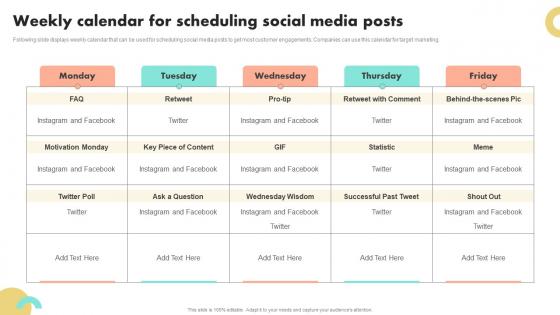
Following slide displays weekly calendar that can be used for scheduling social media posts to get most customer engagements. Companies can use this calendar for target marketing.
People who downloaded this PowerPoint presentation also viewed the following :
Weekly Calendar For Scheduling Social Media Posts Guide To Boost Brand Awareness For Business Growth with all 6 slides:
Use our Weekly Calendar For Scheduling Social Media Posts Guide To Boost Brand Awareness For Business Growth to effectively help you save your valuable time. They are readymade to fit into any presentation structure.





FAQs for Weekly Calendar For Scheduling Social Media Posts Guide To Boost Brand Awareness
Social media scheduling tools deliver consistent posting, improved audience engagement, significant time savings, enhanced content planning, and comprehensive analytics tracking across multiple platforms. These solutions streamline marketing workflows by automating posts, optimizing timing for maximum reach, and enabling strategic content calendars, with many businesses finding that scheduled approaches increase follower growth and reduce daily management overhead.
Scheduling posts improves engagement by enabling consistent posting during peak audience hours, maintaining regular content flow, and allowing strategic timing across different time zones. This approach helps businesses optimize posting frequency, plan cohesive campaigns, and engage audiences when they're most active, ultimately delivering higher reach, better interaction rates, and stronger brand presence.
Key features include content calendar visualization, multi-platform posting capabilities, analytics and performance tracking, team collaboration tools, and automated scheduling options. These functionalities streamline social media management by enabling consistent posting schedules, comprehensive performance insights, and seamless team coordination, with many marketing teams finding that integrated analytics ultimately deliver better engagement rates and more strategic content planning.
Social media scheduling significantly enhances brand consistency by enabling coordinated messaging, uniform visual aesthetics, strategic timing, and cohesive voice maintenance across all platforms. Through automated scheduling tools, organizations streamline content distribution, maintain regular posting frequencies, and ensure brand guidelines adherence, while reducing human error and enabling strategic campaign coordination, ultimately delivering stronger brand recognition and customer trust.
The best times for maximum reach typically include weekday mornings (8-10 AM), lunch hours (12-1 PM), and early evenings (5-7 PM), though optimal timing varies significantly by platform, audience demographics, and industry vertical. Strategic scheduling enables businesses to maximize engagement rates, improve content visibility, and reach target audiences when they're most active online, with many organizations finding that consistent posting during peak hours delivers enhanced brand awareness and stronger customer interactions.
Social media scheduling tools can analyze post performance through engagement metrics, reach analytics, audience insights, click-through rates, and conversion tracking. These platforms enable businesses to optimize content strategies by identifying peak engagement times, top-performing formats, and audience preferences, ultimately delivering improved ROI and streamlined social media management across multiple channels.
Automation enhances social media marketing strategy by streamlining content scheduling, optimizing posting times, and enabling consistent audience engagement across multiple platforms. Through automated analytics and response systems, businesses can deliver personalized customer interactions, reduce operational costs, and maintain 24/7 social presence, ultimately freeing marketing teams to focus on strategic creative development and relationship building.
Audience segmentation enables strategic scheduling by targeting different demographic groups, geographic locations, behavioral patterns, and engagement preferences with tailored content timing. Through segmented scheduling, brands deliver personalized messaging during peak activity windows for each audience segment, while optimizing reach and engagement rates, ultimately maximizing campaign effectiveness across diverse customer bases.
Businesses should adapt scheduling strategies by analyzing each platform's unique audience behaviors, optimal posting times, and content formats, with LinkedIn performing best during weekdays, Instagram favoring evenings and weekends, and Twitter requiring frequent daily updates. This strategic approach enables companies to maximize engagement rates, reach target demographics more effectively, and ultimately deliver higher conversion rates across their social media ecosystem.
Common pitfalls include over-automation without engagement monitoring, ignoring time zone considerations for global audiences, scheduling content without real-time relevance checks, and failing to maintain consistent brand voice across platforms. Many organizations find that successful scheduling requires balancing automated efficiency with human oversight, ultimately delivering consistent presence while avoiding tone-deaf posts during sensitive events or breaking news situations.
A content calendar enhances social media scheduling by providing strategic planning, consistent posting rhythms, and coordinated campaign management across multiple platforms. This systematic approach enables businesses to maintain brand consistency, optimize posting times for maximum engagement, and align social content with marketing objectives, while many organizations finding that structured scheduling delivers improved audience reach and measurable ROI.
Ethical considerations include maintaining authentic engagement, ensuring accurate content representation, respecting audience privacy, avoiding over-automation that diminishes human connection, and being transparent about automated responses. While automation streamlines social media management and enhances consistency, organizations must balance efficiency with genuine interaction, ensuring their automated content reflects brand values authentically and maintains meaningful connections with their communities.
Social media schedule planning integrates with overall marketing campaigns by aligning content calendars with product launches, seasonal promotions, and brand messaging timelines, ensuring consistent cross-channel communication. This strategic coordination enables marketing teams to amplify campaign reach through synchronized email, advertising, and social efforts, while maintaining unified brand voice and maximizing engagement across multiple touchpoints simultaneously.
Visual scheduling tools for social media planners include drag-and-drop calendars, timeline views, content preview capabilities, batch scheduling interfaces, and real-time collaboration dashboards. These platforms streamline content planning by enabling planners to visualize posting patterns, identify content gaps, and maintain consistent brand messaging across multiple channels, with many marketing teams finding that visual workflows reduce scheduling errors and enhance campaign coordination.
Social media scheduling enables small businesses to maximize their limited resources by automating posts, maintaining consistent online presence, and optimizing posting times for peak audience engagement. With scheduling tools, small businesses can batch-create content weekly, reduce daily management time by up to 75%, and maintain professional visibility across multiple platforms, ultimately competing more effectively with larger competitors while focusing core resources on business operations.
-
It's always a delight to see new templates from you! I am extremely pleased with the fact that they are easy to modify and fit any presentation layout in seconds!
-
The visual appeal of the templates is just unparalleled! I was so worried about the design of my presentation but SlideTeam made it all so easy.