


What Is Google Cloud Platform GCP Ppt Powerpoint Presentation Guide




Try Before you Buy Download Free Sample Product
 Impress Your
 Audience
 100%
100% Editable
 Save Hours
 of Time


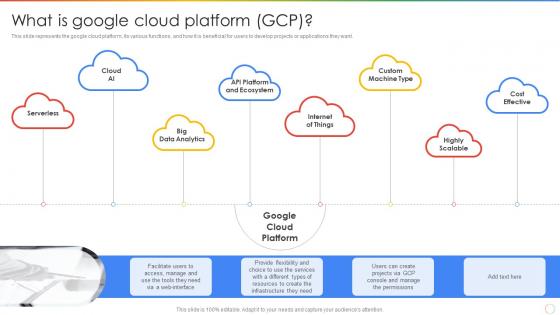
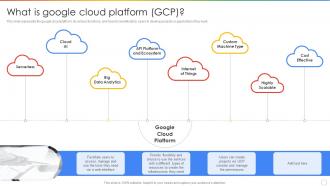
This slide represents the google cloud platform, its various functions, and how it is beneficial for users to develop projects or applications they want.
People who downloaded this PowerPoint presentation also viewed the following :
What Is Google Cloud Platform GCP Ppt Powerpoint Presentation Guide with all 6 slides:
Use our What Is Google Cloud Platform GCP Ppt Powerpoint Presentation Guide to effectively help you save your valuable time. They are readymade to fit into any presentation structure.





FAQs for What Is Google Cloud Platform GCP Ppt
Google Cloud Platform's primary services include Compute Engine for virtual machines, App Engine for application hosting, Cloud Storage for data management, BigQuery for analytics, and Kubernetes Engine for container orchestration. These services streamline operations by delivering scalable infrastructure, automated deployments, and advanced data processing capabilities, with many organizations finding that this strategic combination enhances operational efficiency while reducing costs.
Google Cloud ensures data security and compliance through advanced encryption protocols, multi-layered authentication systems, continuous threat monitoring, regular security audits, and comprehensive compliance certifications including SOC 2, ISO 27001, and GDPR. Through these integrated security measures, organizations across healthcare, financial services, and government sectors streamline their regulatory requirements while maintaining robust data protection, ultimately delivering enhanced operational security and competitive advantage.
Google Kubernetes Engine delivers automated container orchestration, seamless scaling, integrated monitoring, robust security features, and simplified cluster management through Google's managed infrastructure. Through GKE's autopilot mode and built-in CI/CD integration, organizations across retail, finance, and healthcare streamline application deployment, reduce operational overhead, and accelerate development cycles, ultimately enabling faster time-to-market and enhanced competitive positioning.
Google Cloud Storage serves as a foundational data management platform, offering object storage, data archiving, backup solutions, content distribution, and analytics integration capabilities. Through scalable infrastructure and automated lifecycle management, organizations across retail, healthcare, and financial services streamline data workflows, reduce storage costs, and enhance accessibility, ultimately enabling faster decision-making and improved operational efficiency.
Google BigQuery facilitates big data analytics by providing serverless, scalable processing capabilities that handle massive datasets without infrastructure management, enabling real-time querying and machine learning integration. Through its columnar storage and distributed architecture, organizations across retail, healthcare, and financial services achieve faster insights, reduced operational costs, and enhanced decision-making capabilities, ultimately delivering competitive advantages in data-driven markets.
Google Cloud Functions is a serverless compute service for event-driven, short-running functions, while Google App Engine provides a platform for full web applications with automatic scaling and managed infrastructure. Functions excel at microservices, API endpoints, and data processing tasks, whereas App Engine supports comprehensive applications with databases, user sessions, and complex routing, with many organizations finding that Functions reduce costs for simple tasks while App Engine streamlines full application deployment.
Organizations leverage Google Cloud AI through AutoML for custom model development, AI Platform for training and deployment, Vision API for image analysis, Natural Language API for text processing, and Translation API for multilingual capabilities. These tools streamline operations by automating customer service responses, enhancing fraud detection in financial services, and optimizing supply chain management, with many retail and healthcare organizations finding significantly improved operational efficiency and customer experiences.
Google Cloud cost optimization includes rightsizing resources, implementing auto-scaling, leveraging sustained use discounts, utilizing preemptible instances, and regularly monitoring usage patterns through billing analytics. These strategies streamline resource allocation by eliminating waste, automating capacity adjustments, and maximizing discount opportunities, with many organizations finding that strategic combinations of these practices deliver 20-40% cost reductions while maintaining performance.
Google Cloud supports multi-cloud strategies through Anthos for hybrid application management, BigQuery Omni for cross-cloud analytics, and extensive API integrations with AWS and Azure services. These technologies streamline workload portability, data interoperability, and unified monitoring across platforms, with many enterprises finding that this approach minimizes vendor lock-in while maximizing operational flexibility and competitive advantage.
Google Cloud integrates with popular development tools through native IDE plugins, CI/CD pipeline connections, container orchestration with Kubernetes, and comprehensive APIs for custom applications. These integrations streamline workflows by enabling seamless code deployment, automated testing, and real-time monitoring, with many development teams finding that integrated environments significantly accelerate project delivery and enhance collaborative efficiency.
Google Cloud Platform offers Virtual Private Cloud (VPC), Cloud VPN, Cloud Interconnect, Cloud Load Balancing, and Cloud CDN as primary networking options. These services streamline connectivity by providing secure private networks, hybrid cloud integration, and global traffic distribution, with many enterprises finding that strategic combinations deliver enhanced performance, reduced latency, and improved operational efficiency.
Google Cloud Platform enables businesses to scale applications through auto-scaling compute engines, load balancers, managed databases, and containerized services like Kubernetes. These technologies streamline resource allocation by automatically adjusting capacity based on demand, optimizing costs during low-traffic periods, and ensuring consistent performance during peak usage, with many organizations finding enhanced operational efficiency and reduced infrastructure management overhead.
Google Cloud's serverless architecture eliminates server management complexity while automatically scaling applications based on demand, reducing operational overhead and infrastructure costs. This approach enables developers to focus entirely on code development rather than infrastructure maintenance, with organizations across retail, financial services, and healthcare leveraging serverless solutions to accelerate deployment cycles, minimize resource waste, and deliver faster, more responsive customer experiences.
Google Cloud addresses disaster recovery through automated backup services, cross-regional replication, Cloud Storage Archive solutions, and integrated disaster recovery planning tools. These services enable organizations to maintain business continuity by automatically replicating critical data across multiple geographic regions, with many financial institutions and healthcare providers finding that Google's infrastructure delivers faster recovery times, reduced operational costs, and enhanced data protection compliance.
Google Cloud Identity serves as a centralized identity and access management service that controls user authentication, device management, and security policies across Google Cloud resources and applications. It enables organizations to streamline user provisioning, enforce multi-factor authentication, and manage access permissions through single sign-on capabilities, with many enterprises finding that centralized identity management significantly reduces administrative overhead while enhancing security compliance.
-
Informative design.
-
I am not the best at presentations but using SlideTeam’s PPT template made it easier for me. Thank you SlideTeam!