

Green Cloud Computing Powerpoint Presentation Slides




Try Before you Buy Download Free Sample Product
 Impress Your
 Audience
 100%
100% Editable
 Save Hours
 of Time


Check out our professionally designed Green Cloud Computing IT PowerPoint presentation, which briefly explains green cloud computing, including its importance, advantages, top providers, techniques, and green data centers. In this Eco-Friendly Computing PPT, we have covered the overview of green cloud computing, including its characteristics, objectives, and components. In addition, this Carbon Free Computing deck contains how green cloud computing can improve security and compares hazardous and state-of-art recycling technologies. Also, the Solar Computing Powerpoint includes the certifications and education in green cloud computing and techniques used to make the cloud green. Furthermore, this Sustainable IT template caters to green data centers and their types, primary components, metrics, and working of them. Moreover, this Green IT module comprises industrial efforts and restrictions of green computing, architecture, functioning of green computing, training, and budget. Lastly, this Green Computing presentation contains the impacts of green cloud computing on the environment, applications in different areas, and a case study. Download our 100 percent editable and customizable template, which is also compatible with Google Slides.
People who downloaded this PowerPoint presentation also viewed the following :
Content of this Powerpoint Presentation
Slide 1: The slide introduces Green Cloud Computing.
Slide 2: This is an Agenda slide. State your agendas here.
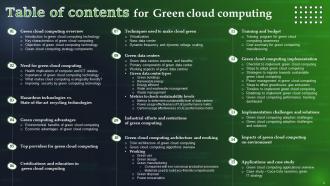
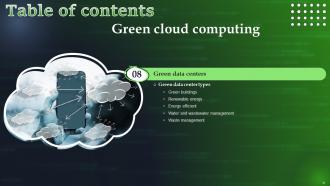
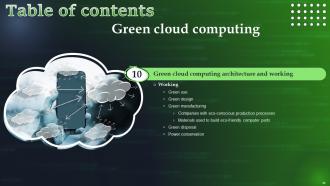
Slide 3: The slide displays Table of contents for presentation.
Slide 4: The slide continues table of contents.
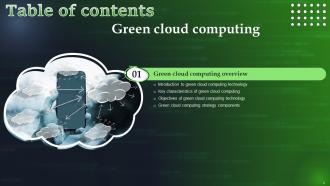
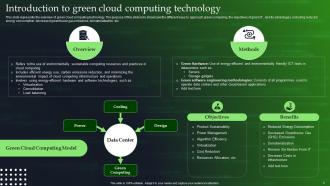
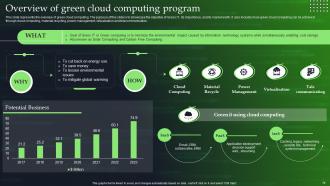
Slide 5: This slide presents the overview of green cloud computing technology.
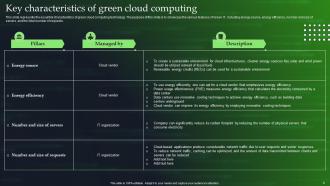
Slide 6: This slide represents the essential characteristics of green cloud computing technology.
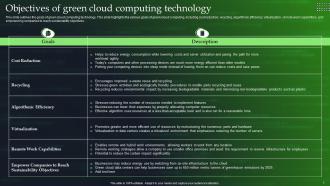
Slide 7: This slide outlines the goals of green cloud computing technology.
Slide 9: The slide highlights title of contents which is to be discussed further.
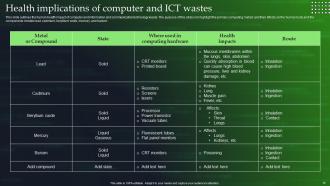
Slide 10: This slide exhibits the human health impact of computer and information and communication technology waste.
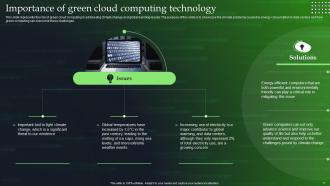
Slide 11: This slide represents the role of green cloud computing in addressing climate change and global warming issues.
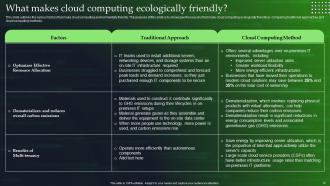
Slide 12: This slide describes various factors that make cloud computing environmentally friendly.
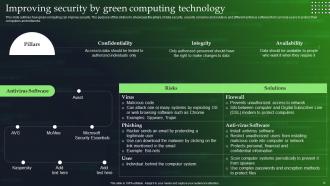
Slide 13: This slide outlines how green computing can improve security.
Slide 14: The slide depicts another title of contents.
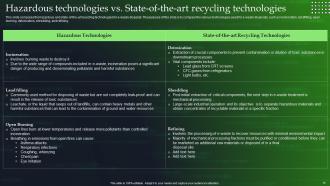
Slide 15: This slide compares the hazardous and state-of-the-art recycling technologies for e-waste disposal.
Slide 16: The slide also renders title of contents.
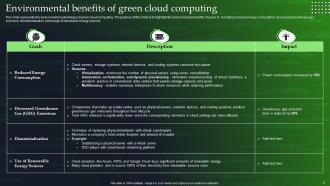
Slide 17: This slide represents the environmental advantages of green cloud computing.
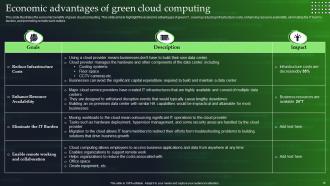
Slide 18: This slide illustrates the economic benefits of green cloud computing.
Slide 19: The slide again contains title of contents.
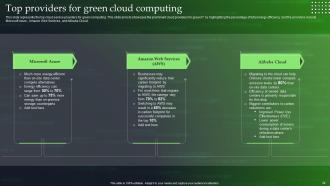
Slide 20: This slide presents the top cloud service providers for green computing.
Slide 21: The slide shows title of contents further.
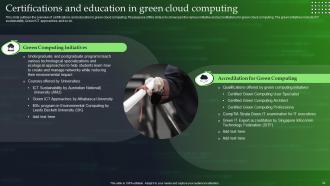
Slide 22: This slide outlines the overview of certifications and education in green cloud computing.
Slide 23: The slide showcases title of contents further.
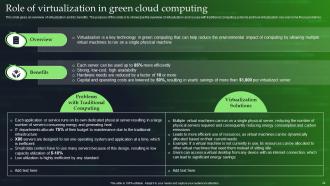
Slide 24: This slide gives an overview of virtualization and its benefits.
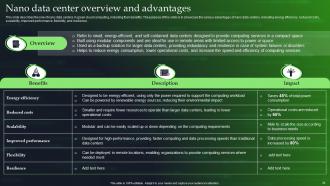
Slide 25: This slide describes the role of nano data centers in green cloud computing, including their benefits.
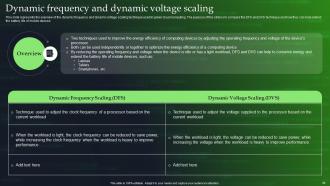
Slide 26: This slide represents the overview of the dynamic frequency and dynamic voltage scaling technique used in green cloud computing.
Slide 27: The slide demonstrates title of contents further.
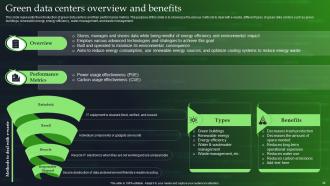
Slide 28: This slide represents the introduction of green data centers and their performance metrics.
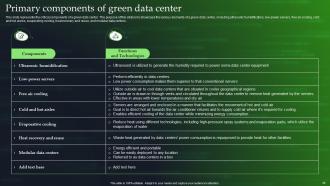
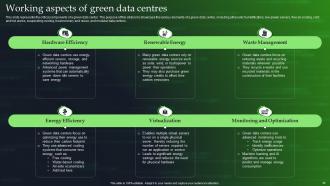
Slide 29: This slide represents the critical components of a green data center.
Slide 30: This slide continues the critical components of a green data center.
Slide 31: The slide renders another title of contents.
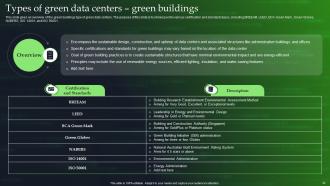
Slide 32: This slide gives an overview of the green buildings type of green data centers.
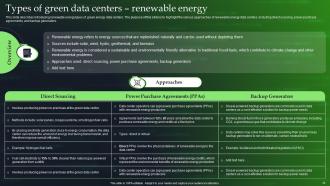
Slide 33: This slide describes introducing renewable energy types of green energy data centers.
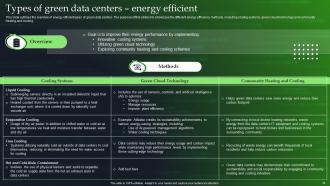
Slide 34: This slide outlines the overview of energy efficient types of green data centers.
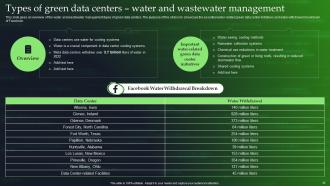
Slide 35: This slide gives an overview of the water and wastewater management types of green data centers.
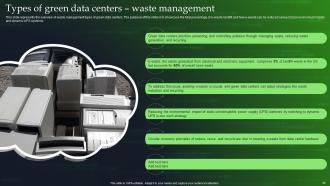
Slide 36: This slide represents the overview of waste management types of green data centers.
Slide 37: The slide again contains title of contents.
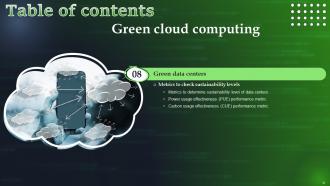
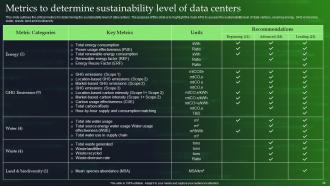
Slide 38: This slide outlines the critical metrics for determining the sustainability level of data centers.
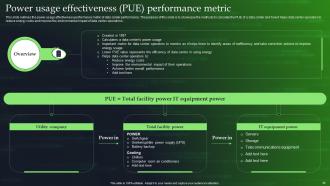
Slide 39: This slide displays the power usage effectiveness performance metric of data center performance.
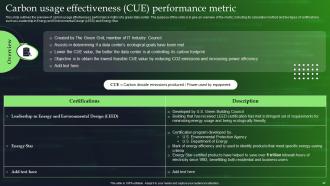
Slide 40: This slide highlights the overview of carbon usage effectiveness performance matric of a green data center.
Slide 41: The slide highlights another title of contents.
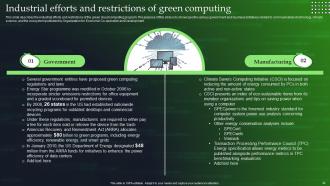
Slide 42: This slide describes the industrial efforts and restrictions of the green cloud computing program.
Slide 43: The slide displays title of contents which is to be discussed further.
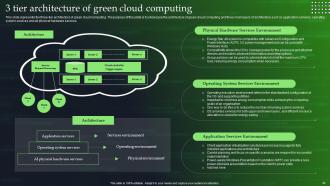
Slide 44: This slide represents the three-tier architecture of green cloud computing.
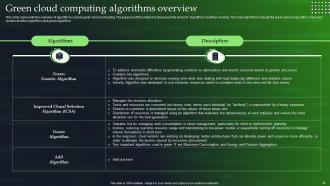
Slide 45: This slide presents the overview of algorithms used in green cloud computing.
Slide 46: Th slide again exhibits title of contents.
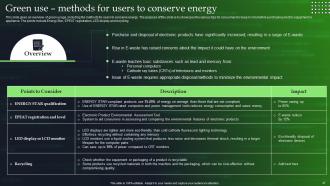
Slide 47: This slide gives an overview of green usage, including the methods for users to conserve energy.
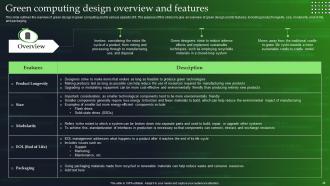
Slide 48: This slide outlines the overview of green design in green computing and its various aspects of it.
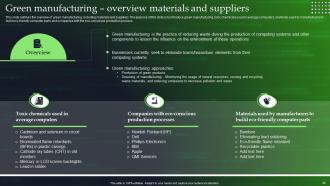
Slide 49: This slide depicts the overview of green manufacturing, including materials and suppliers.
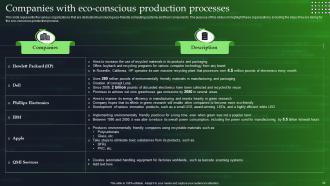
Slide 50: This slide represents the various organizations that are dedicated to producing eco-friendly computing systems and their components.
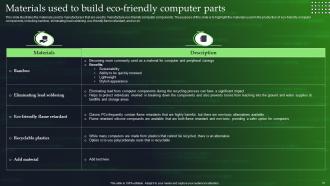
Slide 51: This slide illustrates the materials used by manufacturers that are used to manufacture eco-friendly computer components.
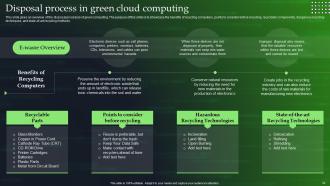
Slide 52: This slide gives an overview of the disposal procedure of green computing.
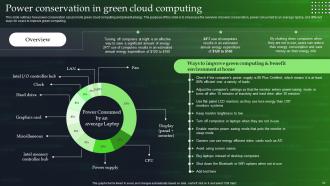
Slide 53: This slide outlines how power conservation can promote green cloud computing and prevent energy.
Slide 54: The slide illustartes title of contents further.
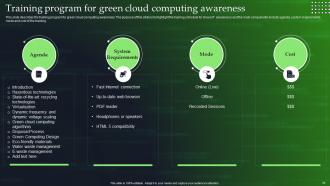
Slide 55: This slide describes the training program for green cloud computing awareness.
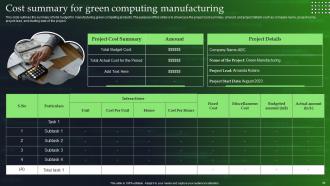
Slide 56: This slide outlines the summary of total budget for manufacturing green computing products.
Slide 57: The slide describes title of contents further.
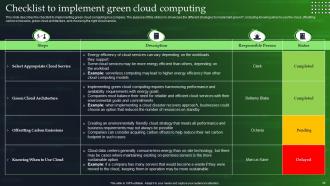
Slide 58: This slide illustrates the checklist to implementing green cloud computing in a company.
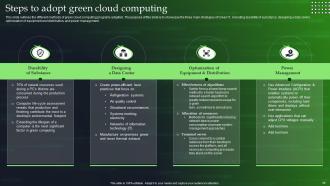
Slide 59: This slide outlines the different methods of green cloud computing programs adoption.
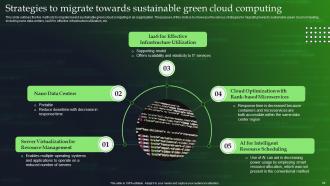
Slide 60: This slide shows the five methods to migrate toward sustainable green cloud computing in an organization.
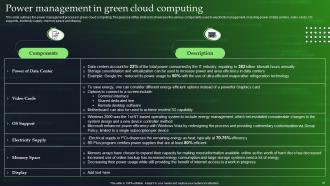
Slide 61: This slide displays the power management process in green cloud computing.
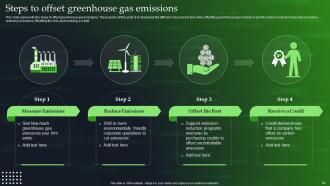
Slide 62: This slide represents the steps to offset greenhouse gas emissions.
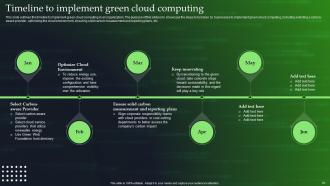
Slide 63: This slide outlines the timeline to implement green cloud computing in an organization.
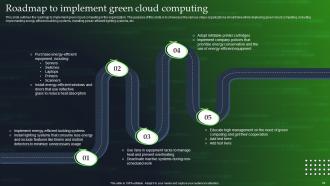
Slide 64: This slide renders the roadmap to implement green cloud computing in the organization.
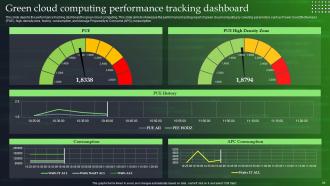
Slide 65: This slide describes the performance tracking dashboard for green cloud computing.
Slide 66: The slide depicts another title of contents.
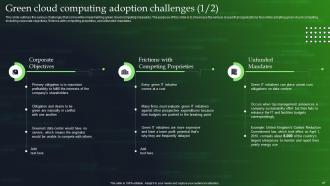
Slide 67: This slide outlines the various challenges that come while implementing green cloud computing measures.
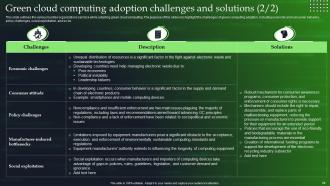
Slide 68: This slide shows the various hurdles organizations can face while adopting green cloud computing.
Slide 69: The slide exhibits another title of contents.
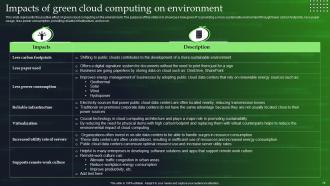
Slide 70: This slide represents the positive effect of green cloud computing on the environment.
Slide 71: The slide renders title of contents further.
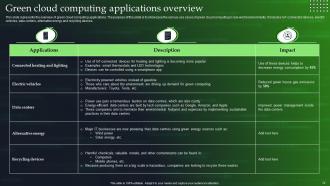
Slide 72: This slide presents the overview of green cloud computing applications.
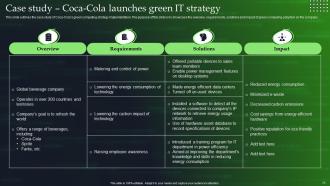
Slide 73: This slide outlines the case study of Coca-Cola’s green computing strategy implementation.
Slide 74: This slide shows all the icons included in the presentation.
Slide 75: This slide is titled as Additional Slides for moving forward.
Slide 76: This slide represents the overview of green cloud computing.
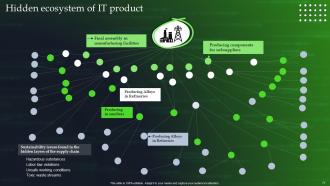
Slide 77: The slide describes Hidden ecosystem of IT product.
Slide 78: This is Our Mission slide with related imagery and text.
Slide 79: This is a Timeline slide. Show data related to time intervals here.
Slide 80: This slide showcases Magnifying Glass to highlight information, specifications etc.
Slide 81: This slide provides 30 60 90 Days Plan with text boxes.
Slide 82: This is Our Target slide. State your targets here.
Slide 83: This slide shows Post It Notes. Post your important notes here.
Slide 84: This slide depicts Venn diagram with text boxes.
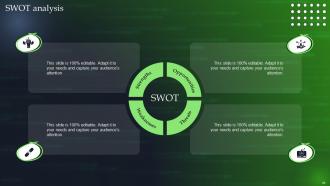
Slide 85: This slide shows SWOT describing- Strength, Weakness, Opportunity, and Threat.
Slide 86: This is a Thank You slide with address, contact numbers and email address.
Green Cloud Computing Powerpoint Presentation Slides with all 91 slides:
Use our Green Cloud Computing Powerpoint Presentation Slides to effectively help you save your valuable time. They are readymade to fit into any presentation structure.











FAQs for Green Cloud Computing
So green cloud computing is basically about making your infrastructure way less wasteful - you're focusing on energy efficiency, renewable power, and smarter resource use. Regular cloud just cares about performance and cost. This approach also factors in your carbon footprint, which honestly more companies should be doing. Think dynamic server provisioning, scheduling workloads based on carbon impact, data centers running on solar/wind - that kind of stuff. It's like choosing a hybrid over the cheapest gas guzzler you can find. Start by checking what you're currently using, then find providers who actually care about sustainability.
So energy efficiency is huge for cutting your cloud's environmental impact - less power means lower carbon emissions and less waste. Data centers that optimize their energy just perform better too. You can pick providers who actually care about efficient infrastructure, use serverless stuff that scales down when you're not using it, and optimize your apps to need less processing power. Honestly, most companies' sustainability reports are pretty telling about where they really stand. It's one of those things that helps the planet AND saves money, which is rare these days.
So basically, renewable energy is what makes cloud computing actually green instead of just marketing BS. Google, Amazon, Microsoft - they're all throwing money at solar and wind farms to power their data centers. These places eat up insane amounts of electricity, like seriously crazy numbers. But here's the cool part: when your stuff runs on their renewable-powered servers instead of coal plants, you're cutting your carbon footprint without doing anything extra. Oh, and definitely peek at a provider's green energy stats before signing up - some are way better than others. Easy sustainability win right there.
So basically, virtualization lets you cram way more stuff onto fewer servers instead of having tons of machines just sitting there barely doing anything. Like, why run 20 servers at 10% when you could run 3 at full capacity? Uses way less power for electricity and cooling, plus you're not constantly buying new hardware. Cloud providers can actually adjust resources on the fly based on what you need right now - pretty neat. When you're shopping around, definitely check which ones have high server utilization rates. Makes a huge difference for cutting emissions.
Look for PUE (Power Usage Effectiveness) first - anything under 1.5 is solid. Carbon footprint and energy per workload matter too. Water usage is huge since cooling eats up tons of it. Most providers publish this stuff now on sustainability dashboards. AWS, Google Cloud, Azure - they've all got tracking tools. Check what percentage of renewable energy they're using and the carbon intensity of their grid. Honestly, I'd just start with whatever your current provider offers for environmental reporting. Way easier than trying to calculate this yourself, trust me.
Honestly, going green is way easier than you'd think and won't hurt performance at all. Pick cloud providers using renewable energy - AWS, Google Cloud, and Azure are all pretty solid on this now. Auto-scaling is your friend here, plus right-sizing instances and actually shutting down those dev environments when nobody's using them. Most companies are massively over-provisioned anyway, so you'll probably save money too which is nice. Serverless is great since it's naturally more efficient. Oh, and try Cloud Carbon Footprint for monitoring - you'll be shocked at how much waste you can cut while things run better.
Honestly, you can cut IT costs by like 20-30% going green with cloud stuff. Energy efficiency is where the real money is - way less power for cooling and servers. Cloud providers just do it better at scale than we ever could in-house. Your CFO's gonna be thrilled when those utility bills drop. Hardware lasts longer too with green practices, so less replacement headaches. Oh and start by checking which workloads are the biggest energy hogs first - that's your low-hanging fruit right there.
So basically, green cloud computing means data centers are getting way smarter about energy use. They're running on renewable power, using better cooling systems, and packing more efficiency into their servers. The virtual sharing thing is actually pretty neat - instead of companies running their own power-hungry servers, multiple users share the same physical machines. Cloud providers can afford the expensive green tech that smaller companies can't justify buying themselves. Honestly, it's one of those rare win-wins where you can cut your carbon footprint and usually save money at the same time.
So there's some cool stuff happening right now - AI optimization for energy use, plus liquid cooling (which honestly looks insane when you see it up close). Edge computing's huge too since it cuts down data transmission. Microsoft and others are going hard on renewables, trying to hit carbon negative by 2030. Oh, and there's this thing called carbon-aware computing where workloads automatically jump to cleaner energy regions. Pretty smart actually. If you're thinking about this for your stuff, I'd probably start by checking your current cloud usage patterns first. Then look into auto-scaling to cut waste.
Honestly, regulations are what's really forcing companies to go green with their cloud stuff. The EU is super strict about carbon reporting and energy efficiency - they don't mess around. California's got these renewable energy targets that cloud providers have to meet too. But then you've got other places that barely care, which is kinda frustrating because it means your green strategy changes depending on where your data centers are. I'd definitely check out what regulations exist in whatever regions you're targeting before making any big moves. Trust me, figuring that out upfront beats dealing with compliance issues later when you're already committed.
Pick cloud providers that run on renewable energy - the big ones usually have decent carbon-neutral goals and you can actually check their progress reports. But here's the thing, even clean energy gets wasted if your code sucks. Rightsize your instances first, set up auto-scaling so you're not paying for servers doing nothing. Store stuff in regions with cleaner grids when possible. Most providers have carbon tracking dashboards now (finally!) so you can see your actual footprint instead of just guessing. Way easier than the overcomplicated frameworks some consultants try to sell you.
Set up cloud analytics dashboards - they'll track energy usage across all your resources in real-time. AWS, Google, Azure all have monitoring tools showing which services eat the most power. Honestly, it's wild what you'll discover. I bet you've got random instances running 24/7 that you totally forgot about (I always do). Scale things down during quiet hours and move workloads to greener regions when possible. The patterns become super obvious once you're watching. Just flip on basic monitoring this week and let it run for a few days - you'll see what I mean.
Honestly, start with renewable energy providers - they can help power your data centers way cleaner. Hardware vendors matter too, especially ones pushing energy-efficient gear. Carbon offset companies are solid partners if you're into that route. Don't sleep on sustainability consultants either. They know their stuff. Other companies in your space? Actually super helpful for swapping tips and splitting costs on green initiatives. Most cloud providers are already dumping money into eco-friendly infrastructure anyway, so that's kind of a no-brainer partnership. Figure out where you're bleeding the most energy first though.
Honestly, it's all about money - customers are putting sustainability requirements right in their RFPs now. Cloud providers can't ignore that without losing deals. Big companies have these net-zero pledges, so they need their cloud stuff to match. Providers are scrambling to buy renewable energy and make data centers more efficient. They're even building carbon tracking tools (which is actually pretty cool). The greenest option wins contracts these days. Oh, and if you're shopping around for providers, definitely grill them about their actual emissions data, not just vague promises.
So IoT devices are constantly sending usage data to cloud systems, which helps them optimize energy automatically. It's like having smart thermostats for entire data centers - they can predict what resources you'll actually need and scale accordingly. Pretty neat, right? This real-time feedback means cloud providers aren't wasting power on unused computing capacity. Honestly, I think more companies should be doing this. If you want to make your cloud strategy greener, IoT sensors are probably your best bet for tracking real usage patterns and cutting waste.
-
The slides come with appealing color schemes and relevant content that helped me deliver a stunning presentation without any hassle!
-
Happy to incorporate such stunning templates in my presentation. Made my presentation look professional and engaging.