


Work breakdown structure of business process modelling




Try Before you Buy Download Free Sample Product
 Impress Your
 Audience
 100%
100% Editable
 Save Hours
 of Time


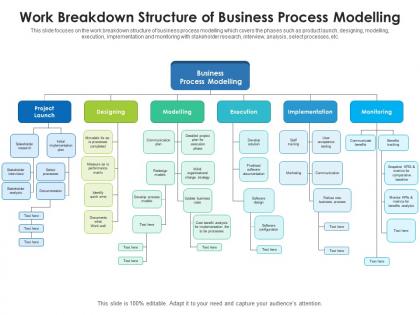
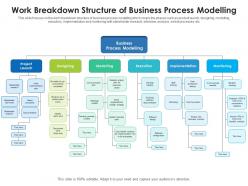
This slide focuses on the work breakdown structure of business process modelling which covers the phases such as product launch, designing, modelling, execution, implementation and monitoring with stakeholder research, interview, analysis, select processes, etc.
People who downloaded this PowerPoint presentation also viewed the following :
Work breakdown structure of business process modelling with all 2 slides:
Use our Work Breakdown Structure Of Business Process Modelling to effectively help you save your valuable time. They are readymade to fit into any presentation structure.
FAQs for Work breakdown structure of
A Work Breakdown Structure (WBS) is a hierarchical decomposition of project deliverables into manageable work packages, breaking complex projects into smaller, measurable components that teams can execute efficiently. This structured approach enables project managers to enhance resource allocation, streamline timeline planning, and improve cost estimation accuracy, with organizations across industries finding that WBS ultimately delivers better project visibility and control.
A well-defined WBS enhances team collaboration by establishing clear task ownership, shared understanding of project scope, and standardized communication protocols across all team members. This structured approach enables teams to identify dependencies more effectively, coordinate resources seamlessly, and maintain consistent progress tracking, with many project managers finding that comprehensive WBS frameworks reduce miscommunication and accelerate decision-making processes.
Key WBS components include work packages, deliverables, milestones, resource assignments, and hierarchical task decomposition that breaks complex projects into manageable elements. These components streamline project planning by enhancing visibility, enabling accurate cost estimation, and facilitating better resource allocation, with many organizations finding that structured WBS implementation ultimately delivers improved timeline adherence and project success rates.
A WBS can be tailored through industry-specific deliverable structures, customized work package definitions, and adapted hierarchical levels that reflect sector requirements. For example, construction projects emphasize phases like design and build-out, while software development focuses on coding and testing phases, with healthcare implementations prioritizing compliance and training components, ultimately enabling organizations to streamline project execution within their operational frameworks.
A WBS facilitates risk management by breaking complex projects into smaller, manageable components where potential risks become more visible and identifiable at granular levels. This structured decomposition enables project managers to systematically assess vulnerabilities across different work packages, implement targeted mitigation strategies, and allocate resources more effectively, ultimately delivering enhanced project control and reduced uncertainty.
Best practices for creating an effective WBS include defining clear project deliverables, breaking work into manageable components, ensuring each element is measurable and assignable, maintaining consistent decomposition levels, and aligning tasks with project objectives. These practices streamline project planning by enhancing resource allocation, improving timeline accuracy, and facilitating better team coordination, with many organizations finding that structured WBS approaches ultimately deliver improved project outcomes and stakeholder satisfaction.
Visual WBS representations include hierarchical charts, tree diagrams, indented outlines, mind maps, and tabular formats that break projects into manageable work packages. These visual tools streamline project communication by making complex scope immediately understandable to stakeholders, enabling better resource allocation and timeline planning, with many project managers finding that visual WBS formats significantly reduce scope creep and enhance team alignment.
A WBS serves as the foundational framework that feeds directly into Gantt charts and critical path analysis, providing the detailed task breakdown necessary for scheduling, resource allocation, and dependency mapping. Once the WBS defines all project deliverables and work packages, project managers use this structure to create Gantt chart timelines and identify critical paths, with many organizations finding that a comprehensive WBS significantly enhances the accuracy and effectiveness of these downstream planning tools.
Common WBS pitfalls include creating overly detailed breakdowns, mixing deliverables with activities, inconsistent decomposition levels, unclear ownership assignments, and failing to align with project objectives. These issues can be avoided by maintaining consistent decomposition criteria, focusing on deliverables rather than tasks, establishing clear accountability for each element, and regularly validating the WBS against project scope, with many project teams finding that collaborative reviews and stakeholder input significantly enhance WBS accuracy and usability.
Stakeholder involvement significantly enhances WBS development by providing diverse perspectives, identifying critical requirements, and ensuring comprehensive scope coverage across all project dimensions. Through collaborative input, project managers can capture overlooked deliverables, validate work packages, and secure stakeholder buy-in, ultimately delivering more accurate project planning and reduced scope creep throughout execution.
WBS enables accurate cost and resource estimation by breaking complex projects into manageable, measurable components that can be individually assessed and priced. This granular approach allows project managers to identify specific resource requirements, labor needs, and material costs for each work package, while accounting for dependencies and potential risks, ultimately delivering more precise budgets and realistic timelines that enhance project success rates.
Technology and software tools enhance WBS development through automated task decomposition, real-time collaboration features, and integrated project tracking capabilities. Project management platforms like Microsoft Project and Asana streamline work package creation, enable seamless team coordination across departments, and provide dynamic updating mechanisms, with many organizations finding that these digital solutions reduce planning time while improving accuracy and maintaining comprehensive project visibility throughout execution phases.
Ensuring WBS flexibility involves designing modular work packages, establishing clear change management protocols, and maintaining hierarchical structures that allow for easy additions or modifications without disrupting the entire framework. Through regular reviews and stakeholder input, project managers can adapt scope changes, resource reallocations, and timeline adjustments seamlessly, with many organizations finding that flexible WBS structures ultimately deliver better project outcomes and stakeholder satisfaction.
A deliverable-based WBS organizes work around specific tangible outcomes like software modules, reports, or product components, while a phase-based WBS structures activities around sequential project stages like planning, execution, and closure. These approaches serve different project types, with deliverable-based structures enhancing clarity for complex product development and phase-based frameworks streamlining process-oriented initiatives, ultimately delivering improved resource allocation and stakeholder communication.
A WBS supports project monitoring by creating detailed tracking points for progress measurement, resource allocation, and milestone achievement throughout execution. This structured framework enables project managers to identify bottlenecks, measure performance against baselines, and generate accurate status reports, with many organizations finding that granular work packages facilitate proactive issue resolution and stakeholder communication.
-
Designs have enough space to add content.
-
Unique and attractive product design.
-
Great quality product.
-
Content of slide is easy to understand and edit.