

Work life balance example powerpoint templates




Try Before you Buy Download Free Sample Product
 Impress Your
 Audience
 100%
100% Editable
 Save Hours
 of Time


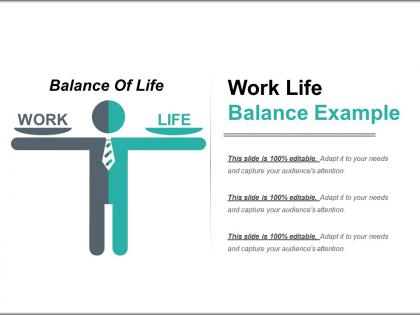
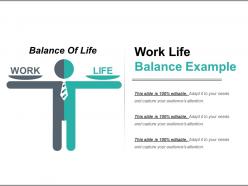
Avail this work life balance example PowerPoint templates presentation which has been crafted by our professional designers for the purpose of presenting and demonstrating the prominent factors which plays a vital role in a person's life and are required to be considered to maintain balance and stability to perform well and efficiently in both professional and personal life. The design of this professional life equilibrium illustration makes it unique and distinct being a compilation of all the essential ingredients which can be avail by all kinds of professionals and that too at all future times to come by reusing this slideshow whenever needed. In short it can be said that you can get rid of those vintage presentations styles and enhance the shine of your presentation skills and win appreciations by using this statistics of balanced career. Undoubtedly, the components and graphics of this job forces balance example PPT slide will provide you overall benefits including explaining your concept(s) to your viewers and audience more clearly and illustratively. Identify the exact formula with our Work Life Balance Example Powerpoint Templates. Create the equation that you desire.
People who downloaded this PowerPoint presentation also viewed the following :
Work life balance example powerpoint templates with all 5 slides:
There may be many who differ with you. Increase agreement with our Work Life Balance Example Powerpoint Templates.

FAQs for Work life balance
Honestly, start by tracking what you're actually doing for a week - not what you think you should be doing. Set real work hours and stick to them (this is harder than it sounds). Block out personal time like it's a meeting you can't cancel. Build in buffer time between stuff so you're not sprinting from one thing to the next constantly. Weekly check-ins help too - what's working, what's making you want to scream? The whole thing needs to bend when life gets messy, which it will. Don't make some fantasy schedule that perfect-you would follow. Make one that works for actual-you.
Honestly, visuals are a game-changer for this stuff. People just tune out when you're throwing bullet points at them about work-life balance. But show them a pie chart of how they're actually spending their day? Boom, instant lightbulb moment. I love using those balance scale graphics—super cheesy but they work. Before/after diagrams hit different too. Flowcharts help break down the messy strategies into steps people won't forget five minutes later. Icons work great for different life areas. Oh, and infographics—those are clutch for making complex concepts stick. Way better than watching people's eyes glaze over during another text-heavy presentation.
Track your overtime hours weekly and how often you actually leave on time. Sleep quality's huge - rate it daily along with stress levels (1-10 scale works). I'd also count family dinners and social stuff because that's usually the first thing to disappear when work gets crazy. Energy levels throughout the day tell you everything about whether this balance thing is actually working. Exercise frequency matters too. Honestly though, keep it to like 5 metrics max or you won't stick with it. Check your patterns weekly and adjust from there.
Honestly, you can't just slap the same policy on everyone and call it flexible. Different roles need different things - like your analysts might thrive working from home, but customer service probably needs consistent hours for coverage. I'd start by actually asking people what's driving them crazy and what would help. Then build role-specific stuff within your main framework. Maybe managers get protected focus time while shift workers can swap schedules easier. Oh, and definitely pilot this with a few departments first - you'll catch issues before they become company-wide disasters. Survey feedback is your friend here.
Honestly, most people bite off way more than they can chew right from the start. Like they'll set all these boundaries then feel terrible actually sticking to them. Or they make this amazing schedule that crumbles the second work gets crazy. Plus your phone doesn't help - you're basically on call 24/7 even during "downtime." And here's the thing nobody talks about: your workplace will fight you on this stuff no matter how much they preach about wellness programs. Just pick one small thing to change and stick with it. Way better than trying to flip your entire life overnight.
Honestly, just pick 2-3 apps that actually work together instead of downloading every productivity thing you see. Calendar blocking is huge - let it auto-schedule your focus time. I've been obsessing over automation lately, it's seriously changed everything for me. Time-tracking apps show you where hours disappear (spoiler: probably social media lol). Digital wellness reminders for breaks are clutch. Oh, and get notification management that kills work apps after hours - your sanity will thank you. Project management tools help batch similar tasks too. Start with your calendar though, then build from there.
Honestly? Culture trumps everything when it comes to work-life balance. You could have the most amazing policies written up, but if your boss is sending emails at 11pm or giving you weird looks when you duck out for your kid's soccer game, those policies are basically worthless. I've seen it happen so many times - companies talk a big game about flexibility but then people feel guilty actually using it. The real test is watching how leadership acts. Do they take vacations without checking email every five minutes? That's your answer right there. Templates are nice and all, but they won't fix a culture that expects you to be available 24/7.
Oh absolutely include stress stuff! That's like the whole point honestly. I'd throw in scheduled breaks, maybe some quick breathing exercises, and definitely track what's making you crazy - patterns are eye-opening. Buffer time between meetings is a game changer too. Weekly check-ins where you rate your stress levels work really well. Don't forget boundaries around late-night emails and texts. Actually, start small though - pick 2 or 3 things that don't make you roll your eyes. Otherwise you'll just stress about your stress management, which is... counterproductive lol.
Focus on stuff like flexible schedules, mental health days, and blocks of time without meetings. Some companies are doing four-day work weeks or mandatory vacation policies (which honestly sounds amazing). Right-to-disconnect policies work well too - basically people can't email you after hours. The trick is backing everything up with real numbers. Like if Company X cut burnout by 30% with flex Fridays, say that. Don't go overboard though. Pick maybe 3-4 things that actually make sense for whoever you're presenting to, and include the data to prove it works.
Honestly, you NEED to get your team's input on this stuff or it'll totally backfire. They know what's actually doable - like if flexible hours mess with client calls or if the wellness programs feel super fake. I swear, half the policies I've seen crash because management just made them up without asking anyone! Quick surveys work great, or just grab people for casual chats. Keep it anonymous so they'll be real with you. The key part? Actually use their suggestions. People stop caring if you ignore what they tell you anyway.
Check out Microsoft's Japan experiment - they tried a four-day work week and productivity jumped 40%. Pretty wild, right? Patagonia does on-site childcare plus flexible hours, which keeps people from jumping ship. Buffer went with transparent salaries and unlimited PTO for their remote folks. Salesforce has this V2MOM thing that helps employees balance work goals with personal stuff. Honestly, I'd grab maybe 2-3 examples that actually match your company's vibe and size. Then just break down what they did and how you can steal their best ideas for your templates.
Honestly, demographics make a huge difference here. Young employees want flexible schedules for their social lives, but parents need predictability for childcare pickup times. Women often handle more caregiving stuff (unfortunately still true), so factor that in. Cultural backgrounds matter too - some families are way more tight-knit than the typical American work-first mentality. Income's another big one since not everyone can afford the "luxury" of work-life balance options. I'd skip the one-size-fits-all approach completely. Survey your team first to see what they actually need, then build a few different template versions. Way more effective than guessing what works.
Honestly, start with your own team's data - employee surveys and time tracking will tell you way more than any fancy report. HR stuff like overtime hours and turnover rates are goldmines too. I always check Gallup or HBR for industry benchmarks, though sometimes those feel kinda disconnected from reality, you know? Exit interviews are clutch because people finally tell the truth when they're walking out the door. Manager observations help fill in gaps. Oh, and just send out a quick survey about energy levels during the week - sounds basic but you'd be surprised what comes up.
Honestly, those templates are game-changers for having tough convos about workload without things getting weird. You can actually tell your manager when you're swamped instead of just suffering in silence. They give managers a way to check on you that doesn't feel awkward or invasive either. Everyone ends up speaking the same language about what's realistic and what's not. I'd start with something simple - maybe a weekly check-in template? Trust me, it makes those conversations so much easier for everyone. Plus your manager won't have to guess if you're struggling.
Make a time-blocking section that shows exactly when work ends and your life starts. Set up communication windows too - I swear by no emails after 7pm because those random Slack messages at 9pm are the worst. Add space for shutdown rituals and weekend boundaries, plus emergency contact rules. Pre-write some scripts for saying no to extra stuff (trust me on this one). The whole point is making these boundaries super visible and non-negotiable. Oh, and don't try to implement everything at once - pick one boundary this week and go from there.
-
Colors used are bright and distinctive.
-
Editable templates with innovative design and color combination.