


Achieving business balance example of ppt




Try Before you Buy Download Free Sample Product
 Impress Your
 Audience
 100%
100% Editable
 Save Hours
 of Time


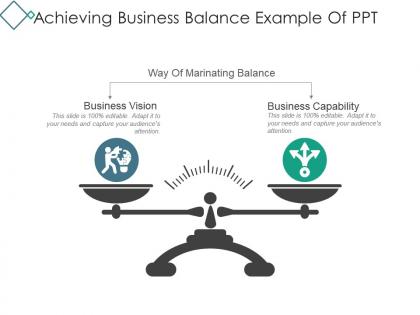
Bring balance to your company’s vision and its capability model with our achieving business balance PPT slide design. You can define the role and significance of business capability on the process of achieving the targets which are set on your business plan. Thus, it is important to maintain the balance in between your business functions with the expertise required to meet those set objectives. This BCM model PPT diagram will further helps your management to develop strategies which may provide better returns to your business. Use this business capability and vision maps PPT model to further explain the efficiency of your organization while defining the strengths of your employees. Define the various benefits of maintaining balance in your business model with this capability management PPT image. It helps in improving your business reputation and performance value. Hence, simply click on the download tab given below to start working over this expertly developed business modelling technique PowerPoint template. Our Achieving Business Balance Example Of Ppt are genuinely gilt edged. They give you a golden chance.
People who downloaded this PowerPoint presentation also viewed the following :
Achieving business balance example of ppt with all 5 slides:
Create a client friendly atmosphere with our Achieving Business Balance Example Of Ppt. They feel well disposed towards you.




FAQs for Achieving business balance
Key factors contributing to business balance include strategic resource allocation, effective time management, clear priority setting, stakeholder communication, and operational flexibility. These approaches streamline decision-making by aligning goals with available resources, managing competing demands, and maintaining adaptability, with many organizations finding that balanced operations ultimately deliver sustained growth and competitive advantage.
Companies can effectively measure growth-sustainability balance through integrated KPIs like carbon footprint per revenue dollar, employee retention rates, customer lifetime value, and resource efficiency metrics alongside traditional financial indicators. These comprehensive dashboards enable organizations to track environmental impact, social responsibility, and profitability simultaneously, with many finding that sustainable practices ultimately deliver competitive advantage and long-term resilience.
Employee well-being serves as a cornerstone of business balance by enhancing productivity, reducing turnover costs, and fostering innovation through engaged teams. Companies prioritizing wellness programs, flexible work arrangements, and mental health support find that healthier employees deliver superior performance, maintain better client relationships, and drive sustainable growth, ultimately creating competitive advantage in talent retention.
Organizations can assess and mitigate risks by implementing comprehensive risk frameworks, conducting regular audits, diversifying operations, maintaining contingency plans, and establishing clear governance protocols. Through strategic risk management, companies in sectors like banking and manufacturing enhance decision-making, protect assets, and maintain operational continuity, while pursuing growth objectives, ultimately delivering sustainable competitive advantage and stakeholder confidence.
Businesses can balance profitability with social responsibility through sustainable supply chains, employee wellness programs, community partnerships, environmental initiatives, and ethical governance practices. These strategies enhance brand reputation, attract conscious consumers, reduce operational costs, and improve employee retention, with many organizations finding that responsible practices ultimately drive long-term profitability and competitive advantage.
Leadership styles significantly influence organizational balance by shaping decision-making processes, resource allocation strategies, and cultural priorities within companies. Transformational leaders often emphasize innovation and employee development, while transactional leaders focus on operational efficiency and short-term results, with many organizations finding that adaptive leadership approaches enable better alignment between competing priorities and sustained competitive advantage.
Decision-making frameworks include SWOT analysis, cost-benefit analysis, stakeholder mapping, risk assessment matrices, and balanced scorecards. These tools enable managers to evaluate multiple perspectives systematically, weigh quantitative and qualitative factors objectively, and minimize bias, with organizations increasingly finding that structured approaches streamline complex decisions while enhancing strategic outcomes.
Companies can ensure innovation doesn't disrupt operational balance by implementing phased rollouts, maintaining robust change management protocols, and establishing clear communication channels across departments. Through strategic pilot programs and continuous feedback loops, organizations in manufacturing, healthcare, and financial services streamline innovation adoption while preserving core operations, ultimately delivering sustainable growth without operational instability.
Work-life balance significantly enhances organizational culture and productivity by reducing employee burnout, improving retention rates, increasing job satisfaction, and fostering stronger team collaboration. Companies prioritizing balance experience higher engagement levels, lower absenteeism, and improved innovation, with many organizations finding that flexible policies ultimately deliver competitive advantages through enhanced talent attraction and operational efficiency.
Businesses should balance short-term goals and long-term vision by aligning immediate objectives with strategic priorities, establishing clear performance metrics, and regularly reviewing resource allocation decisions. Through strategic planning frameworks, organizations can pursue quarterly targets while investing in innovation, talent development, and market expansion, ultimately delivering sustainable growth and competitive advantage in an increasingly dynamic business environment.
Diversifying revenue streams reduces financial risk, enhances stability during market fluctuations, creates multiple growth opportunities, improves cash flow predictability, and strengthens competitive positioning. This strategic approach enables organizations across retail, technology, and financial services to weather economic uncertainties while capturing new market segments, ultimately delivering sustained profitability and operational resilience.
Companies align mission and values with balanced business approaches by integrating stakeholder considerations, sustainable practices, and long-term strategic planning into daily operations and decision-making processes. Through comprehensive frameworks that prioritize employee well-being, customer satisfaction, and community impact alongside profitability, organizations increasingly find that this alignment enhances brand reputation, attracts top talent, and delivers sustained competitive advantage in today's purpose-driven marketplace.
Technology enhances business balance by automating routine tasks, enabling flexible work arrangements, and streamlining communication across teams and departments. However, it can also disrupt balance through constant connectivity demands and rapid change requirements, with many organizations finding that strategic technology adoption ultimately delivers improved operational efficiency and better work-life integration when implemented thoughtfully.
Cultural differences significantly shape business balance perceptions through varying work-life integration expectations, communication styles, decision-making processes, and relationship priorities across global markets. While Western markets often emphasize individual efficiency and structured boundaries, Asian and Latin American cultures frequently prioritize collective harmony and flexible scheduling, with many multinational organizations finding that adapting balance strategies to local cultural values ultimately delivers stronger employee engagement and market penetration.
Failed businesses often teach valuable lessons about operational balance, including the importance of diversifying revenue streams, managing cash flow effectively, balancing growth with sustainability, and maintaining strategic focus while adapting to market changes. These failures frequently stem from overexpansion, neglecting core operations, or failing to balance innovation with proven business fundamentals, ultimately highlighting how strategic equilibrium drives long-term competitive advantage.
-
Great product with effective design. Helped a lot in our corporate presentations. Easy to edit and stunning visuals.
-
Informative presentations that are easily editable.