

Work life balance template powerpoint slide show




Try Before you Buy Download Free Sample Product
 Impress Your
 Audience
 100%
100% Editable
 Save Hours
 of Time


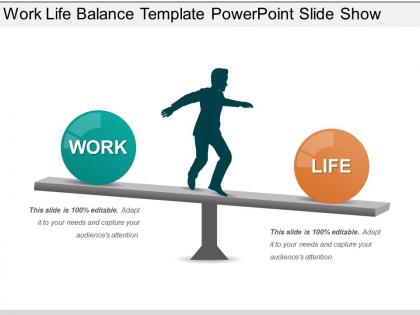
Work-life balance template PowerPoint slide show is a template that fits in all presentations related to contemporary issues in a working atmosphere. Professional and personal life balance PowerPoint template is a motivating slide design that can be used for presenting life oriented lectures on how to tackle the professional and personal problems. The visual of the equilibrium with work and life on two sides each depicts that an individual requires a balance between time allotted for labor and other facets of personal life. Encourage a healthy work-life balance PPT template covers all the social and psychological issues of an employee regarding the loss in work and efficacy. The presenters can use these tips and techniques for work-life balance PPT presentation model for representing the concept in an easy manner. Often such PPTs form an important part of motivational and inspirational messages by life coach experts. Human resource team of any company irrespective of the product type, make use of this equilibrium PPT to coach the employees about the intricacies of work-life balance. Advertise your feats on our Work Life Balance Template Powerpoint Slide Show. Attract enthusiasts for your events.
People who downloaded this PowerPoint presentation also viewed the following :
Work life balance template powerpoint slide show with all 5 slides:
Excellence is the anthem of your team. Our Work Life Balance Template Powerpoint Slide Show will affirm their commitment.
FAQs for Work life balance template
Honestly, it's all about boundaries - like actually sticking to work hours instead of just saying you will. Take real breaks during the day too. Find time for stuff that actually recharges you, whether that's family time, hobbies, or binge-watching Netflix (no shame). Learning to say no is huge - you don't have to say yes to every random request. Oh, and sleep matters more than people think. Maybe try delegating some stuff if you can? I'd start with just one boundary this week and see how it goes.
Look for companies that actually respect PTO - avoid places where people brag about never taking vacation days (huge red flag). Good employers offer flexible schedules, remote work, and mental health resources. Childcare help and wellness programs are bonuses too. The smart ones set boundaries on after-hours emails and make sure managers aren't working 24/7. Honestly, realistic workloads make all the difference. If your current job sucks at this stuff, try pushing for small wins first. Even getting flexible start times or mental health days can help.
Ugh, tech is such a blessing and curse for work stuff. You get amazing flexibility - working from coffee shops, quick remote fixes, controlling your own schedule. But then you're literally never off the clock. I'm so bad at this - checking Slack at like 10pm, answering emails on weekends. It's addictive honestly. You gotta be ruthless with boundaries though. Turn off those work notifications after hours. Use different devices if you can swing it. And seriously, fight that urge to respond to everything instantly - the world won't end if you wait till morning.
Honestly, you've gotta draw hard lines about when work stops. I turn off Slack at 6pm - used to be awful about checking emails during dinner but that had to stop. Physical stuff helps too: close the laptop, change out of work clothes, whatever signals you're done. Oh and definitely tell your team upfront when they can expect replies, otherwise they'll text you at midnight thinking it's normal. Pick one boundary this week and actually stick to it. That's really the only way it works - being consistent about it, not just trying when you feel like it.
Honestly, it's all over the place depending on your situation. Moms I know love it - no commute, can grab kids from school, way less stress. But then work bleeds into everything, which is kinda annoying. Younger people in tiny apartments? They go stir-crazy and end up working like 12-hour days. Older folks dig the flexibility but miss chatting by the coffee machine - makes sense. Your teammate might be thriving while you're losing your mind, so don't feel weird if remote work isn't clicking for you. It's really about what's going on in your life right now.
Honestly, you've gotta block out time that's completely off-limits - like for workouts or just zoning out. I'm terrible at this but learned after burning out twice (oops). Say no to random stuff people dump on you and actually use those vacation days. They're not just decorative! Try having hours where you don't touch email at all. Watch for warning signs too - when you're exhausted all the time or getting super cynical about everything. Pick one boundary to start with this week. Even small ones help. Your brain needs the break more than you think.
Honestly, work-life balance is a game changer for productivity and job satisfaction. Your brain just works better when you're not constantly fried - I've noticed this myself. Research backs it up too, showing like 20% better productivity rates. People make fewer dumb mistakes and actually come up with creative solutions when they've had time to recharge. The crazy thing is, employees who feel their personal time gets respected end up way more engaged during actual work hours. If you're managing anyone, pushing for real boundaries isn't just being nice. It's actually the smart move business-wise.
Oh man, you'll know when you're constantly drained even after weekends off. Like, sleep doesn't even help anymore. I used to check emails at dinner (so dumb) and felt weird guilt whenever I wasn't working. Your relationships start tanking because literally every conversation becomes about work drama. Sleep goes to shit too. Here's the weirdest part though - you'll actually perform WORSE at work despite grinding more hours. Your brain just taps out. Honestly? Start stupid small. Pick one boundary like no emails after 8pm and stick to it this week.
Honestly, good time management is like getting your life back. I block out chunks for specific tasks - game changer. Also learned to say no to pointless meetings (sorry not sorry). What really helps is treating personal time like actual appointments. Can't cancel on yourself, right? Used to be awful at this but now I'm way less stressed about work creeping into my evenings. Oh and the guilt about "doing nothing" basically disappears when you plan for it. Start small though - block one hour tomorrow for whatever you want and don't budge on it.
So this stuff varies wildly depending where you are. Denmark and Germany? They're hardcore about work boundaries - like, don't even think about emailing after hours. Japan and South Korea are the complete opposite though, where staying late shows you're committed. Latin American cultures put family first, which honestly makes way more sense to me. It's pretty wild how different expectations can be! When you're dealing with international teammates, just knowing these differences helps you figure out how to communicate without accidentally stepping on toes or looking lazy.
Look, you've gotta walk the walk here. Block off personal time on your calendar like it's a real meeting - because honestly, it should be that sacred. Stop sending those late-night emails (your team notices everything). Actually take your vacation days instead of just talking about work-life balance. When someone works all weekend, don't praise them for it. That just sends the wrong message. Focus on what they accomplished, not how many hours they burned. Short breaks during the day? Totally fine to mention those too. Your team will only feel comfortable setting boundaries if they see you doing it first. It's pretty simple but requires actual commitment on your part.
Honestly, your family stage changes everything about work-life balance. Single? You can probably handle longer hours and focus on climbing the career ladder. But once you have little kids, daycare pickup becomes non-negotiable - trust me on that one. Empty nesters often dive back into hobbies they forgot about or even work more again. Then there's caring for aging parents, which throws a completely different wrench into things. Your approach will definitely shift over time, so don't box yourself into some perfect system that'll never change.
Honestly, there's tons of ways to figure this out! Start with those free questionnaires on HR websites - they ask about stress and how you spend your time. RescueTime is pretty good for tracking screen time, though sometimes the results are... brutal lol. The Work-Life Balance Wheel thing works too - you just rate different parts of your life. I've heard people get good insights from simple time-tracking apps or even keeping a basic journal. Just pick something and stick with it for at least a week. You can't really change anything without knowing where you actually stand first.
So mindfulness basically trains your brain to stop ping-ponging between work and home stuff. Like, you won't be sitting at dinner obsessing over tomorrow's presentation or checking emails during your supposed "relaxation time." It keeps you actually present instead of mentally somewhere else - which honestly took me forever to get the hang of. The breathing thing really works though. Just 5 minutes of focused breathing when you're transitioning from work to home acts like hitting a reset button. Plus it cuts down on that constant low-level anxiety that makes everything feel super urgent.
Honestly, work-life balance pays off big time in the long run. You'll burn out way less and actually perform better - weird how that works, right? Companies benefit too since they keep employees longer and deal with fewer sick days. Nobody's doing great work when they're running on fumes 24/7. These days, good work-life policies help businesses attract talent because people actively hunt for that stuff. My advice? Set firm boundaries around your work hours and don't budge on them, even when things get crazy.
-
Best way of representation of the topic.
-
Easy to edit slides with easy to understand instructions.