

Work life balance objectives powerpoint shapes




Try Before you Buy Download Free Sample Product
 Impress Your
 Audience
 100%
100% Editable
 Save Hours
 of Time


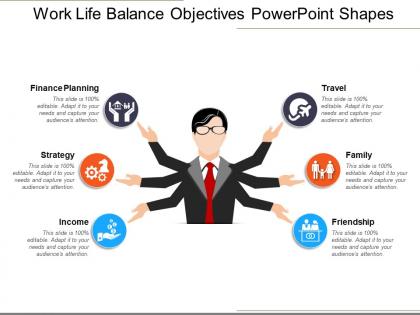
Access our work life balance objectives PowerPoint shapes to make effective communication about work management in today’s time. Employee worklife balance is a key aspect in the corporate that helps to achieve better productivity, a healthy blend of employee’s worklife and personal life. This presentation template helps to share details about facets that encourage business professionals to give their best without taking stress of the final result. Our designing experts have created this PPT slide with some aspects that every corporate should pay attention towards which are travel, family, friendship, income, strategy and finance planning. To get the best out of employees, it is important to give them the freedom to share their thoughts and show their creative skills. Corporate leaders can use this PowerPoint graphic to understand this valuable aspect which will ultimately help the organization to grow. The presentation visual created with icons that can convey the message effectively. So, what are you waiting for, just download this amazing design and let it make an impact on your audience. Attrition comes down with the help of our Work Life Balance Objectives Powerpoint Shapes. Give your employees cause to be faithful.
People who downloaded this PowerPoint presentation also viewed the following :
Work life balance objectives powerpoint shapes with all 5 slides:
Enable common folk to figure out the idea with our Work Life Balance Objectives Powerpoint Shapes. It helps decode the jargon.


FAQs for Work life balance
Flexible schedules are a game-changer - remote work, different hours, whatever works. But honestly, the midnight email thing drives me nuts. Managers need to chill with that stuff. Mental health resources help too, plus PTO that people won't feel guilty about using. Oh, and normalizing actual breaks during the day instead of treating them like you're being lazy. Leadership has to walk the walk though. If your boss is pinging everyone at 2am, good luck getting anyone to disconnect. It's really about creating a culture where work-life balance isn't just corporate buzzword nonsense.
Honestly, the biggest thing is boundaries get super messy with remote work. You'll find yourself answering emails at like 10pm because your laptop's just sitting there. Office work? You leave, you're done - though good luck sneaking out for a dentist appointment lol. Remote does let you throw in laundry between meetings or pick up your kid, which is pretty nice. But man, without that physical separation, work just bleeds everywhere. I've learned you gotta be really deliberate about shutting down, no matter where you're working. Otherwise you'll burn out either way.
Ugh, tech is such a mixed bag for work-life balance. Sure, you can work from your couch or duck out early for your kid's soccer game and finish stuff later. That flexibility is pretty sweet. But then you're constantly getting pinged with emails and Slack messages at like 9 PM on a Sunday. It's brutal. I've learned you gotta be ruthless about boundaries - turn off those notifications after work hours and maybe use different browsers or apps for personal vs work stuff. Trust me, your sanity depends on actually having real downtime where nobody can reach you.
You've gotta lead by example first - no midnight emails from you, and don't expect instant replies unless something's actually on fire. Be super clear about what "urgent" really means (spoiler: most stuff isn't). I'd honestly celebrate when team members push back on pointless late meetings or log off at reasonable hours. Regular workload check-ins help you catch burnout early too. The weird thing is, giving people explicit permission to set boundaries actually makes them more productive. Just make sure you're not secretly judging them for using those boundaries - people can smell that BS from miles away.
Honestly, good work-life balance makes you way more productive and happier at your job. When you're not completely burned out, you actually get stuff done faster. Makes sense, right? Nobody performs well when they're exhausted and pissed off all the time. Research backs this up too - people with better boundaries call in sick less, stick around longer, and come up with better solutions. I learned this the hard way last year. Setting limits and actually following through is crucial. Your brain needs downtime to recharge, otherwise you're just spinning your wheels.
Ugh, bad work-life balance is honestly brutal on your mental health. You'll get hit with chronic stress, anxiety, and burnout - the whole package. Sleep goes to hell, which makes everything ten times worse because your brain never gets to reset. Concentrating becomes impossible, and you're constantly irritable and overwhelmed. Depression creeps in too when you can't ever truly disconnect. Your self-esteem tanks along with job satisfaction. The worst part? It doesn't stay at work - it bleeds into your relationships and messes with your physical health too. Worth addressing before it spirals.
Okay so first thing - don't just complain about being stressed (I totally did this and it went nowhere lol). Instead, frame it around how better balance would actually make you MORE productive at work. Like maybe flexible hours would help you focus better, or taking real breaks prevents you from burning out completely. Timing is huge too - bring it up during your one-on-one or performance review when they're actually listening. And honestly? Don't just dump problems on them. Come with actual solutions ready. They'll take you way more seriously if you've thought it through.
Ugh, workplace culture is everything when it comes to work-life balance. If your company's always sending after-hours emails or praising weekend warriors, good luck trying to disconnect. You'll feel guilty just for leaving on time. But when leadership actually respects boundaries? Game changer. I've seen the difference between places that just pay lip service to balance versus ones that really mean it. Honestly, the best indicator is whether managers text you at 9pm or if people actually use their vacation days without drama.
Oh man, finance and consulting are absolutely the worst for this - they literally celebrate the "always on" thing. Healthcare and law aren't much better honestly. Startups in tech? Total nightmare with all that hustle culture BS, though weirdly some of the bigger tech companies are actually improving. The problem is these places tie your paycheck and promotions directly to how many hours you're grinding. You'll have to be really picky about which companies you target. Don't just believe their website fluff about work-life balance - dig deeper and find places that actually mean it.
Okay so time blocking is basically scheduling everything - your deep work, meetings, even gym time gets the same priority as client calls. I thought it'd be too restrictive at first, but it's actually freeing? Like, when you know work officially ends at 6, you can actually chill without wondering if you forgot something. Don't skip the buffer time between stuff - even 15 minutes helps you switch gears. Oh, and start small. Just block your biggest work task and one personal thing. You'll get the hang of it. Trust me, it beats constantly reacting to whatever's screaming for attention.
Honestly, you've got to plan way ahead and actually disconnect. Book something longer than just random days off - your brain needs time to shift out of work mode. Set up a proper out-of-office that doesn't say you'll "respond when possible" because that's just sabotaging yourself. When you're off, stay off. I know it's tempting but don't check Slack or emails at all. That's literally the whole point of vacation. Try blocking out a full week in the next couple months and commit to being completely offline. Trust me, everything will survive without you for a few days.
Honestly, work-life balance is kinda BS unless you actually know what matters to you first. Like, what are your actual non-negotiables? Family dinners? Your workout? (Coffee doesn't count but whatever.) Write down your top 3 things, then see where work keeps bulldozing over them. That's where you need boundaries. Instead of just letting your job eat everything, be intentional about protecting those priorities. It's not rocket science, but most people skip the whole "figure out what you care about" part and wonder why they're miserable. Start there.
Honestly, knowing when you're stressed or burning out is huge for work-life balance. Like, you can actually catch it before you're completely fried. Setting boundaries becomes way easier too - you get *why* you need them instead of just going through the motions. Teams that actually talk about mental health? They just seem to have their shit together more, balance-wise. People speak up about crazy deadlines instead of drowning silently. I'd start simple - just check in with yourself daily. "How am I feeling and what do I actually need right now?" Sounds basic but it works. Oh, and workplaces that normalize these conversations make everything less awful.
Flexible work is seriously life-changing when you're a parent. Being able to work from home when your kid's sick? Total lifesaver. You can shift your hours for school pickup or squeeze in that work call while making dinner. Instead of being stuck with the whole 9-5 office thing, you actually get some control over your schedule. Honestly, it cuts down on that awful feeling where you're constantly dropping the ball at work AND home. I'd start small though - maybe ask your manager about working from home a couple days or tweaking your hours slightly.
Honestly, start with the obvious stuff - overtime hours and how much PTO people actually use (vs just having it pile up). Turnover rates are telling too, especially when good people just... leave. I'd definitely survey folks directly about stress and satisfaction. Here's something that bugs me - check if employees are responding to emails at crazy hours. That's a red flag right there. Sick day patterns matter more than you'd think. Don't just look at one metric though. Track maybe 2-3 things monthly after you get a baseline. The real story comes from seeing how they connect.
-
Nice and innovative design.
-
Great quality slides in rapid time.