

Workplace Emergency Action Plan For Power Outage





Try Before you Buy Download Free Sample Product
 Impress Your
Audience
 100%
Editable
 Save Hours
of Time


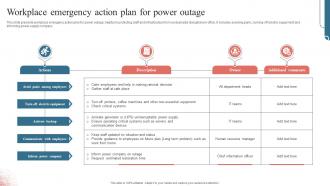
This slide presents workplace emergency action plan for power outage, helpful in protecting staff and infrastructure from undesirable disruptions in office. It includes avoiding panic , turning-off electric equipment and informing power supply company.
People who downloaded this PowerPoint presentation also viewed the following :
Workplace Emergency Action Plan For Power Outage with all 6 slides:
Use our Workplace Emergency Action Plan For Power Outage to effectively help you save your valuable time. They are readymade to fit into any presentation structure.





FAQs for Workplace Emergency Action Plan
Key components include emergency procedures and evacuation routes, communication systems and alert mechanisms, designated assembly points and shelter areas, employee roles and responsibilities, and emergency contact information. These elements work together by ensuring clear coordination during crises, minimizing response time through structured protocols, and maintaining safety compliance, with many organizations finding that comprehensive planning significantly reduces workplace risks while enhancing overall operational resilience.
Organizations assess workplace-specific risks through comprehensive hazard identification, facility walkthroughs, employee surveys, historical incident analysis, and consultation with safety experts or local emergency services. Manufacturing facilities might focus on chemical spills and machinery accidents, while offices prioritize fire evacuation and medical emergencies, with many organizations finding that regular risk assessments ultimately enhance preparedness and minimize response times.
Employee training serves as the cornerstone of successful Workplace Emergency Action Plans, ensuring staff understand evacuation procedures, emergency protocols, communication systems, and their specific roles during crises. Through regular drills and comprehensive education programs, organizations enhance response times, minimize confusion, and ultimately protect lives, with many companies finding that well-trained employees become force multipliers during actual emergencies.
Emergency drills should be conducted quarterly for comprehensive scenarios, with monthly fire drills and semi-annual evacuation exercises to maintain optimal preparedness levels. Many organizations find that this strategic combination of regular practice sessions enhances employee response times, identifies procedural gaps, and ultimately delivers improved safety outcomes while ensuring regulatory compliance across various workplace environments.
Effective emergency communication strategies include designated communication chains, multiple alert systems, clear evacuation routes, backup communication methods, and trained emergency coordinators. These approaches streamline crisis response by establishing redundant channels, minimizing confusion, and ensuring rapid information flow, with many organizations finding that regular drills and communication protocols ultimately deliver faster response times and enhanced employee safety.
Organizations should prioritize emergencies based on likelihood of occurrence, potential impact on operations and safety, regulatory requirements, and facility-specific vulnerabilities like location and industry risks. Through comprehensive risk assessments, companies can strategically allocate resources to address high-probability scenarios first, while ensuring compliance with safety standards, ultimately creating actionable plans that protect employees and maintain business continuity.
Legal requirements for emergency action plans vary by jurisdiction and industry, with OSHA mandating written plans for workplaces with specific hazards, fire safety codes requiring evacuation procedures, and industry regulations like healthcare and manufacturing having additional compliance standards. These regulations typically require designated evacuation routes, emergency communication systems, and regular training protocols, with organizations finding that comprehensive compliance not only meets legal obligations but also enhances employee safety and operational continuity.
Businesses can incorporate employee feedback through regular surveys, post-drill debriefings, anonymous suggestion systems, cross-departmental review committees, and formal feedback sessions after emergency exercises. This collaborative approach enables organizations to identify practical gaps, refine evacuation procedures, and enhance communication protocols, with many companies finding that employee input significantly improves plan effectiveness and workplace safety compliance.
Technology enhances Workplace Emergency Action Plans through automated alert systems, real-time communication platforms, mobile emergency apps, GPS tracking for evacuations, and integrated monitoring sensors. These technologies streamline emergency response by enabling instant notifications, coordinating evacuation routes, and providing real-time updates to emergency teams, ultimately delivering faster response times and improved safety outcomes.
Best practices for documenting emergency action plans include creating clear evacuation procedures, establishing communication protocols, defining roles and responsibilities, maintaining current employee contact information, and conducting regular drills. These comprehensive documentation strategies streamline response coordination by ensuring accessibility, accuracy, and regular updates, with many organizations finding that quarterly reviews and post-incident assessments ultimately enhance workplace safety and regulatory compliance.
Organizations ensure comprehensive emergency preparedness by implementing virtual training platforms, conducting regular video-based drills, and creating role-specific emergency protocols for both on-site and remote locations. Through digital simulation tools and mobile emergency apps, companies can deliver consistent training experiences across distributed workforces, while establishing clear communication chains and location-specific procedures, ultimately ensuring all employees receive adequate preparation regardless of their work environment.
Emergency evacuation plans should include clear evacuation routes, assembly points, emergency contact information, roles and responsibilities for staff, and communication protocols for different scenarios like fires, medical emergencies, or natural disasters. These comprehensive plans streamline response coordination, minimize confusion during critical situations, and ensure regulatory compliance, with many organizations finding that regular drills and scenario-specific procedures significantly enhance employee safety and operational resilience.
Businesses can balance detailed planning with flexibility by establishing core response frameworks while allowing adaptable procedures for specific scenarios, regular training updates, and decentralized decision-making authority. This strategic combination enables organizations to maintain structured protocols for common emergencies while empowering teams to respond effectively to unique situations, ultimately delivering both preparedness and agility in crisis management.
Organizations can access OSHA guidelines, emergency management software platforms, professional safety consultants, industry-specific templates, and crisis communication tools to develop comprehensive emergency action plans. Many companies find that combining regulatory frameworks with specialized training programs, evacuation planning software, and regular drills creates robust preparedness systems, ultimately delivering enhanced workplace safety, regulatory compliance, and operational resilience during critical incidents.
Organizations create a safety culture through regular emergency drills, comprehensive employee training programs, open communication channels for safety concerns, and leadership commitment to preparedness initiatives. By implementing cross-departmental safety committees, recognition programs for proactive safety behaviors, and transparent incident reporting systems, companies enhance employee engagement while building organizational resilience, ultimately delivering improved response capabilities and workplace confidence.
-
I looked at their huge selection of themes and designs. They appeared to be ideal for my profession. I'm sure I'll grab a few of them.
-
The slides come with appealing color schemes and relevant content that helped me deliver a stunning presentation without any hassle!