


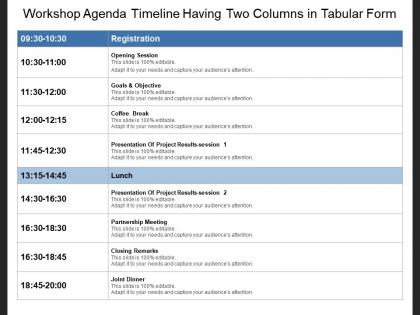
Workshop agenda timeline having two columns in tabular form




Try Before you Buy Download Free Sample Product
 Impress Your
 Audience
 100%
100% Editable
 Save Hours
 of Time


Just come by our Workshop Agenda Timeline Having Two Columns In Tabular Form store. You will surely stop and shop for more.
People who downloaded this PowerPoint presentation also viewed the following :
Workshop agenda timeline having two columns in tabular form with all 5 slides:
Our Workshop Agenda Timeline Having Two Columns In Tabular Form enable you to give it all you have. They allow you to get your head into it.



FAQs for Workshop agenda timeline having two columns
Essential workshop agenda timeline components include session objectives, allocated timeframes, speaker introductions, interactive activities, networking breaks, Q&A segments, and clear transition periods between topics. These elements streamline workshop flow by maintaining participant engagement, ensuring comprehensive coverage, and facilitating meaningful connections, with many organizations finding that structured timelines enhance learning outcomes while delivering more focused, productive sessions.
Effective time allocation involves analyzing session objectives, participant engagement levels, content complexity, and desired outcomes for each segment. Strategic planning should account for opening activities, core content delivery, interactive discussions, and meaningful wrap-up sessions, with many facilitators finding that building in buffer time and regularly monitoring progress ensures workshops stay productive while maintaining participant energy and focus.
Participant engagement significantly influences agenda timing by determining discussion depth, activity duration, and break frequency needed for optimal learning outcomes. Highly engaged groups often extend valuable discussions and require more interactive elements, while less engaged participants benefit from shorter segments, varied formats, and strategic energizers, with many facilitators finding that adaptive timing based on real-time engagement levels delivers more impactful workshop results.
Workshop timeline adjustments should occur during natural breaks, typically every 2-3 hours or between major segments, based on participant engagement and comprehension levels. Effective facilitators monitor group energy, question frequency, and completion rates, making real-time modifications to pacing while maintaining core objectives, ultimately ensuring optimal learning outcomes and participant satisfaction.
Effective workshop time management strategies include setting clear objectives, allocating specific time blocks for each activity, building in buffer periods, using timekeepers, and incorporating regular breaks. These approaches streamline workshop flow by maintaining participant engagement, preventing agenda overrun, and ensuring all critical topics receive adequate attention, with many facilitators finding that structured time management ultimately delivers more productive outcomes and higher participant satisfaction.
Technology tools enhance workshop agenda timeline creation by enabling collaborative planning, real-time updates, automated scheduling, and resource integration across teams and locations. Digital platforms like project management software, calendar applications, and collaborative whiteboards streamline coordination while providing templates, time tracking, and stakeholder notifications, ultimately delivering more organized workshops and improved participant engagement.
Common pitfalls include underestimating activity duration, failing to build in adequate breaks, over-packing content without reflection time, and neglecting buffer periods for discussions. These scheduling missteps often result in rushed presentations, participant fatigue, and reduced engagement, with many facilitators finding that realistic time allocation and strategic pacing ultimately deliver more impactful outcomes.
When time is limited, prioritize workshop topics by focusing on core learning objectives, participant needs assessment results, and immediate actionable outcomes that deliver maximum value. Start with foundational concepts, address the most critical pain points identified in pre-workshop surveys, and allocate more time to interactive elements that enable skill application, while many facilitators find that ending with concrete next steps ensures participants leave with clear implementation strategies.
Smooth transitions between agenda items require strategic time buffers, clear verbal bridges, and designated transition facilitators who signal topic changes. Workshop leaders achieve seamless flow by using visual cues, summarizing key takeaways before shifting topics, and implementing brief energizer activities, with many organizations finding that structured transition protocols reduce confusion and maintain participant engagement throughout lengthy sessions.
Strategic breaks can enhance workshop momentum by scheduling 10-15 minute energizing pauses every 90 minutes, incorporating walking discussions, and using break transitions to preview upcoming content. These approaches maintain engagement by preventing cognitive overload, allowing networking opportunities, and creating anticipation for next sessions, with many facilitators finding that well-timed breaks actually accelerate learning outcomes.
Setting clear objectives for each agenda segment ensures focused discussions, measurable outcomes, and efficient time management throughout the workshop. This strategic approach enables facilitators to maintain participant engagement, track progress against specific goals, and deliver tangible results, with many organizations finding that well-defined segment objectives ultimately enhance productivity and participant satisfaction.
Visuals and templates enhance workshop timeline comprehension by providing clear structure, visual flow, and standardized formatting that participants can quickly grasp. Through color-coded sections, milestone markers, and intuitive layouts, organizers streamline communication while participants better anticipate transitions, ultimately delivering improved engagement and reduced confusion across diverse learning styles.
Best practices for sharing agenda timelines include distributing materials 3-5 days in advance, providing clear session descriptions with learning objectives, highlighting key breaks and networking opportunities, and including presenter bios with relevant expertise. This strategic preparation enables participants to prepare mentally, prioritize sessions aligned with their goals, and maximize engagement, with many organizations finding that advance communication significantly enhances workshop outcomes and satisfaction.
Address unexpected delays by building buffer time into your agenda, having flexible activity alternatives ready, and maintaining transparent communication with participants about adjustments. Effective workshop leaders prioritize essential content, delegate time management to co-facilitators when possible, and use brief breaks strategically to recalibrate, ultimately ensuring key objectives are met while maintaining participant engagement and productive outcomes.
A well-structured agenda timeline enhances learning outcomes by creating clear expectations, optimizing cognitive load distribution, and providing strategic breaks for information processing and retention. Through systematic pacing and milestone tracking, participants achieve deeper comprehension, maintain higher engagement levels, and retain more knowledge, with many educational institutions and corporate training programs finding that structured timelines increase completion rates and practical application by up to 40%.
-
Great product with effective design. Helped a lot in our corporate presentations. Easy to edit and stunning visuals.
-
Appreciate the research and its presentable format.