

1114 vision mission strategic and enabling pillars powerpoint presentation





Try Before you Buy Download Free Sample Product
 Impress Your
 Audience
 100%
100% Editable
 Save Hours
 of Time


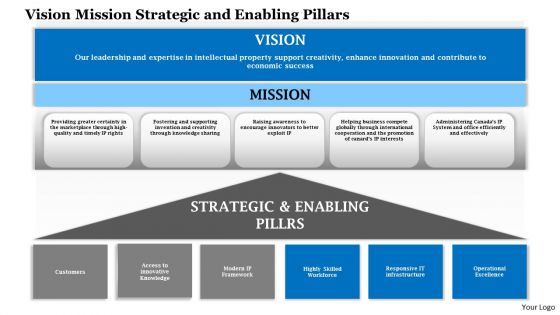
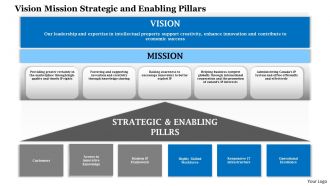
Capture the hearts of your audience with an engaging vision, decked up in our exclusive Vision Mission Strategic and Enabling Pillars PowerPoint Presentation Template. Our peculiar PPT design will not only help you focus on just the specifics of your data but also save your crucial time owing to the exclusive customisation services that we offer to our esteemed clientele. The beauty of this slide lies in the high quality, graphic design of the process flow chart. Moreover, the unique framework of this diagram allows you to add the objectives and mission to support the vision, initiating, clarity of the values to the audience. Going further, with this PPT template you are just a step away to motivate your workmates do their best and make a marked increase in their energy, commitment and trust. So, just download this PowerPoint Presentation and make a significant contribution to your organization success. Adapt to the circumstances with our 1114 Vision Mission Strategic And Enabling Pillars Powerpoint Presentation. Get a big dose of flexibility.
People who downloaded this PowerPoint presentation also viewed the following :
1114 vision mission strategic and enabling pillars powerpoint presentation with all 5 slides:
Have a hassle free experience with our 1114 Vision Mission Strategic And Enabling Pillars Powerpoint Presentation.They enable easy functioning.
FAQs for 1114 vision mission strategic and enabling
Think of it this way - your mission is what you're doing right now. Who you serve, your current purpose, how you actually operate today. Vision is totally different - that's your big dream for where you want to be in like 5-10 years. Mission should be concrete and actionable. Vision gets to be more inspirational (though honestly, that makes it way harder to write sometimes). I'd start with mission first. Get clear on your reality today, then you can paint that future picture. Short sentences work better than rambling ones, trust me.
Honestly, good vision and mission statements are like having a compass for your whole team. People actually know what matters and can make decisions that fit. But here's the thing - they only work if leadership isn't just talking the talk, you know? I've watched companies where everyone could tell you the mission off the top of their head, and it showed in how they handled problems or picked projects. Then there are places where it's just fancy words on the break room wall. If your team can't connect with them or they sound like generic corporate BS, you're basically wasting everyone's time.
Honestly, most companies totally mess this up. Break down your vision into actual measurable goals first. Then make sure every big strategic move connects back to hitting those targets. Your mission should drive how you spend money and what you prioritize - like if you're all about customer satisfaction, your budget better show it. I know it sounds super basic, but you'd be shocked how many places skip this step entirely. Do regular check-ins to see if your strategy's drifting from your original vision. Oh, and create a simple one-page map linking each priority to your mission. Makes it way easier to spot the gaps.
Dude, you absolutely need stakeholders involved in your vision/mission stuff. Here's the thing - I've watched so many leadership teams lock themselves in a room and come out with these gorgeous mission statements that literally no one else cares about. Get your employees, customers, investors talking early on. Their perspectives will totally strengthen what you're building, plus people actually support things they helped create (weird how that works, right?). Run some focus groups or surveys before you lock anything down. The feedback makes everything way more real and doable. Trust me on this one.
Honestly, track the obvious stuff first - employee engagement scores and retention rates. But here's what really matters: can your people actually explain your vision without googling it? That tells you everything about whether they actually care. Customer satisfaction surveys show if your mission hits right externally too. I'd do quarterly check-ins asking employees if they see the vision playing out in real decisions - not just the fancy posters in the break room. Those pulse surveys will tell you what's actually working versus what's just corporate theater. Start there and you'll get your answer pretty quick.
Honestly? Don't be vague - saying "we strive for excellence" is basically saying nothing. Keep it short too. Nobody's memorizing some long paragraph you wrote. The worst thing though is when companies sound exactly like their competitors. I see this all the time and it's cringe. Also, don't just grab something random from Google - people can tell immediately. You'll want something your team can actually relate to, not some pie-in-the-sky thing that has zero connection to what you do daily. Quick test: read it to someone who doesn't work there and see if they get it right away.
Review your vision/mission every 3-5 years officially, but smart companies are constantly checking if theirs still makes sense. Big market shifts or company growth? That's when you definitely need updates. I've watched too many places cling to cringe mission statements that make everyone internally groan. Your strategy needs way more attention though - annually minimum, quarterly if your industry moves fast. Oh, and set a reminder to gut-check your vision/mission every six months even if you don't actually change anything. Better to catch it early than realize it's been irrelevant for years.
Tesla's "accelerate the world's transition to sustainable energy" is probably my favorite - it's huge but you can actually visualize it happening. Disney keeps it simple with "make people happy." Amazon went with "Earth's most customer-centric company" which honestly sounds kinda corporate now but worked for them. Microsoft's got "empower every person and organization to achieve more" though that one's getting pretty buzzword-y if you ask me. The trick is making yours memorable enough that your team can repeat it without rolling their eyes. Best ones are ambitious but concrete.
Look, having a clear vision totally changes everything for your team. People need to see how their daily grind connects to something bigger - otherwise they're just going through the motions, you know? When employees actually understand where the company's headed, they get way more invested in their work. Honestly, I've seen teams completely transform once they stopped feeling like random cogs and started feeling like they're building toward something real. The trick is making your vision actually inspiring (not just fancy corporate speak that nobody gets). Share it often and tie specific projects back to it. Makes such a difference.
Start with SWOT analysis - it's quick and shows you exactly where you stand right now. After that, try the Strategy Canvas or Business Model Canvas since they're amazing for visualizing everything (I'm honestly obsessed with how clear they make complex stuff). For turning your mission into actual goals, OKRs work really well for quarterly planning. Oh, and balanced scorecard gives you different angles if you want that. SWOT first though, then pick whichever canvas fits your situation better. You'll probably find one clicks way more than the other.
Looking at what your competitors are doing helps you find the gaps they're missing - that's where you can swoop in. Market trends show you which direction everything's heading, so you're not building something that'll be dead on arrival. I always think of it like checking the weather before you leave the house, except way more important for your business. You can validate whether your ideas actually make sense or if you're just being delusional. The thing is, you can't just research once and call it done. Markets shift constantly, so you've got to keep updating your intel and tweaking your strategy accordingly.
Look, having a clear mission actually builds trust because customers can tell you stand for something real, not just profit. People get emotionally attached when they connect with your "why" - like they're genuinely rooting for you. It gives them a reason to pick you over competitors, especially when everything else looks the same. Your team needs to nail explaining this mission though, or it's pointless. Consistency across all your stuff matters too. Honestly, the loyalty boost is huge because people love supporting businesses that match their values. Worth figuring out.
Your vision and mission statements are basically your nonprofit's GPS - they keep you on track when everything gets chaotic. Good ones rally people around your cause and make fundraising way easier. I've watched so many organizations fumble this though. They write these boring, generic statements that put people to sleep instead of firing them up. But nail it? Then you've got something that attracts the right volunteers and helps you turn down stuff that doesn't fit your goals. Honestly, half the battle is just being clear about why you exist. Does your current statement actually make people want to get involved?
Your vision and mission are like your brand's backbone - they show customers who you really are. Look at Patagonia's whole environmental thing, it's woven into everything they do. These statements give your team a north star when they're making decisions about products or campaigns. Super important for keeping everyone aligned, honestly. Without clear ones, your brand just feels all over the place and people won't remember you. The key is making them specific enough to actually matter - not just generic fluff that could apply to anyone. They've gotta feel authentic to your actual values.
Honestly, repetition is your best friend here. Get it everywhere - town halls, email sigs, those meeting conversations where you can naturally bring it up. Stories beat bullet points every single time, trust me on this one. Find real examples of people actually living your mission and share those instead of corporate speak. Your managers need training though - they should connect daily work back to the big picture, not just recite scripts. Oh, and make sure leaders use their own words when they talk about it. Nobody wants mission statements that feel like expensive wall decorations.
-
good
-
Great product with effective design. Helped a lot in our corporate presentations. Easy to edit and stunning visuals.
-
Top Quality presentations that are easily editable.