

Vision mission goals and objectives powerpoint presentation slides





Try Before you Buy Download Free Sample Product
 Impress Your
 Audience
 100%
100% Editable
 Save Hours
 of Time


The mission is a general statement of how you will achieve your target. With our vision mission goals and objectives, PowerPoint presentation slides you can monitor all the day-to-day activities of the organization. This strategic planning PPT presentation includes slides like vision-aim statements, statement chart, our business, future intentions, strategic pyramid, strategy process, developing strategy, setting objectives, strategic management process, factors shaping decisions, aim statement, key questions, common shortcomings, well-communicated strategy, core concept, short-term vs. long-term goals, crafting strategy, scheme making hierarchy, values & philosophy, future plans etc. Not only this, you can use our vision and mission powerpoint presentation for topics like an idea statement, mission statement, objective vision, business strategy, idea & aim of companies, mission idea values, company values, goal setting, operational objective, vision statement, mission statement etc. What are you waiting for download our predesigned and well-researched vision mission goals and objectives PowerPoint presentation and align your future goals. Guide folks on initiating improvements with our Vision Mission Goals And Objectives Complete Powerpoint Deck With Slides. Be able to deliver constructive advice.
People who downloaded this PowerPoint presentation also viewed the following :
Content of this Powerpoint Presentation
Slide 1: This slide introduces to Vision Mission Goals And Objectives. State Your Company Name and get started.
Slide 2: This is an Agenda slide. State your agendas here.
Slide 3: This is The Vision slide. State company/organization's vision here.
Slide 4: This slide presents Vision And Mission Statements. State them here.
Slide 5: This slide presents Vision And Mission Statement Chart in triangular pyramid image form. State them here.
Slide 6: This slide presents Vision And Mission Statement Definitions: Which Comes First? MISSION (In a company, the vision statement is often led by the mission, which was already accomplished, and by strategic future plans). VISION (For any new start up, formulate the vision statement first and it will guide the mission statement and the rest of the strategic plan).
Slide 7: This slide presents What Is Our Business? State business speicfications etc. here.
Slide 8: This slide showcases What Do You Want To Become with imagery and text box to go with. State in detail here.
Slide 9: This slide displays The Strategic Pyramid to show strategies to be used in order of importance.
Slide 10: This slide shows Mission And Vision In The Strategy Process with- Action Plan, Strategy, Vision, Value, Mission, Goals.
Slide 11: This slide showcases Developing a Strategic Vision, Mission and Values. State about them in specific details here.
Slide 12: This slide showcases Setting Objectives for a particular goal, project etc.
Slide 13: This slide showcases the Strategic Management Process under the main subheading- External and Internal Factors divided into: 1: Executing the strategy, 2: Crafting a strategy to achieve the objectives and move the company along the intended path, 3: Developing a strategic vision, mission, and values, 4: Monitoring developments, evaluating performance, and initiating corrective adjustments, 5: Setting objectives.
Slide 14: This slide shows Factors Shaping Strategic Decisions with the central subheading External Considerations divided into- 1:What are the company’s external opportunities? 2:What are the key factors for future competitive success? 3:What are the industry’s economic characteristics? 4:What market positions do rivals occupy and what move are they likely to make next? 5:How strong are the competitive forces at play? 6:What forces are driving change in the industry?
Slide 15: This slide present the Mission Statement. State it here.
Slide 16: This slide presents Key Questions For Developing A Mission Statement. Listed ones are- What do we do today? Why do we do it? For whom we do it? What is the benefit?
Slide 17: This slide present the Vision Statement. State about it here.
Slide 18: This slide shows Key Questions For Developing A Vision Statement. The VISION aspect is defined by- Where Do You Want To Be Going Forward? When Do You Want To Reach That Stage? How Do We Want To Do It? The vision statement defines the future. It gives details on future goals and where you wish to. It explains why you choose to work for it.
Slide 19: This slide describes Strategic Vision with the following points- 1:It’s the top management’s views about the firm’s direction and future product-market-customer-technology focus. 2:Provides a panoramic view of “where we are going”. 3:Is distinctive and specific to a particular organization. 4:Definitively states how the company’s leaders intend to position the firm beyond where it is today.
Slide 20: This slide showcases the Characteristics of Effectively Worded Vision Statements. The main points focused are- GRAPHIC, DIRECTIONAL, FOCUSED, FLEXIBLE, FEASIBLE, DESIRABLE, EASY TO COMMUNICATE.
Slide 21: This slide presents Common Shortcomings Of Company Vision Statements. Some listed points are- Vague or incomplete, Bland or uninspiring, Too broad, Not forward looking, Not distinctive, Too reliant on superlatives.
Slide 22: This slide explains Why A Sound Well-communicated Strategic Vision Matters. Some explanations given as examples are- It crystallizes senior executives’ own views about firm’s long-term direction, It reduces the risk of rudderless decision making by management at all levels, It is a tool for winning the support of employees to help make the vision a reality, It provides a beacon for lower-level managers in forming departmental missions, It helps an organization prepare for the future.
Slide 23: This slide displays Core Concept of a company/organization. A firm’s values are the beliefs, traits, and behavioral norms that the firm’s personnel are expected to display in conducting the firm’s business and pursuing its strategic vision and mission.
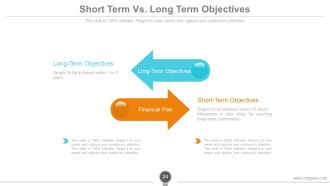
Slide 24: This slide presents Short Term Vs. Long Term Objectives. The divided objectives are- Targets to be achieved soon, Milestones or stair steps for reaching long-range performance, Targets to be achieved within 3 to 5 years, Financial Plan.
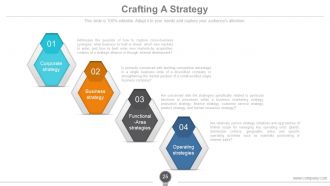
Slide 25: This slide presents Crafting A Strategy as- Corporate strategy, Business strategy, Functional-Area strategies, Operating strategies.
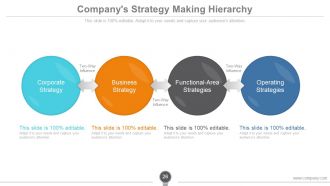
Slide 26: This slide showcases Company's Strategy Making Hierarchy in Two-Way Influence for- Operating Strategies, Functional-Area Strategies, Business Strategy, Corporate Strategy.
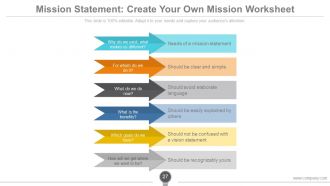
Slide 27: This slide elaborates Mission Statement: Create Your Own Mission Worksheet with the following points- Needs of a mission statement- Why do we exist, what makes us different? Should be clear and simple- For whom do we do it? Should avoid elaborate language- What do we do now? Should be easily explained by others- What is the benefits? Should not be confused with a vision statement- Which goals do we have? Should be recognizably yours- How will we get where we want to be?
Slide 28: This slide presents Mission Statement Components. Listed some components are- Customers, Products Or Services, Markets, Technology, Concern For Survival, Growth, Profitability, Philosophy, Self-concept, Concern For Public Image, Concern For Employee.
Slide 29: This slide presents Values And Philosophy with Our Philosophy as the main subheading.
Slide 30: This slide presents Our Future Plans in timeline form with target imagery and text boxes.
Slide 31: This slide presents Company Name Design with- Goal, Mission and Vision. State them here.
Slide 32: This slide also presents Company Name Design with- Vision, Mission and Core Value. State them here.
Slide 33: This slide too presents Company Name Design with- Mission, Values, Vision. State them here.
Slide 34: This slide too presents Company Name Design with- Mission, Values, Vision. State them here.
Slide 35: This slide showcases Company Name Design with Company Names to be put.
Slide 36: This slide showcases Company Name Design with Company Names to be put. You can choose to show aspects of- Teamwork, Quality, Creativity, Improvement, Respect, Passion.
Slide 37: This slide showcases Company Name Design with- GOAL, MISSION, VISION.
Slide 38: This slide showcases Company Name Design with- Vision, Mission, Value.
Slide 39: This slide showcases Company Name Design with- Vision, Mission, Value in triangular image form.
Slide 40: This slide is titled Additional Slides to move forward.
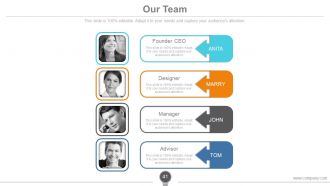
Slide 41: This is Our Team slide with name, designation, image and text boxes to fill information.
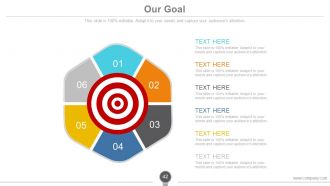
Slide 42: This slide showcases Our Goal with imagery and text boxes to go with. State goals here.
Slide 43: This is a Quotes slide to showcase company message, beliefs etc.
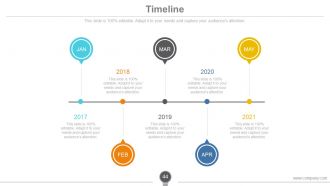
Slide 44: This is a Timeline slide to show growth, milestones, highlighting factors etc.
Slide 45: This is the Important note slide to mark reminders, events, occasions etc.
Slide 46: This is a Puzzle image slide to show information, specification etc.
Slide 47: This is a Target image slide to show information, specification etc.
Slide 48: This is a Circular image slide to show information, specification etc.
Slide 49: This is a Venn diagram image slide to show information, specification etc.
Slide 50: This is a Mind Map image slide to show information, specification etc.
Slide 51: This is a Bulb/Idea image slide to show information, innovative aspects, specification etc.
Slide 52: This is a Magnifying glass image slide to show information, innovative aspects, specification etc.
Slide 53: This is a Thank You slide with Address # street number, city, state, Contact Numbers, Email Address.
Vision mission goals and objectives powerpoint presentation slides with all 53 slides:
Our Vision Mission Goals And Objectives Complete Powerpoint Deck With Slides dispel any chance of haze. The goal becomes absolutely clear.
-
Vision Mission Goals and Objectives
-
Agenda Slide
-
The Vision
-
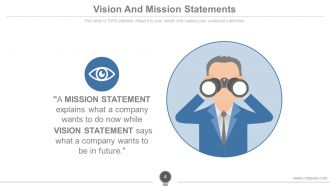
Vision And Mission Statements
-
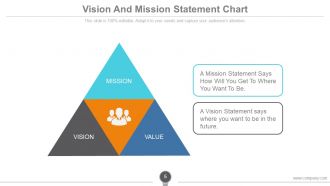
Vision And Mission Statement Chart
-
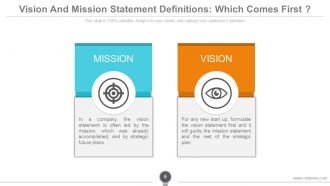
Vision And Mission Statement Definitions Which Comes First
-
What Is Our Business
-
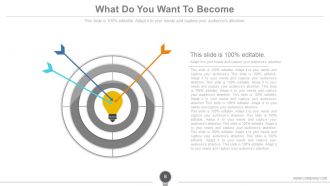
What Do You Want To Become
-
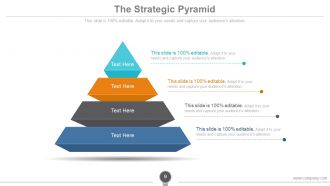
The Strategic Pyramid
-
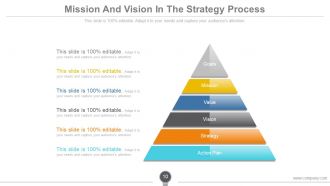
Mission And Vision In The Strategy Process
-
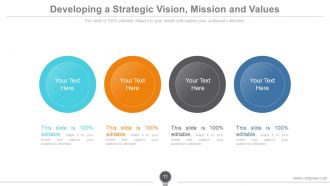
Developing a Strategic Vision Mission and Values
-
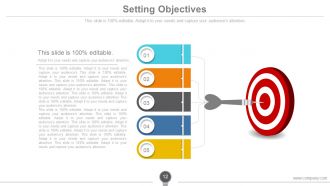
Setting Objectives
-
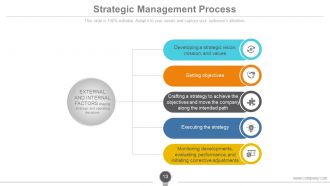
Strategic Management Process
-
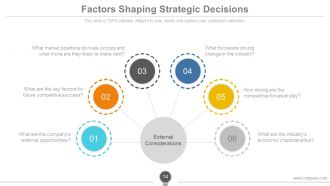
Factors Shaping Strategic Decisions
-
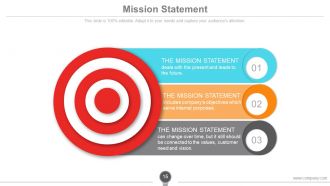
Mission Statement
-
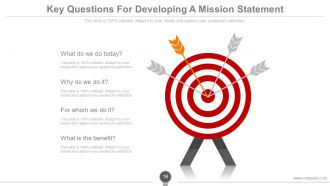
Key Questions For Developing A Mission Statement
-
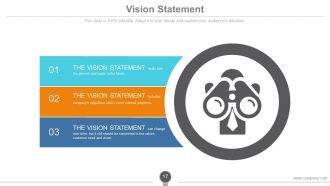
Vision Statement
-
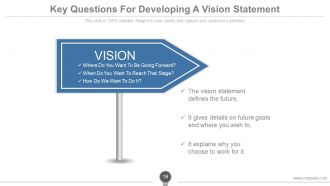
Key Questions For Developing A Vision Statement
-
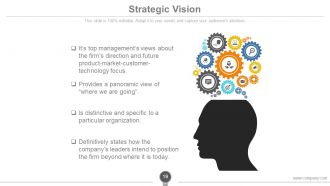
Strategic Vision
-
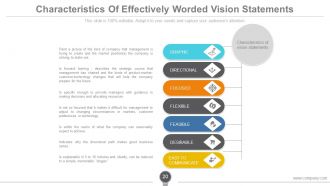
Characteristics Of Effectively Worded Vision Statements
-
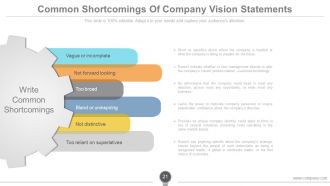
Common Shortcomings Of Company Vision Statements
-
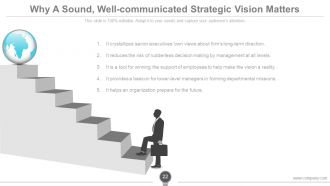
Why A Sound Well communicated Strategic Vision Matters
-
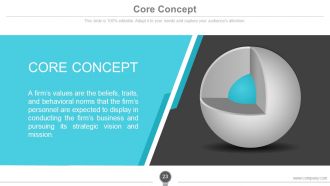
Core Concept
-
Short Term Vs Long Term Objectives
-
Crafting A Strategy
-
Company s Strategy Making Hierarchy
-
Mission Statement Create Your Own Mission Worksheet
-
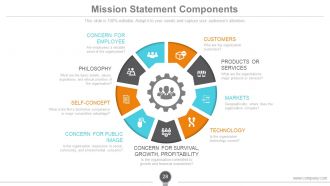
Mission Statement Components
-
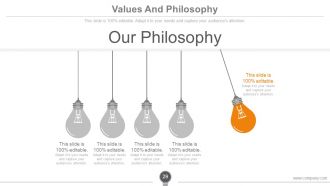
Values And Philosophy
-
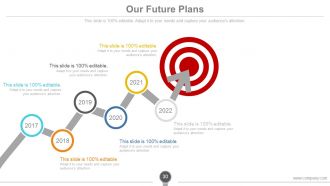
Our Future Plans
-
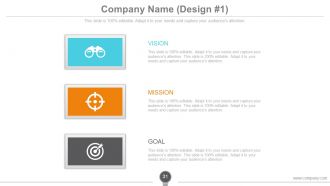
Company Name Design 1
-
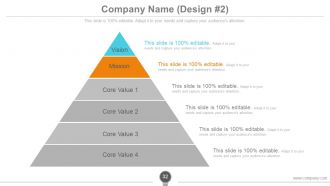
Company Name Design 2
-
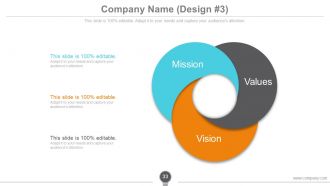
Company Name Design 3
-
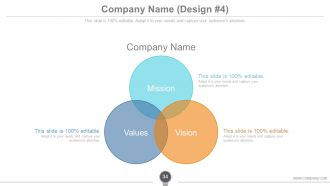
Company Name Design 4
-
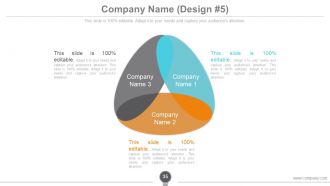
Company Name Design 5
-
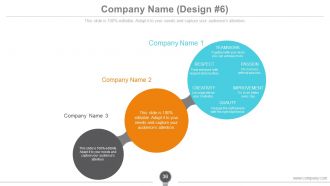
Company Name Design 6
-
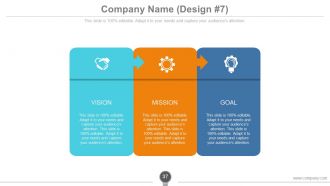
Company Name Design 7
-
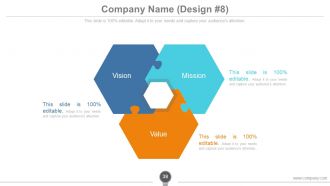
Company Name Design 8
-
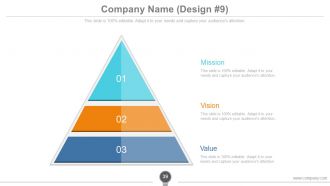
Company Name Design 9
-
Additional Slides
-
Our Team
-
Our Goal
-

Quotes
-
Timeline
-
Important note
-
Puzzle
-
Target
-
Circular
-
Venn
-
Mind Map
-
Bulb Or Idea
-
Magnify Glass
-
Thank You
FAQs for Vision mission goals and objectives
Okay so basically your mission is what you're doing right now - like your day-to-day purpose and how you help customers. Vision is way more future-focused, like where you want to be in 10+ years. I always think of mission as the "what and why" of today, while vision is your big aspirational dream. Honestly, the North Star comparison is overused but whatever, it works. Your vision should get people excited - something like "change how the world communicates." Just make sure your current mission actually moves you toward that bigger vision, otherwise you'll end up all over the place.
Here's what I'd do - take your big vision and break it down so every goal actually connects to it. Like if you're all about customer excellence, don't just chase random numbers that look impressive. Your quarterly targets should actually serve that mission. Get your team leads to spell out how their stuff ties to the bigger picture. I've seen too many goals just... drift over time, you know? Regular check-ins help catch that. The trick is making those connections super obvious to everyone, not leaving people to guess how their work matters.
So objectives are like your bridge from big vision stuff to actual work that gets done. Your vision statement is probably pretty inspiring but also kinda vague, right? Objectives chop that down into pieces your team can actually tackle - with real deadlines and ways to measure if you're winning. Think of it as the "how" while your vision is the "what." Honestly, without them you're just staring at motivational words on the wall. The cool part is when you can say "hit these 3 things this quarter and we're actually moving somewhere." I'd start with maybe 3-5 key ones that connect directly to your main vision.
Honestly, a good mission statement is like having GPS for your team - everyone knows where they're headed. When people can't figure out how their daily tasks connect to something bigger, they just phone it in. But give them clarity about the "why" and suddenly work feels meaningful instead of just... work. I've seen teams completely transform when they actually understand their impact. Oh, and pro tip: if your current mission sounds like it was written by a committee of consultants, scrap it. Read it out loud first though - you'll know immediately if it's garbage.
Hit different teams with separate meetings first - marketing needs to hear different stuff than finance does. Posters and email signatures sound cheesy but they actually work. Town halls where the CEO keeps repeating it? Yeah, those help too, weirdly enough. The trick is making each department see how it affects their actual day-to-day work instead of some vague company-wide thing. Oh, and make sure your managers can explain it without sounding like robots reading a script.
Honestly, you've gotta pick metrics that actually connect to your mission - not just random numbers that look impressive. Say your mission is customer satisfaction. Track retention and NPS scores instead of obsessing over revenue alone. I always ask myself "does this metric prove we're actually doing what we say we do?" Too many places I've worked get distracted measuring pointless stuff. List out your mission's main pieces first, then find 2-3 ways to measure each one. Check these every quarter and tweak as needed - your mission stays the same, but how you track it might shift.
Don't go with boring stuff like "we strive for excellence" - honestly, that could be any company on the planet. Keep it short too. Nobody's remembering a paragraph-long mission statement. Here's what kills me though - companies that only talk about making money instead of actually helping people. Big mistake. Also, don't promise things you can't deliver on. That backfires fast. Make yours specific to what you actually do. Quick test: if you could slap a competitor's name on it and it still works? Yeah, you need to start over. It should sound like YOUR company, not some generic template.
Okay so SMART criteria - you gotta hit all five parts: Specific, Measurable, Achievable, Relevant, and Time-bound. Like instead of "improve customer satisfaction," try "boost our satisfaction scores from 7.2 to 8.0 in six months through better support training." Way more concrete, right? Here's the thing though - I've watched teams nail the SMART format but pick objectives that don't actually matter. Write your main goal at the top first, then create 2-3 SMART objectives that actually ladder up to it. If you're going for market leadership, your objectives better connect to that somehow. Otherwise you're just checking boxes.
Your vision statement basically shows people what you're building toward - and honestly, that matters more than you'd think. Customers want to feel like they're supporting something bigger than just another product. Investors? They're looking for proof you've got long-term plans, not just quick cash grabs. The whole thing creates this emotional hook that turns casual buyers into loyal fans and gets investors actually excited about cutting checks. Just make it specific enough that people believe it's real, but inspiring enough that they want to be part of it. Nobody wants boring corporate speak.
Honestly, I'd say every 3-5 years for a formal review. But here's the thing - if your industry gets turned upside down or you pivot hard, don't just sit there waiting for your scheduled review date. That's kinda pointless, right? Your team will be confused if they're working toward some outdated mission that doesn't match reality anymore. Just don't go crazy tweaking them every month because people need some consistency to actually get stuff done. Quick annual check-ins work well to see if everything still makes sense. Then do the heavy lifting every few years. Set a reminder now or you'll totally forget about it.
Look, you absolutely need their input or you'll just end up with meaningless corporate speak nobody cares about. Employees, customers, investors - they all see things you don't. I've seen so many companies skip this step and wonder why their "inspiring" vision falls flat. Get people involved through workshops or surveys, whatever works. When they help build it, they actually buy into it. Short version: don't write mission statements in a vacuum. Oh, and those focus groups? Actually worth the time investment, even though they can feel like a drag to organize.
Oh totally! Your vision statement basically gives everyone permission to think bigger and take some risks. When people actually get the "why" behind what you're doing, they'll come up with way more creative stuff instead of just playing it safe. I've watched this happen - it's pretty cool to see. Make sure your vision is ambitious enough though, not just "let's do 10% better." Actually, try this: look at your current projects and see if they really push against your vision statement. Bet you'll find spots where you could be way bolder.
Honestly, people just zone out when you hand them another text-heavy document. But throw the same info into a chart or simple diagram? Suddenly everyone gets how the pieces fit together. I swear visuals stick in your brain way better - like that priority pyramid will be stuck in their heads for weeks while bullet points get forgotten by lunch. Plus it actually tells a story instead of feeling like homework. Next time skip the boring PowerPoint and just make a one-page visual roadmap. Way more effective and people might actually look at it.
Your mission actually changes how people act every single day - it's wild how much it matters. Patagonia's whole environmental thing? Their employees live it, even telling customers not to buy stuff they don't need. Southwest built their entire goofy, helpful culture around making flying accessible to everyone. Honestly, most companies just slap their mission on the wall and call it done. But when people get the "why" behind their work, they start making decisions that fit those values without being told. Does yours actually guide what people do daily, or is it just corporate wall art?
Get everyone in a room for focused workshops where each person brings their expertise to the table. First thing - make sure people actually understand the shared goals because honestly, half the time everyone's working toward completely different things! Break into smaller groups to brainstorm objectives, then use dot voting to prioritize them. Assign clear owners with deadlines. The real magic happens when people feel ownership over what they helped create. You'll want regular check-ins to track progress and pivot when needed.
-
Excellent material
-
Really like the color and design of the presentation.
-
Very unique, user-friendly presentation interface.
-
Vision Mission Goals And Objectives PowerPoint Presentation is very excellent and ready to be used with the appropriate pictures. It will be support for the visualization aid in the knowledge sharing session.