


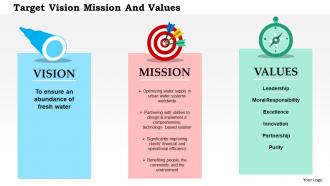
Target vision mission and values flat powerpoint design





Try Before you Buy Download Free Sample Product
 Impress Your
 Audience
 100%
100% Editable
 Save Hours
 of Time


Are you a project team leader and want your team to stay ahead of the game and complete the given objective on time? Are you a businessman and want your employees to know your vision of the company and how that vision affects how things are done and tasks are performed in the organization? You may be a motivational speaker and want to invigorate your viewers into giving them confidence so that they achieve their targets with full force? Are you finding it difficult to find PowerPoint slide inspiration and need PowerPoint slide ideas that are more powerful and efficient? Your search for an example of great PPT ends here with our target vision mission and values Presentation deck. This PPT slide employs state of the art PPT infographics and exquisite PowerPoint graphics to inspire the viewers to attain the goal with more enthusiasm. Furthermore, you can add bullet points or complete texts in dedicated text areas below each icon. Counter harassment with our Target Vision Mission And Values Flat Powerpoint Design. They allow you to answer your critics.
People who downloaded this PowerPoint presentation also viewed the following :
Target vision mission and values flat powerpoint design with all 5 slides:
Our Target Vision Mission And Values Flat Powerpoint Design facilitate in gaining exposure with our Target Vision Mission And Values Flat Powerpoint Design. They ensure your ability is not hampered.
FAQs for Target vision mission and values
So your vision statement should look 5-10 years ahead and actually get people pumped. Like, "own the skies" hits different than "be profitable," you know? Keep it short but specific enough that your team gets the direction. Make it ambitious but not totally unrealistic - there's a sweet spot there. Honestly, the best ones stick in people's heads and help with big decisions later. I'd write up a few different versions first. Then bounce them off your team to see which one actually clicks. Sometimes what sounds great in your head falls flat when you say it out loud.
Honestly, a solid mission statement is like having a compass for your whole team. People know what they're actually working toward instead of just showing up for a paycheck. I've watched companies where everyone could recite their mission - those teams just *click* differently, you know? They make better decisions without needing someone to hold their hand constantly. It shows up in weird ways too - like how they talk to customers or what projects they get excited about. Just make sure yours isn't some corporate word salad that nobody remembers five minutes later.
Look, when companies actually live their values instead of just posting them on conference room walls, people give a damn about their work. You'll feel like you're part of something meaningful rather than just collecting a paycheck. It creates this sense of belonging that makes you want to stay. Plus it makes decisions easier when everyone's on the same page about what matters. The trick is spotting whether leadership actually walks the walk - because honestly, most places talk a big game but their policies tell a different story. When values are real though? Total game changer for how safe and engaged people feel.
Your mission and vision are basically your business GPS - they tell you which direction to go when you're making big decisions. Mission is what you're actually doing right now, vision is where you want to end up in like 5-10 years. Honestly, most companies write these things and then forget about them, which is such a waste. When you're looking at new projects or thinking about changing direction, just ask yourself: does this get us closer to our vision? Does it fit with what we said our mission was? If not, skip it. Simple filter that actually works.
Look, you gotta talk to people first before writing those statements. Survey your customers, employees, whoever matters to your business. I've watched companies waste months creating these fancy mission statements that nobody cares about because they never asked what actually matters. Your stakeholders will tell you what problems they need solved and how they see your brand's purpose. Don't just wing it in some boardroom meeting - that's how you end up with corporate fluff. Also check what your competitors are saying so you're not copying their homework. The research part isn't glamorous but it'll save you from looking completely out of touch.
Honestly, you've gotta actually use those values in real decisions - hiring, promotions, the works. Don't just stick them on a poster and call it a day. Train your managers to bring up values during performance reviews and interviews. Make them actual criteria, not afterthoughts. Here's the thing though - consistency is everything. If you're preaching teamwork but only rewarding the lone wolves, people see right through that BS. Your recognition programs need to match what you're saying you stand for. Otherwise it's just corporate theater and everyone knows it.
Don't go generic with stuff like "exceed customer expectations" - literally every company says that. Also avoid getting so ambitious it sounds fake. Keep it short! Three paragraphs? Nobody's remembering that. Here's what I learned the hard way: get your leadership involved, but test it with regular employees too. They're the ones who actually have to live this stuff daily. Oh, and make sure it matches your real culture, not some fantasy version of what you wish your company was like. Authenticity beats aspirational corporate speak every time.
Honestly, visuals are a game-changer for this stuff. People process images 60,000 times faster than text, so you're basically working with their brain instead of against it. Try infographics or slide decks with good imagery - even simple diagrams work. I've watched companies completely transform boring mission statements into visual stories that employees actually remember. Photos showing your values in action hit different than just listing them out. Icons and charts help too. The whole point is making something people will glance at and think about later when they're making decisions. Oh, and make sure it's easy to share around.
Yeah, vision statements totally need to evolve when markets get crazy. Netflix is the perfect example - they went from mailing DVDs to streaming to making their own shows. When new tech pops up or customer expectations shift, you gotta adjust your aspirational language too. Companies that refuse to touch their vision? They usually end up irrelevant, honestly. But here's the thing - you're tweaking the "how" and "where" you're going, not ditching your core identity completely. I'd say review yours regularly to see if it still matches where real opportunities actually exist. Don't abandon who you are, just adapt the direction.
Honestly, most companies just do employee surveys and check customer feedback scores to see if people actually care about their mission. Retention rates tell you a lot too - if everyone's bailing, your vision probably isn't landing. Brand perception studies are helpful, but here's the real test: can your employees say your mission statement without wanting to laugh? That's brutal but true. Leadership should be bringing up these values in meetings naturally, not just during onboarding. I'd start with quarterly team surveys asking how connected people feel to your company's purpose. Way more telling than fancy analytics tools.
Okay so basically you've gotta weave your values into everything customers actually see - website, social, packaging, all that. But here's the thing: train your team to actually live this stuff during every interaction. People can tell when you're being fake about it, trust me. Share real stories about what you're doing - maybe your sustainability work or community stuff? Oh and definitely don't just talk about it, show it. Actually, start small this week. Pick one touchpoint and ask yourself: do our values even come through here? That's honestly the best place to begin.
Dude, here's the thing - a solid vision statement literally gives your team permission to think big and take real risks. People will actually pitch bold ideas instead of playing it super safe with tiny improvements. Why? Because everyone knows what you're working toward long-term. It's like having a creative North Star, honestly. Plus when people inevitably mess up (which they will), those failures just become learning moments that still push the bigger mission forward. Just make sure your vision is specific enough to guide decisions but not so narrow that there's only one path to get there.
Think of company values as your North Star for picking CSR stuff. Environmental stewardship as a core value? You'll probably end up doing sustainability programs, green supply chains, whatever makes sense there. Without that connection, your CSR just looks fake - and people can smell that from a mile away. I've seen companies throw money at random causes that have zero to do with who they are. Total waste. So yeah, every time you're looking at partnerships or new initiatives, just ask: does this actually match what we supposedly believe in?
Honestly, the best approach is baking your values right into job postings and interviews. Ask people for specific examples of when they've actually lived those principles - not hypotheticals. Share real stories during interviews about how your team operates day-to-day. Skip the corporate fluff because people see right through it. Once they're hired, pair them with someone who genuinely walks the walk (not just talks it). I'd focus those first three months way more on cultural stuff than boring process training. Makes such a difference long-term.
Look at Google - their whole "organize the world's information" thing pushed them way beyond just search into maps, Gmail, cloud stuff. Disney bases everything on making people happy, from their parks to movies. Patagonia's environmental angle creates these super loyal customers (honestly borderline obsessive lol). Southwest built their entire low-cost model around democratizing air travel. The trick isn't just having a nice mission statement on your wall. You've got to actually use it when making real decisions. Otherwise it's just corporate fluff that nobody cares about.
-
Best Representation of topics, really appreciable.
-
Helpful product design for delivering presentation.