

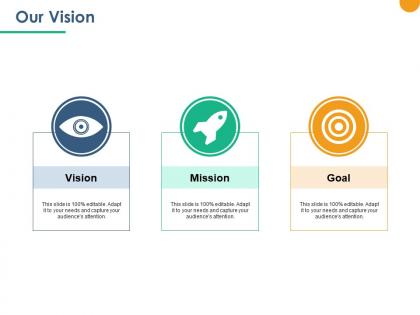
Our vision mission goal ppt powerpoint presentation outline templates




Try Before you Buy Download Free Sample Product
 Impress Your
Audience
 100%
Editable
 Save Hours
of Time


Have time on hand with our Our Vision Mission Goal Ppt Powerpoint Presentation Outline Templates. Avoid delays due to any haste.
People who downloaded this PowerPoint presentation also viewed the following :
Our vision mission goal ppt powerpoint presentation outline templates with all 5 slides:
Choose the best course with our Our Vision Mission Goal Ppt Powerpoint Presentation Outline Templates. Give equal consideration to all angles.


FAQs for Our vision mission goal ppt powerpoint
Key elements include vision statement, mission statement, core values, strategic objectives, and stakeholder alignment frameworks. These components work together by establishing organizational direction, defining purpose and principles, and creating measurable targets, with many companies finding that well-structured presentations enhance employee engagement and strategic clarity across all departments.
A well-structured outline enhances PowerPoint presentation clarity by organizing key messages, establishing logical flow between sections, defining clear objectives, and ensuring consistent messaging throughout all slides. This strategic framework enables presenters to communicate goals more effectively, maintain audience engagement through coherent transitions, and deliver compelling narratives that drive understanding, with many organizations finding that structured presentations significantly improve stakeholder buy-in and strategic alignment.
**INPUT**: What design principles should be considered when creating a vision mission goals slide deck? **OUTPUT**: Essential design principles include visual hierarchy through strategic typography and spacing, consistent brand alignment, clean layouts with ample white space, and compelling imagery that reinforces organizational values. These elements enhance stakeholder engagement by ensuring clarity, professionalism, and memorability, with many organizations finding that cohesive visual storytelling significantly strengthens leadership communication and strategic buy-in.
Common mistakes include reading directly from slides, using vague corporate jargon, failing to connect statements to actionable outcomes, overwhelming audiences with lengthy text, and presenting without real-world examples or employee stories. Organizations across industries find that successful presentations combine clear visual storytelling, specific measurable goals, and interactive elements that demonstrate how vision translates into daily operations, ultimately creating authentic engagement and organizational alignment.
Templates streamline vision mission goals presentations by providing pre-structured frameworks, consistent formatting, professional design elements, and strategic content guidance that eliminates starting from scratch. Through these comprehensive templates, organizations accelerate development timelines, ensure message clarity, and maintain brand consistency, while enabling teams to focus on strategic content rather than design complexities, ultimately delivering more impactful presentations.
Visuals enhance vision and mission communication by simplifying complex concepts, creating emotional connections, and ensuring consistent messaging across diverse audiences. Through infographics, icons, and structured presentation templates, organizations streamline stakeholder understanding, accelerate alignment processes, and deliver memorable brand experiences, with many companies finding that visual storytelling ultimately drives stronger employee engagement and strategic buy-in.
Storytelling techniques can be incorporated by crafting narrative arcs that connect current challenges to future aspirations, using customer journey examples, employee success stories, and transformation scenarios that bring abstract concepts to life. These approaches enhance audience engagement through emotional connection, visual metaphors, and relatable case studies, with many organizations finding that narrative-driven presentations significantly improve stakeholder buy-in and strategic alignment.
**INPUT**: What are the best practices for aligning presentation content with audience expectations? **OUTPUT**: Best practices include conducting thorough audience research, tailoring language and complexity levels, structuring content around audience priorities, incorporating relevant industry examples, and addressing specific pain points or objectives. These approaches enhance engagement by delivering targeted messaging, demonstrating clear value propositions, and connecting strategic concepts to audience workflows, ultimately ensuring presentations resonate effectively and drive desired outcomes.
Interactive elements enhance engagement in vision mission goals presentations by incorporating polls, clickable sections, animated transitions, Q&A segments, and collaborative brainstorming activities. These features transform passive presentations into dynamic experiences, with many organizations finding that interactive components increase audience participation by over 60%, ultimately fostering deeper buy-in and clearer understanding of strategic objectives.
Vision statements define an organization's long-term aspirations and desired future state, mission statements articulate the company's core purpose and primary objectives, while goals represent specific, measurable targets that support the mission's achievement. These elements should be presented hierarchically in slides, with vision emphasizing inspirational future outcomes, mission focusing on current operational purpose, and goals displaying concrete metrics and timelines, ultimately creating a strategic narrative that demonstrates organizational alignment and clear pathways to success.
Organizations should revisit their vision and mission statements every 3-5 years, or when significant strategic shifts, market changes, or organizational transformations occur. However, many companies find that annual reviews help ensure alignment with evolving business landscapes, while major revisions typically happen during strategic planning cycles, mergers, or leadership transitions, ultimately maintaining relevance and competitive positioning.
Key performance indicators (KPIs), balanced scorecards, OKRs (Objectives and Key Results), SMART criteria, and ROI measurements can effectively track goal achievement progress. These frameworks enable organizations to monitor financial performance, customer satisfaction, operational efficiency, and strategic milestones, with many companies finding that regular metric reviews enhance accountability and accelerate results.
Templates enable businesses to maintain consistent visual branding, messaging hierarchy, and structural flow across all vision and mission presentations through standardized fonts, colors, layouts, and content frameworks. This strategic approach ensures that leadership teams, HR departments, and sales divisions deliver unified corporate messaging while saving preparation time, with many organizations finding that template-driven presentations enhance stakeholder comprehension and reinforce brand identity.
Nonprofit presentations should emphasize social impact, stakeholder stories, and community outcomes, while for-profit presentations focus on market opportunities, competitive advantages, and financial returns. Nonprofits benefit from incorporating beneficiary testimonials, volunteer engagement metrics, and partnership networks, whereas corporations highlight revenue projections, shareholder value, and operational efficiency, with each approach ultimately delivering authentic messaging that resonates with their distinct audiences.
Including a call to action in vision and mission presentations is crucial because it transforms inspirational concepts into actionable commitments, encouraging audience engagement, alignment, and immediate next steps. Through strategic calls to action, organizations can mobilize stakeholders, employees, and partners around shared objectives, ultimately driving measurable progress toward their stated vision while ensuring the presentation delivers tangible outcomes rather than remaining purely aspirational.
No Reviews