

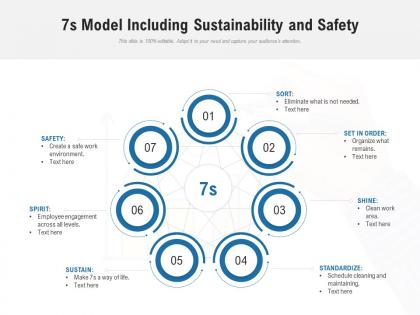
7s model including sustainability and safety




Try Before you Buy Download Free Sample Product
 Impress Your
 Audience
 100%
100% Editable
 Save Hours
 of Time


Generate fodder for their brains with our 7s Model Including Sustainability And Safety. Feed them with the facts to chew on.
People who downloaded this PowerPoint presentation also viewed the following :
7s model including sustainability and safety with all 2 slides:
Feed them with the facts to chew on with our 7s Model Including Sustainability And Safety. Generate fodder for their brains.
FAQs for 7s model including
The 7S model comprises Strategy, Structure, Systems, Shared Values, Skills, Style, and Staff, which can be strategically aligned with sustainability through eco-focused policies, green organizational frameworks, and environmental management systems. Companies like Patagonia and Unilever demonstrate this alignment by embedding sustainability into corporate values, developing green skills across teams, and implementing leadership styles that prioritize environmental responsibility, ultimately delivering competitive advantage while reducing operational costs.
The 7S model facilitates safety integration by aligning structure, systems, staff, skills, style, strategy, and shared values around safety objectives, ensuring comprehensive organizational commitment. Through this framework, companies systematically embed safety protocols across departments, enhance employee training programs, and cultivate safety-focused cultures, ultimately delivering reduced incidents, improved compliance, and sustainable competitive advantage.
Shared values in the 7s model enhance sustainability by creating organizational alignment around environmental responsibility, embedding eco-conscious principles into decision-making processes, and fostering employee commitment to green initiatives. When sustainability becomes a core shared value, companies streamline resource allocation toward renewable energy, waste reduction, and circular economy practices, with many organizations finding that value-driven sustainability efforts deliver competitive advantage and stronger stakeholder relationships.
The skills dimension can be leveraged by developing competencies in risk assessment, environmental stewardship, safety protocols, incident prevention, and sustainability practices through targeted training programs. Organizations in manufacturing, healthcare, and energy sectors enhance employee capabilities in hazard identification, resource optimization, and compliance management, while building cross-functional expertise that ultimately delivers reduced workplace incidents and improved environmental performance.
Structure provides the organizational framework, reporting hierarchies, accountability systems, and cross-functional coordination mechanisms essential for embedding sustainability initiatives and safety protocols throughout operations. Through clear governance structures, organizations streamline environmental compliance, enhance safety oversight, and integrate sustainable practices across departments, with many companies finding that well-defined structural frameworks ultimately deliver measurable environmental outcomes and comprehensive risk mitigation.
The system component can be optimized through implementing circular economy processes, adopting renewable energy infrastructure, integrating environmental management systems, establishing waste reduction protocols, and deploying real-time sustainability monitoring technologies. These systematic approaches enable organizations to streamline resource utilization, minimize environmental impact, and enhance operational efficiency, with many manufacturing and retail companies finding that systematic sustainability integration delivers both cost savings and competitive advantage in increasingly environmentally-conscious markets.
Effective strategies include establishing open communication channels, promoting cross-functional safety teams, implementing shared decision-making processes, encouraging transparent incident reporting, and creating collaborative problem-solving sessions. These approaches enhance organizational safety culture by breaking down silos, facilitating knowledge sharing across departments, and empowering employees to actively participate in safety initiatives, ultimately delivering improved risk management and sustainable safety outcomes.
The strategy element serves as the foundational blueprint for sustainability goals by aligning resource allocation, operational priorities, and competitive positioning with environmental and social objectives. Through strategic integration, organizations embed sustainability into core business processes, product development, and stakeholder relationships, ultimately delivering enhanced brand reputation, operational efficiency, and competitive advantage while meeting increasingly demanding regulatory and consumer expectations.
Monitoring and evaluation processes integrate into the 7s model through systematic assessment of each element's safety and sustainability performance, including regular audits of systems, skills training effectiveness, and structural compliance measures. Organizations can embed continuous feedback loops within their strategy development, staff performance reviews, and shared values alignment, ultimately delivering measurable improvements in environmental impact and workplace safety while maintaining operational excellence.
Leadership development within the 7s framework enhances safety and sustainability by aligning skills, shared values, and style with organizational objectives, while strengthening systems and structures that support environmental stewardship. Through strategic leadership training, organizations cultivate safety-conscious decision-making, sustainable resource management, and accountability frameworks, ultimately delivering improved workplace safety, reduced environmental impact, and competitive advantage in increasingly sustainability-focused markets.
Organizations face challenges including conflicting priorities between short-term profits and long-term sustainability goals, resistance to cultural change, inadequate skills for green practices, and misaligned performance systems. These alignment issues create operational inefficiencies, with many companies finding that systematic integration across strategy, structure, and shared values ultimately delivers competitive advantage while enhancing safety outcomes.
The 7s model adapts to evolving sustainability and safety regulations by aligning systems, structure, and strategy with new compliance requirements, while embedding environmental and safety considerations into skills development, staff training, and shared values. Organizations increasingly integrate regulatory monitoring into their strategic planning processes, with companies in manufacturing, energy, and healthcare finding that proactive 7s alignment enables faster regulatory response, reduces compliance costs, and ultimately delivers competitive advantage through sustainable operational excellence.
Stakeholder engagement within the 7S model ensures alignment across structure, systems, and shared values while building trust, transparency, and accountability for sustainability and safety initiatives. Through collaborative involvement, organizations streamline decision-making, enhance compliance monitoring, and accelerate implementation, with many companies finding that engaged stakeholders deliver stronger environmental outcomes and workplace safety performance.
Technology and innovation enhance the 7s model through digital safety monitoring systems, IoT sensors for environmental tracking, AI-powered risk assessment tools, and automated compliance platforms. These technologies streamline strategy development, strengthen safety-focused skills training, and enable real-time sustainability reporting, with many organizations finding that integrated digital solutions ultimately deliver improved operational efficiency and competitive advantage.
Organizations should evaluate employee engagement scores, incident reduction rates, sustainability target achievement, resource efficiency improvements, and stakeholder satisfaction levels when measuring 7s model effectiveness in promoting sustainability and safety. These metrics enable comprehensive assessment across all seven elements, with many companies finding that integrated measurement approaches deliver clearer insights into organizational transformation and competitive advantage.
No Reviews