


Our goals and objectives ppt powerpoint presentation icon inspiration




Try Before you Buy Download Free Sample Product
 Impress Your
 Audience
 100%
100% Editable
 Save Hours
 of Time


Influence further developments with our Our Goals And Objectives Ppt Powerpoint Presentation Icon Inspiration. Guide folks on figuring out the course to follow.
People who downloaded this PowerPoint presentation also viewed the following :
Content of this Powerpoint Presentation
Description:
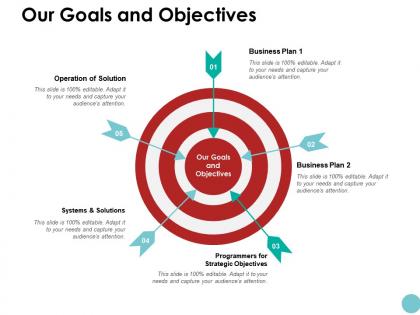
The image is a PowerPoint slide titled "Our Goals and Objectives." It features a central circular target graphic with arrows pointing to different sections of the target, symbolizing the focus on various goals or aspects of a strategic plan. Each section of the target is associated with a specific area of focus, and is numbered for reference:
1. Business Plan 1:
This section is likely meant to outline the first part of a business strategy.
2. Business Plan 2:
This could be a continuation or a different aspect of the business strategy.
3. Programmers for Strategic Objectives:
This may refer to specific initiatives or projects designed to meet strategic goals.
4. Systems & Solutions:
This could represent the technological or systematic approaches to achieving objectives.
5. Operation of Solution:
This is possibly focused on the implementation and management of the solutions proposed.
Each section includes a note, "This slide is 100% editable. Adapt it to your needs and capture your audience's attention," indicating that the slide is customizable for specific presentations.
Use Cases:
This type of slide is versatile and can be effectively used in various industries for strategic planning and goal setting:
1. Technology:
Use: Outlining new product development plans.
Presenter: CTO
Audience: Development teams, stakeholders
2. Healthcare:
Use: Setting objectives for patient care improvement.
Presenter: Healthcare Administrator
Audience: Medical staff, department heads
3. Education:
Use: Detailing goals for educational programs and curricula.
Presenter: Academic Director
Audience: Faculty, educational planners
4. Finance:
Use: Discussing financial targets and growth strategies.
Presenter: CFO
Audience: Investors, financial analysts
5. Real Estate:
Use: Planning property development and sales strategies.
Presenter: Real Estate Developer
Audience: Sales teams, investors
6. Retail:
Use: Laying out marketing and expansion objectives.
Presenter: Retail Operations Manager
Audience: Marketing teams, store managers
7. Manufacturing:
Use: Defining production efficiency and innovation goals.
Presenter: Operations Manager
Audience: Production supervisors, engineers
Our goals and objectives ppt powerpoint presentation icon inspiration with all 5 slides:
Emerge as the favorite candidate with our Our Goals And Objectives Ppt Powerpoint Presentation Icon Inspiration. Influence the decision of the electorate.

FAQs for Our goals and objectives ppt powerpoint
So basically, goals are the big picture stuff you want to hit, and objectives are the nitty-gritty steps that actually get you there. Like if your goal is "improve customer satisfaction" - that's super vague, right? Your objectives would be way more specific: "boost our NPS score by 15 points in 6 months" or "cut response times to under 2 hours." Honestly, I used to mix these up all the time. When you're mapping out your next project, figure out your main goal first. Then break it into maybe 3-5 solid objectives with actual deadlines and numbers you can track.
Honestly, clear goals are like giving your team a roadmap instead of just saying "figure it out." Everyone knows what they're actually working toward, so there's way less confusion and wasted effort on random stuff. Plus you can actually track if you're making progress, which feels pretty good. I've found breaking big goals into smaller chunks works best - people can see they're getting somewhere instead of just grinding away at some massive thing. Oh, and celebrating those small wins? Total game changer for keeping everyone motivated. It's basically the difference between wandering around lost versus knowing exactly where you're headed.
Oh man, SMART criteria are like a lifesaver for writing objectives that don't suck. You know how people write vague goals like "improve customer satisfaction"? Yeah, that's useless. SMART makes you get specific about what you're measuring, if it's actually doable, and when you'll finish. I bombed a project last year because I skipped this step - learned my lesson! The acronym stands for Specific, Measurable, Achievable, Relevant, Time-bound. Honestly just run through each letter as a checklist before you finalize anything. It'll save you so much headache later.
Honestly, visual templates are game-changers for goal clarity. They force you to organize stuff the same way every time, so people know exactly where to find deadlines and updates. No more hunting through random email paragraphs - which is the worst, by the way. Clean layouts with progress bars or milestone charts just grab attention better than walls of text. You'll save tons of time too since you're not starting from scratch each update. I'd make maybe 2-3 different formats depending on what type of goal you're tracking. Trust me, consistency makes everything easier.
Don't bite off more than you can chew - stick to 3-5 goals max. The worst thing? Making them super vague like "boost customer satisfaction." That tells you literally nothing useful. Get your team involved from day one since they're doing the actual work anyway. I've seen so many managers skip this step and wonder why nothing gets done. Make everything specific and measurable. Oh, and don't just tell people what you want - explain why it matters to the business. People work way harder when they get the bigger picture.
Honestly, this stuff actually works. People want to know their work matters beyond just hitting random targets. Once someone sees how their daily tasks connect to bigger company wins, they're way more invested. It's that "aha" moment where everything clicks. Short bursts of clarity beat endless confusion every time. You should literally map out each person's goals and show them the line to company objectives - sounds obvious but most places skip this step entirely. Makes people feel ownership instead of just showing up for a paycheck, which let's be real, changes everything about how they approach their work.
Honestly, just pick whatever method you'll actually use consistently - that matters way more than finding some perfect system. I usually do weekly check-ins to see what I've knocked out and what's still hanging around. Breaking big goals into smaller chunks with deadlines is a game changer, makes things way less intimidating. For tracking, you could go simple with checklists or get fancy with metrics if your goals have numbers attached. I've been using Notion lately but even a basic spreadsheet does the trick. The key is sticking with whatever you choose... which is easier said than done, let's be real.
Get stakeholders involved early - like, during planning, not after you've already decided everything. They'll tell you what success actually looks like from their end and catch roadblocks you'd totally miss. Honestly, I've watched so many goals crash because nobody bothered asking the people doing the actual work. Have them help rank priorities too since they know way better than leadership what's realistic with current resources. Run some workshops or quick surveys to gather input. Way better than just dropping goals on people later and expecting buy-in.
Honestly, team stuff can totally sink your goals even when the plan looks solid on paper. Good communication and trust? You'll crush deadlines and come up with way better solutions. But throw in drama, mixed signals, or people not knowing their role - suddenly everything's a mess. Oh, and that psychological safety thing is real. When people aren't scared to speak up, they actually catch problems before they explode. Plus they get more creative which is always nice. Just check in on how they're actually vibing together, not just the work output.
Honestly? Every quarter at minimum, but monthly is way better if you can swing it. I used to think quarterly was enough until I realized how fast things change - like, what made sense in January can be totally irrelevant by March. Crazy how that happens. Do deeper dives quarterly where you really assess everything and maybe shift priorities. Monthly check-ins can be super quick, just making sure you're not completely off course. Oh, and actually put these in your calendar right now or you'll definitely forget.
Figure out what actually matters to your stakeholders first - like what numbers they really care about. I'd rank everything by impact vs effort because honestly, those quick wins are gold. MoSCoW method works great (Must have, Should have, etc.) since it makes people have the hard conversations upfront instead of later when everything's chaos. Pick maybe 3-5 main goals tops. Any more and you'll spread yourself too thin. Each goal should tie back to your main thing somehow. Write it all down and check weekly - priorities change and that's just life. Oh, and don't feel bad about saying no to stuff that doesn't fit.
Honestly, visuals just make everything click better than boring bullet points. Your audience can actually follow what you're trying to say when you use charts and timelines instead of walls of text. People remember pictures way better anyway - there's real research on that. Bar charts work great for showing progress, and timeline graphics help map out your key goals. You'll probably catch gaps in your own thinking too, which is kinda nice. I'd start simple and add more complex stuff only if you need it. Way better than watching people's eyes glaze over during your presentation.
Ugh, missed goals are the worst but totally fixable. Take a step back and figure out what actually happened - maybe you set the bar too high or life just got in the way (happens to me constantly). You've got options though. Push the deadline back, chop it into bite-sized pieces, or honestly just change course completely if it doesn't fit your situation anymore. I'm a big believer that sometimes the original plan was just wrong from the start. Whatever you do, just be real about what went sideways and make your next move concrete.
Oh man, yeah cultural stuff can totally mess with goal-setting if you're not paying attention. People from hierarchical cultures expect goals handed down from the top. Meanwhile others want everyone involved in planning sessions - it's honestly a balancing act. Some teams love super detailed targets, others prefer keeping things flexible and relationship-based. Then there's the whole time thing... like some cultures are all about long-term vision while others need quick wins. I actually got burned on this with our Tokyo team once! Best bet is just talking openly about everyone's preferences upfront and finding something that works for the whole group.
Dude, collaborative tools are honestly a game changer for goal-setting. Everyone jumps in at once instead of that awkward "who wants to go next" silence. People actually engage more when they can type their thoughts digitally - weird but true. The visual stuff really helps too since you can literally see how your goals fit into the bigger picture. What I love most? Everything gets saved automatically so you're not frantically scribbling notes. Try Miro or even just a Google Doc next time. Your team will thank you, trust me.
No Reviews