


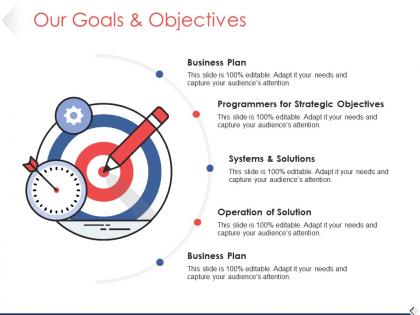
Our goals and objectives ppt background template 1




Try Before you Buy Download Free Sample Product
 Impress Your
 Audience
 100%
100% Editable
 Save Hours
 of Time


Develop the desire for achievement with our Our Goals And Objectives Ppt Background Template 1. Generate ideas that fan aspirations.
People who downloaded this PowerPoint presentation also viewed the following :
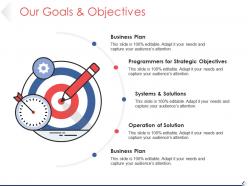
Our goals and objectives ppt background template 1 with all 5 slides:
Your hunger for ideas will be appeased by our Our Goals And Objectives Ppt Background Template 1. Allow your eyes to feast on them.

FAQs for Our goals and objectives ppt
Goals are broad, overarching outcomes a project aims to achieve, while objectives are specific, measurable steps that lead to goal accomplishment. In project management, goals provide strategic direction and vision, while objectives break down into actionable tasks with defined timelines, metrics, and deliverables, ultimately enabling teams to track progress systematically.
Aligning team goals with organizational objectives enhances productivity by creating unified direction, eliminating conflicting priorities, and ensuring resource optimization across departments. This strategic alignment enables teams to focus efforts on high-impact activities, reduces duplicated work, and accelerates decision-making, with many organizations finding that coordinated teams deliver measurably faster project completion and improved operational efficiency.
Effective SMART goal strategies include breaking large objectives into smaller milestones, involving stakeholders in the planning process, establishing clear timelines with regular check-ins, and creating measurable metrics that align with organizational priorities. These approaches enhance accountability, improve resource allocation, and maintain team focus, with many organizations finding that collaborative goal-setting increases employee engagement and ultimately delivers higher achievement rates across departments.
Visually appealing presentation templates enhance goal communication by improving audience engagement, clarifying complex information through strategic design elements, and ensuring consistent messaging across organizations. These templates streamline content creation while maintaining professional standards, with many companies finding that well-designed presentations increase stakeholder buy-in and accelerate decision-making processes, ultimately delivering clearer strategic alignment.
Stakeholder feedback provides critical insights for identifying gaps, validating priorities, and ensuring goals align with operational realities and market expectations. This input enables organizations to refine objectives through diverse perspectives, uncover potential challenges, and enhance buy-in, with many companies finding that incorporating stakeholder insights ultimately delivers more achievable goals and stronger strategic alignment.
Team performance metrics evaluate objective success by measuring key indicators like productivity rates, quality scores, deadline adherence, customer satisfaction levels, and revenue targets against predefined benchmarks. Through comprehensive tracking systems, organizations can identify performance gaps, optimize resource allocation, and adjust strategies in real-time, with many companies finding that data-driven evaluation ultimately enhances accountability and delivers measurable competitive advantage.
Common pitfalls include setting vague or unmeasurable objectives, creating unrealistic timelines, failing to align goals with organizational strategy, and neglecting stakeholder input during the planning process. Many organizations find that overly ambitious targets without proper resource allocation lead to team burnout and missed deadlines, ultimately undermining strategic initiatives and competitive positioning.
Collaborative goal-setting strengthens team cohesion by fostering shared ownership, aligning individual strengths with collective objectives, and creating transparent accountability structures. Through inclusive planning sessions, teams in sectors like healthcare and financial services enhance communication, build mutual trust, and maintain higher engagement levels, ultimately delivering improved performance and stronger workplace relationships.
Technology facilitates tracking team objectives through project management platforms, real-time dashboards, automated progress monitoring, collaborative tools, and performance analytics systems. These solutions streamline workflow coordination, enhance transparency across departments, and deliver data-driven insights, with many organizations finding that integrated tracking technologies significantly accelerate goal achievement while improving accountability.
Timeline management directly impacts project resource allocation, milestone tracking, and stakeholder coordination, with compressed schedules requiring enhanced communication and strategic prioritization. Organizations across industries find that realistic timelines enable better quality control and risk mitigation, while ambitious deadlines can accelerate innovation, ultimately delivering competitive advantage through faster market entry.
Short-term business goals include quarterly sales targets, monthly customer acquisition metrics, inventory optimization, and employee training completions, while long-term goals encompass market expansion, brand positioning, digital transformation initiatives, and sustainable revenue growth. These strategic combinations enable organizations to maintain operational efficiency while building competitive advantage, with many companies finding that aligning immediate objectives with broader vision ultimately delivers scalable success and enhanced market positioning.
Locke's Goal-Setting Theory enhances team dynamics by establishing specific, measurable objectives, encouraging collaborative commitment, and creating clear accountability structures that align individual contributions with collective outcomes. Through strategic goal clarity and regular progress tracking, teams achieve improved communication, enhanced motivation, and coordinated effort allocation, ultimately delivering stronger performance results and sustainable competitive advantage.
Tools for presenting goals and objectives include PowerPoint, Prezi, Canva, Tableau, Microsoft Project, and specialized OKR platforms like Monday.com or Asana. These technologies streamline communication by offering visual templates, interactive dashboards, and progress tracking capabilities, with many organizations finding that strategic presentation tools enhance stakeholder engagement, improve alignment across teams, and ultimately deliver faster goal achievement and measurable accountability.
Setting clear objectives improves team accountability by establishing measurable expectations, defined deadlines, specific responsibilities, and transparent performance metrics. When teams understand their targets, they can track progress more effectively, identify bottlenecks earlier, and maintain open communication about challenges, with many organizations finding that structured goal-setting ultimately delivers enhanced collaboration and stronger project outcomes.
Regular goal revision enhances organizational agility, strategic alignment, market responsiveness, performance optimization, and resource allocation effectiveness. This iterative approach enables companies to adapt to changing market conditions, capitalize on emerging opportunities, and maintain competitive advantage, with many organizations finding that quarterly reviews deliver improved outcomes, stronger team engagement, and accelerated business growth.
-
The Designed Graphic are very professional and classic.
-
Great designs, really helpful.