


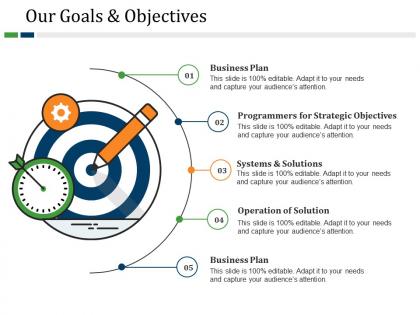
Our goals and objectives powerpoint slide ideas




Try Before you Buy Download Free Sample Product
 Impress Your
 Audience
 100%
100% Editable
 Save Hours
 of Time


Avert disappointments with our Our Goals And Objectives Powerpoint Slide Ideas. They discourage any half measures.
People who downloaded this PowerPoint presentation also viewed the following :
Our goals and objectives powerpoint slide ideas with all 5 slides:
Get the correct beat with our Our Goals And Objectives Powerpoint Slide Ideas. Get them all in the groove.

FAQs for Our goals and objectives
Okay so think of it this way - goals are like your big destination, objectives are the actual turn-by-turn directions. Goals are broader stuff like "make customers happier." Objectives get specific: "hit 90% positive feedback by Q3." You can't really cross goals off a list (they're more ongoing), but objectives? Super satisfying to check those off. Goals answer the "why," objectives handle the "what exactly and by when." Honestly, I'd start with maybe 2 clear goals max for your project, then break each into 3-4 concrete objectives with real deadlines. Otherwise you'll just overwhelm yourself.
Honestly, SMART goals are a game-changer because they stop you from being super vague. Instead of saying "improve sales," you'd write something like "increase Q4 sales by 15% through email campaigns by December 31st." Way clearer, right? The whole Specific, Measurable, Achievable, Relevant, Time-bound thing creates this roadmap you can't really ignore. You'll actually know if you're winning or not. Plus tracking progress becomes so much easier when everything's laid out like that. I swear, once you rewrite one of your goals this way, you'll wonder why you didn't do it sooner.
Honestly, setting clear goals upfront saves you SO much headache later. Your team needs to agree on what you're actually trying to accomplish before anyone touches a slide. I've watched people spend forever making gorgeous presentations that completely bombed because nobody knew what they were aiming for. It's like that saying about rowing in different directions - except way more frustrating when you're on deadline. Once everyone knows what success looks like, decisions about content and design become way easier. No more second-guessing every choice. Just get the team together first and hash out exactly what winning looks like for this thing.
Honestly, visuals just make everything click faster than reading through paragraphs of text. People's brains are wired that way. Try flowcharts for showing your step-by-step process, or timelines if you've got deadlines to hit. I'm obsessed with color coding lately - it instantly shows what's priority vs. what can wait. Charts work great for tracking actual numbers too. Don't just bullet point everything though. Create more of a roadmap showing your starting point, major milestones, then where you're headed. Trust me, people will actually remember your presentation instead of zoning out halfway through.
Honestly, the worst thing you can do is be super vague with your goals. Like saying "inform people about our product" - how do you even know if that worked? I see this all the time and it drives me crazy. Also don't try cramming everything into one presentation. Your audience will just walk away confused about what you actually wanted from them. Pick maybe 2-3 specific things you want to happen - like "get 80% of people to sign up for our pilot." Way better than some generic nonsense. Oh, and make sure it's stuff your audience actually gives a damn about, not just what you think is important.
Okay so first thing - decide what you're actually measuring before you present. Engagement rates, feedback scores, whether people do the action items you gave them, whatever matches your goals. Honestly I'm terrible at remembering this part but it's a game changer when you do! Get those follow-up surveys out within like 48 hours max while everything's still fresh in people's minds. Then track if anyone's behavior actually changed over the next few weeks. Calendar reminders are clutch - set them for one week out and one month. Otherwise you'll totally forget to check back.
Don't just drop your goals on them like "here's what we're doing!" Ask them what success actually looks like first. What problems are they dealing with? Then frame your objectives around fixing *their* stuff or helping them win. Honestly, I bombed a few presentations before figuring this out. Give them a heads up on your main points beforehand too - nobody likes surprises in meetings. The whole thing works better when they feel like they helped shape the goals instead of just sitting there listening to your agenda. Makes such a difference.
Honestly, you've gotta figure out what each group actually gives a damn about first. Executives? Hit them with ROI numbers and big-picture stuff - they don't want the weeds. Technical people are the opposite - they need specifics, timelines, all that detailed work they'll actually be doing. Sales folks are pretty predictable though. Show them how it affects their numbers or customer relationships, or they'll check out fast. I always try to think "what's stressing them out right now?" Then position whatever you're proposing as fixing that exact problem. Oh, and literally tell them upfront what they're getting out of it.
PowerPoint and Canva actually give you decent feedback on design stuff as you go. Track your prep with project management apps - sounds boring but it helps. Screen recording yourself is surprisingly useful for catching weird habits (I cringe every time but whatever). Set calendar reminders for practice sessions or you'll definitely forget. During the actual presentation, try Mentimeter to see if people are actually getting it. Oh, and presentation software can track how long people spend on each slide if you're doing it virtually. Don't go crazy with tools though - pick like 2 or 3 max. You won't use them otherwise.
Oh man, Steve Jobs nailed this with the iPhone launch - remember how he said "we're introducing three revolutionary products" then boom, it was just one device? Genius move. TED speakers do this too, opening with stuff like "I want to change how you think about failure." Even boring sales pitches work better when you're upfront about your goal from minute one. Like "I'm gonna show you how this saves your team 10 hours a week." The trick is being so clear that people know exactly where you're taking them. Makes everything way smoother.
Check in monthly at minimum, but honestly? If your project's moving fast or you're dealing with new tech, bump it to every two weeks. I've watched so many teams cling to goals that made zero sense anymore just because they wrote them down once. Don't do that. Regular checkpoint meetings are your friend here - make goal review a standard agenda item or it'll get pushed aside. The trick is staying flexible without changing direction every five minutes. New info comes up, circumstances shift - your objectives should shift too when it makes sense.
Honestly, ditch the bullet points - they're so overdone. Try roadmaps or pyramid layouts instead. I'm obsessed with visual metaphors right now, like showing goals as mountain peaks or puzzle pieces. Way more interesting than wall-of-text slides that put everyone to sleep. Before/after comparisons work great too, especially if you're showing some kind of transformation. Infographics with progress bars and icons will actually keep people awake (shocking, I know). Canva's pretty solid for this stuff, or even PowerPoint's SmartArt if you're feeling lazy. Just pick something that fits your vibe and don't wing it - test run it first.
Get everyone to poke holes in your initial goals - seriously, fresh eyes catch stuff you miss. Have them ask the basic questions: what are we actually trying to do here? How do we know if it worked? Each person should look at the objectives through their own department's perspective and suggest concrete ways to measure success. You want honest feedback about whether this is even doable with your timeline and budget. Oh, and try this - start your next meeting by having everyone anonymously write their top priority, then compare. The results might surprise you.
Honestly, having clear goals makes such a huge difference for engagement. Your audience can totally tell when you know where you're going vs. just rambling (been guilty of this myself lol). Write down 2-3 specific objectives before you start. This helps you pick better examples and ask questions that actually matter to them. Plus you'll sound way more confident - there's something about having that roadmap that just makes everything click. People lean in more when they sense you're taking them somewhere specific. Those "aha moments" happen naturally when your content has real purpose behind it.
Think of long-term goals as your bigger vision - stuff like boosting brand awareness or getting more people using your product over the next year. Short-term objectives? Those are the concrete things you want right after your presentation ends. Like getting 20 demo requests or booking three follow-up meetings by Friday. Goals can feel pretty abstract sometimes (honestly, a bit wishy-washy). But objectives should be specific and trackable. Your presentation needs to hit both, though I'd focus on nailing those short-term objectives first - they're what you can actually control and measure immediately.
-
Easy to edit slides with easy to understand instructions.
-
Unique design & color.