


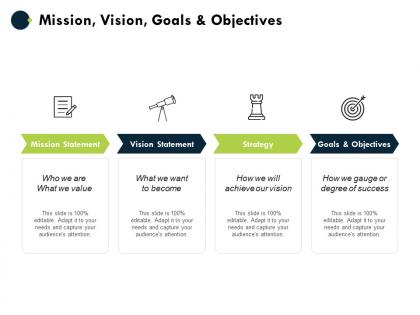
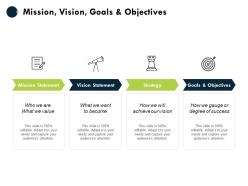
Mission vision goals and objectives statement strategy ppt powerpoint presentation layouts tips




Try Before you Buy Download Free Sample Product
 Impress Your
 Audience
 100%
100% Editable
 Save Hours
 of Time


Interact with journalists through our Mission Vision Goals And Objectives Statement Strategy Ppt Powerpoint Presentation Layouts Tips. Discuss every aspect of important issues.
People who downloaded this PowerPoint presentation also viewed the following :
Mission vision goals and objectives statement strategy ppt powerpoint presentation layouts tips with all 5 slides:
Discuss important aspects of the issue with our Mission Vision Goals And Objectives Statement Strategy Ppt Powerpoint Presentation Layouts Tips. It allows you to interact with journalists.


FAQs for Mission vision goals and objectives statement strategy ppt powerpoint
Mission statements focus on an organization's current purpose, target audience, core activities, and immediate value proposition, while vision statements articulate future aspirations, long-term goals, and desired market position. These complementary elements work together to guide strategic decision-making, with many organizations finding that clear mission-vision alignment enhances employee engagement, streamlines resource allocation, and ultimately delivers stronger competitive positioning in increasingly dynamic markets.
Defining clear goals enhances team productivity by establishing shared priorities, eliminating confusion about responsibilities, and enabling focused resource allocation toward measurable outcomes. Through structured goal-setting frameworks, organizations streamline decision-making processes, reduce duplicated efforts, and create accountability systems, with many companies finding that aligned teams deliver projects faster and achieve higher performance standards.
Organizations can ensure objective alignment through regular strategic planning sessions, cascading goal-setting frameworks, performance measurement systems, and cross-departmental collaboration initiatives. These approaches streamline decision-making by creating clear accountability structures, establishing measurable milestones, and fostering transparent communication channels, with many companies finding that consistent alignment reviews ultimately deliver enhanced operational efficiency and stronger competitive positioning.
Presentation templates aid in mission and vision communication by ensuring consistent messaging, professional visual design, structured content flow, and clear narrative frameworks that align with corporate branding. Through standardized layouts and cohesive formatting, organizations streamline their strategic storytelling, enhance stakeholder understanding, and deliver compelling presentations that reinforce company values, ultimately creating stronger alignment and engagement across teams, investors, and clients.
Stakeholders significantly influence organizational direction by providing diverse perspectives, market insights, resource commitments, and accountability measures that shape mission clarity, vision alignment, and strategic goal setting. Through continuous feedback, investment decisions, and operational support, stakeholders like employees, customers, investors, and communities help organizations refine objectives, ensuring strategies remain relevant and achievable while delivering sustainable competitive advantage.
Companies measure strategic success through key performance indicators, customer satisfaction metrics, financial benchmarks, employee engagement scores, and market position analysis that directly align with mission and vision statements. Through regular assessments and stakeholder feedback, organizations can track progress across operational efficiency, brand reputation, and competitive advantage, with many finding that quarterly reviews and annual strategic audits deliver measurable insights.
Common pitfalls include setting vague objectives, creating unrealistic timelines, lacking measurable metrics, failing to align goals with strategic vision, and insufficient stakeholder involvement. Organizations can avoid these by establishing SMART criteria, conducting thorough resource assessments, and implementing regular review processes, with many companies finding that quarterly check-ins and cross-departmental collaboration ultimately deliver better alignment and sustainable growth outcomes.
Visual storytelling enhances strategic goal understanding by transforming abstract concepts into memorable narratives, creating emotional connections with stakeholders, and simplifying complex frameworks through compelling graphics and data visualization. Through infographics, roadmaps, and scenario illustrations, organizations streamline communication across departments, accelerate buy-in from leadership teams, and ensure consistent strategic alignment, ultimately delivering clearer execution pathways and stronger organizational commitment.
Organizations can employ frameworks like OKRs (Objectives and Key Results), Balanced Scorecard, SMART goals methodology, strategic planning matrices, and cascading alignment models to develop cohesive mission-vision frameworks. These approaches streamline organizational focus by connecting high-level purpose with measurable outcomes, actionable targets, and departmental accountability, with many companies finding that structured frameworks ultimately deliver clearer direction and enhanced performance across all operational levels.
Mission and vision statements evolve through strategic refinements in scope, market positioning, stakeholder focus, and operational scale as organizations mature. Growing companies often expand their mission from local to global reach, broaden their vision to encompass new markets or technologies, and refine objectives to reflect increased capabilities, with many organizations finding that periodic evolution maintains relevance while preserving core values.
Regularly revisiting and revising goals and objectives is critically important for maintaining competitive advantage, ensuring strategic alignment, and adapting to evolving market conditions, customer demands, and industry disruptions. Organizations that embrace this adaptive approach streamline their response times, enhance operational flexibility, and ultimately deliver sustained growth, with many companies finding that quarterly strategic reviews enable faster pivots and stronger market positioning.
Effective communication of strategic objectives includes cascading messaging through multiple channels, using role-specific language, creating visual dashboards, conducting regular town halls, and establishing feedback loops. These approaches enhance understanding by connecting individual contributions to organizational goals, providing transparent progress updates, and enabling two-way dialogue, with many companies finding that consistent, multi-layered communication significantly improves employee engagement and strategic alignment.
SMART criteria can be integrated by ensuring each goal is Specific with clear outcomes, Measurable through quantifiable metrics, Achievable within resource constraints, Relevant to strategic priorities, and Time-bound with defined deadlines. This framework enables organizations across sectors like healthcare, finance, and manufacturing to enhance accountability, streamline progress tracking, and ultimately deliver measurable results while minimizing ambiguity in execution.
Nonprofit mission and vision statements emphasize social impact, community benefit, and stakeholder accountability, while for-profit organizations focus on market competitiveness, shareholder value, and revenue generation. These fundamental differences shape messaging strategies, with nonprofits highlighting purpose-driven outcomes and transparent resource allocation, while businesses emphasize profitability and competitive advantage, ultimately delivering distinct value propositions.
Cultural differences can significantly impact mission and vision interpretation through varying communication styles, value systems, hierarchical expectations, and business relationship approaches across global markets. Companies like McDonald's and Unilever address this by adapting messaging while maintaining core principles, with many multinational organizations finding that localized interpretations enhance employee engagement and customer connection, ultimately delivering stronger market penetration and competitive advantage.
No Reviews