

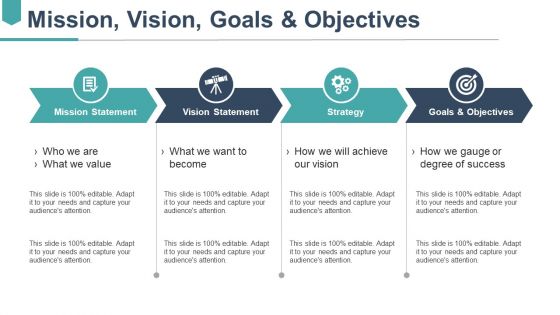
Mission vision goals and objectives ppt slides download





Try Before you Buy Download Free Sample Product
 Impress Your
 Audience
 100%
100% Editable
 Save Hours
 of Time


Our Mission Vision Goals And Objectives Ppt Slides Download allow no excuses. Nothing is too hard for them.
People who downloaded this PowerPoint presentation also viewed the following :
Mission vision goals and objectives ppt slides download with all 5 slides:
Our Mission Vision Goals And Objectives Ppt Slides Download enable effective follow up action. Draw from the benefits of events gone by.
FAQs for Mission vision goals and objectives
Okay so think of it like building a house - your **mission** is why you're doing it (shelter your family), **vision** is what it'll look like finished (that cozy farmhouse with the big porch). **Goals** are your major milestones. "Finish foundation by March." **Objectives** get way more specific - "pour concrete March 15th, pass inspection by March 20th." People confuse these constantly and honestly it drives me crazy! Like, I get it, they sound similar. But if your team can't tell the difference, nobody knows what they're actually supposed to prioritize. Just start with mission first - everything else flows from there.
Honestly, a good mission statement is like having a compass for your whole team. Everyone knows what direction you're heading, so daily decisions become way easier. People feel more connected to their work when they actually get the bigger picture - which sounds cheesy but it's true. You'll find yourself using it as a filter for everything: hiring, priorities, those random "should we do this?" moments. The trick is not letting it become one of those corporate posters gathering dust. Reference it regularly. Actually live by it, you know?
Your vision statement is like having a destination plugged into your GPS - it shows where you're headed long-term, so you can make smarter moves today. Without one? Strategic planning becomes this messy grab bag of random projects that don't connect. I've seen too many businesses do this and wonder why nothing sticks. Having a clear vision keeps everyone on the same page about the big picture. It also helps you decide which opportunities are worth chasing versus the shiny objects you should ignore. Before any major decision, just ask yourself: "Does this actually move us closer to where we want to be?"
Honestly, I'd start with your mission/vision and work backwards from there. Ask yourself - does this goal actually get us closer to where we want to be? I've watched so many teams (including mine lol) pick goals that sound impressive but basically take you in circles. Make them specific enough that you can track progress. Get your team involved in setting them too - people work way harder when they see how their stuff connects to the big picture. Oh, and review them against your mission regularly. Goals have a sneaky way of drifting if you don't.
Honestly, just stick to SMART criteria - it sounds boring but it works. Make everything specific, measurable, achievable, relevant, and time-bound. So instead of "improve satisfaction," say "increase customer satisfaction by 15%." I learned this the hard way after setting vague goals that nobody could agree we'd actually hit. Always ask yourself "how will we know when we've achieved this?" Set clear deadlines. Assign ownership so there's no finger-pointing later. The real test? Anyone on your team should be able to look back in six months and definitively say whether you nailed it or not.
Honestly, pick a few channels and stick with them - don't try to do everything at once. Your company website and team meetings are obvious starting points. Employee handbooks work too, but let's be real, who actually reads those? Social media's great for reaching people outside your company. The trick is staying consistent everywhere so your message doesn't get muddled. Weave it into performance reviews and onboarding naturally. Videos and infographics beat boring text every time - people actually remember visual stuff. Oh, and don't just blast it out once then forget about it. Keep bringing it up in casual conversations too.
Honestly, templates are a lifesaver when you're staring at that terrifying blank page. Why reinvent the wheel when someone already mapped out a solid framework? They'll walk you through the important stuff - your values, what makes you different, future goals. The key is making them yours though. Don't just fill in the blanks like some boring worksheet. Add your personality and actual language. I'd grab 2-3 different styles and see what vibes with your team. Some people think better with bullet points, others need more open-ended prompts. You'll figure out what works pretty quickly.
Honestly, most people mess up by being way too vague - like saying "boost customer satisfaction" without actually defining what that means or how you'll track it. Super annoying when teams do that! Then there's the opposite problem where you set like 10 goals and everyone's drowning. Stick to 3-5 max. Each one needs a real deadline and someone who's actually responsible for hitting it. Oh, and don't just pick random goals that sound good - they should actually connect to your bigger picture. Otherwise you're basically just playing goal bingo. Start with: what specific thing do we want to happen?
Honestly, I just think about which stuff actually moves the needle toward what I'm trying to achieve. Map each objective back to your main goals and see which ones hit multiple targets - those are gold. I make a quick matrix (yeah I know, spreadsheets are nerdy but they work) scoring impact vs how realistic each one is. Tackle the high-impact ones first obviously. Don't forget to check back every few months though since priorities change way more than you'd expect. Oh and feasibility matters just as much as impact - learned that one the hard way.
Honestly, start with employee surveys to see if people actually get what you're trying to do. Customer satisfaction scores help too. Track retention - if your team keeps jumping ship, your mission probably isn't landing. Revenue and market position are obvious ones since a good vision should move the needle business-wise. But here's the thing: don't get caught up in fancy metrics that look impressive but mean nothing. Pick 3-4 specific outcomes your mission should create, then figure out how to measure those directly. What your mission promises matters way more than checking generic boxes.
Look, people need to know WHY they're doing what they're doing. When your team gets the bigger picture, they actually give a damn about their work instead of just showing up for the money. A solid mission helps them connect their boring daily stuff to something that matters. Vision gives them a target to aim for - otherwise you're basically telling people to run blindfolded, which is... not great. The key thing though? You gotta actually talk about this stuff regularly. Can't just slap it on the break room wall and call it a day. Most companies do that and wonder why nobody cares.
Start with surveys or workshops to get feedback from everyone - not just executives. Frontline people usually have the best take on what's actually broken since they deal with the reality gap daily. Draft new mission/vision statements based on what you learn, then run them by the same groups before going live. Honestly, this stuff only works if it feels collaborative rather than some board room decree that gets handed down. The CEO needs to champion it obviously, but don't skip the input phase. Most companies rush that part and wonder why nobody cares about their shiny new statements.
Look at what actually drives your industry crazy first. Tech companies obsess over innovation and user experience - makes sense. Healthcare? Patient safety and outcomes, obviously. Manufacturing has gotten really into the sustainability thing lately, plus the usual quality stuff. You'll want to figure out your top three industry headaches and address at least one in your mission statement. What keeps your competitors' CEOs awake at night? Start there. Don't just copy what sounds good - your customers can smell generic corporate speak from miles away. Make it speak to real problems people in your space actually face.
Honestly, break those big goals into tiny pieces you can actually measure. Check in monthly (or quarterly if you're busy) and actually look at the numbers - don't just talk about checking in. I swear every team I know sets goals in January then completely forgets until year-end panic mode hits. Someone needs to own each piece, and you've gotta weave accountability into regular meetings somehow. The whole point is keeping this stuff visible so you can pivot when things inevitably go sideways. Oh, and if you're drowning? Just pick one or two objectives to start.
So basically, it comes down to what they're chasing. For-profits are all about revenue and making shareholders happy - you know, the whole "industry leader" and "maximizing returns" thing. Non-profits? They're focused on actually helping people and communities. Their mission statements sound way different too - like "serving families" instead of "dominating market share" or whatever. Both still need solid vision statements that actually mean something though. Oh, and here's what I've noticed - the language has to match what you're really trying to do. Otherwise people see right through the BS.
-
Topic best represented with attractive design.
-
Great product with effective design. Helped a lot in our corporate presentations. Easy to edit and stunning visuals.