


12 Month Digital Marketing Plan For Effective Campaign




Try Before you Buy Download Free Sample Product
 Impress Your
 Audience
 100%
100% Editable
 Save Hours
 of Time


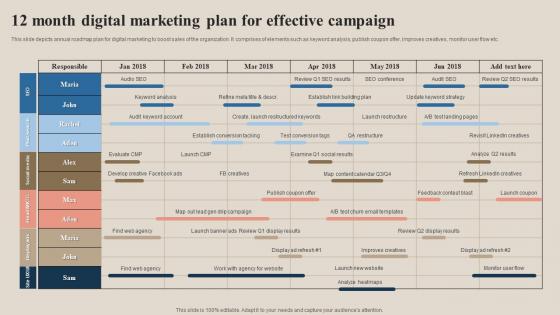
This slide depicts annual roadmap plan for digital marketing to boost sales of the organization. It comprises of elements such as keyword analysis, publish coupon offer, improves creatives, monitor user flow etc.
People who downloaded this PowerPoint presentation also viewed the following :
12 Month Digital Marketing Plan For Effective Campaign with all 6 slides:
Use our 12 Month Digital Marketing Plan For Effective Campaign to effectively help you save your valuable time. They are readymade to fit into any presentation structure.





FAQs for 12 Month Digital Marketing Plan
Honestly, focus on these five things: set specific goals (like boosting leads by 30%), know exactly who you're targeting, pick your channels, plan your content, and figure out how you'll track results. Budget matters more than people think - I made the mistake of spreading mine too thin across like six platforms. Pick 2-3 where your audience actually is instead of trying to be everywhere. That whole "we need to be on TikTok because it's popular" thing? Total waste if your customers are all on LinkedIn. Make everything measurable so you can show leadership what's working and ditch what isn't.
Honestly, pick 2-3 platforms where your people actually are instead of trying to be everywhere. Social media's great for showing your brand's personality and getting people back to your site. I'd start by checking out what your competitors are doing well - sounds obvious but most people skip this step. Post regularly and focus on stuff that gets people talking and sharing since that's what boosts your reach organically. Don't overthink it too much. The real magic happens when you engage authentically with your audience rather than just broadcasting at them.
So here's the deal with SEO - it's like the backbone for everything else you'll do online. Your content marketing, social media, all that stuff works better when you've got solid SEO driving organic traffic. Sure, it takes months to see real results (which honestly drives me crazy sometimes), but it's way cheaper than constantly paying for ads. Good SEO actually makes your whole site better for users too, so that helps with conversions. I'd start by checking where your site stands now, then build your content around whatever keywords you want to rank for. Makes the whole process less random.
Okay so first thing - figure out what success actually looks like for you. Leads? Sales? Brand stuff? Pick like 3-5 metrics that matter and ignore the rest for now. Google Analytics is clutch, but also check out the native analytics on Facebook, LinkedIn, whatever you're using. UTM parameters are a game changer for tracking which campaigns actually work (not just pretty vanity metrics). Focus on conversion rates, cost per acquisition, ROI - the stuff that hits your bottom line. I made the mistake early on of getting lost in all the data. It's honestly overwhelming at first. Review weekly and you'll start seeing patterns.
Honestly, start with short-form video if you haven't already - TikTok's here to stay whether we like it or not. AI personalization is getting really good too, plus interactive stuff like polls actually works now. Voice search is blowing up since literally everyone talks to Siri instead of typing. Oh, and you'll definitely want to collect your own customer data because third-party cookies are basically dead. Community building through user-generated content is solid gold right now. Sustainability messaging hits different with Gen Z if that fits what you do. Don't try everything at once though - audit what you're missing, then test maybe 2-3 things max.
Start with whatever customer data you've got - CRM stuff, purchase history, how people engage with your content. Build buyer personas from that. Then break it down by age, location, what they're into, where they are in the buying process. Social media analytics are honestly where you'll find the best insights though. Google Analytics and Facebook Audience Insights work great, or just send out surveys to figure out what's bugging people. Once you know your segments, match your messaging to each group and pick the right channels. Test different approaches and tweak based on what actually works.
Okay so first thing - figure out what you're already spending on ads, tools, team stuff, all that. Content creation costs are sneaky too, they really do add up. I swear by the 70/20/10 split: most money goes to what's already working, 20% for testing promising stuff, then 10% for wild experiments. Always budget extra though - maybe 15-20% cushion for when platforms suddenly change their algorithm or whatever. Start by looking at your current spend, then move money around based on what's actually getting you results. Makes way more sense than starting from scratch.
Think of content marketing as your home base - everything else flows from there. Create blog posts or videos that actually solve problems your audience has. Then just repurpose that same stuff across social media, emails, whatever. Way cheaper than making new materials constantly (and honestly less exhausting). Plus it helps with SEO and makes you look like you know what you're talking about instead of just selling all the time. I'd start with maybe 3-4 main topics that fit your business, then squeeze every drop out of each piece by sharing it everywhere. Works way better than random promotional posts.
Google Analytics and Google Ads are must-haves, no question. Hootsuite's great for scheduling social posts - saves me so much time honestly. For email stuff, Mailchimp works well and won't break the bank. HubSpot's CRM is solid too, helps track who's actually interested vs just browsing around. Oh, and everything changes crazy fast in this space, so don't get too attached to any one tool lol. Start with free versions first though! Once you figure out what you actually use (vs what sounds cool), then upgrade.
Okay so email marketing is basically your most direct way to reach customers without paying crazy ad costs. Don't send the same boring message to everyone though - split your list up by what people actually buy or how they behave on your site. Send them stuff they'd care about: exclusive deals, useful tips, whatever makes sense for each group. Set up those automated sequences for new subscribers and people who abandon their carts (seriously saves so much time). You'll want to watch your open rates like a hawk. Oh and always make it super clear what you want them to do next - whether that's buying something or just clicking through to your site.
Know your audience's actual problems first - that's where good ads start. Headlines need to hook people immediately, so test different angles. Visuals should make someone stop scrolling, and honestly? Most CTAs I see are way too vague. Write like you're talking to someone, not pitching at them. Focus on what they get, not what your product does. Test everything - images, headlines, buttons. Don't stuff multiple messages into one ad either. Track your click-through rates and pivot when something's not hitting. It's really about finding what connects with people.
Honestly, analytics are a game-changer because they show you what's *actually* working, not just what you think is working. Track which channels get you the most conversions and what content people actually engage with. You'll see exactly where folks bail out of your funnel too. I know it sounds boring, but set up weekly dashboard reviews - the data will surprise you sometimes. Oh, and here's the key thing: only test one change at a time or you won't know what's actually making the difference. Trust me, your gut instincts aren't always right about this stuff.
Honestly, most people mess up by being way too vague with their goals and trying to do everything at once. Don't target "everyone" - that never works. Pick 2-3 channels tops when you're starting. Budget way more time and money than you think because this stuff takes forever to actually pay off. I always tell people to research their competitors first, but like half ignore that advice for some reason? Get super specific about who you're actually trying to reach and what success looks like. Test small, then double down on whatever's working.
Honestly, working with influencers is a game-changer for getting your stuff in front of new people. Their followers already trust them, so it doesn't feel like you're shoving ads down people's throats. Don't get caught up in follower counts though - I've seen micro-influencers absolutely crush it with engagement rates. Focus on finding people whose audience actually matches who you're trying to reach. They'll create content that feels natural, send traffic your way, and you can reuse their posts later. Oh, and start small - maybe reach out to 3-5 relevant creators with a solid pitch first.
GDPR and CCPA are the big ones for data stuff - get consent before collecting emails or tracking cookies. FTC wants you to disclose sponsored posts and affiliate links clearly. Copyright's another headache if you're grabbing random images or music. Any product claims? Better have proof ready. Rules shift constantly and honestly it's exhausting trying to stay on top of everything. Run bigger campaigns by legal first - saves headaches later. Oh, and don't make health claims unless you want the FDA knocking on your door.
-
Their professional templates are very impressive, even my manager was curious about the source. I am very grateful.
-
World-class PowerPoint designs that are fully customizable!