

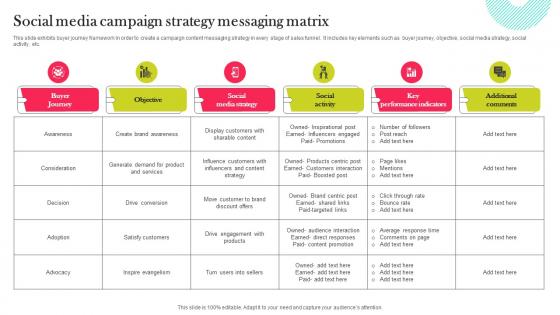
Social Media Campaign Strategy Messaging Matrix




Try Before you Buy Download Free Sample Product
 Impress Your
 Audience
 100%
100% Editable
 Save Hours
 of Time


This slide exhibits buyer journey framework in order to create a campaign content messaging strategy in every stage of sales funnel. It includes key elements such as buyer journey, objective, social media strategy, social activity, etc.
People who downloaded this PowerPoint presentation also viewed the following :
Social Media Campaign Strategy Messaging Matrix with all 6 slides:
Use our Social Media Campaign Strategy Messaging Matrix to effectively help you save your valuable time. They are readymade to fit into any presentation structure.





FAQs for Social Media Campaign
Okay so you need clear goals first - like are you trying to get people to know about you, engage with your stuff, or actually buy something? Figure out who you're talking to too. Most people just post random content everywhere which is honestly such a waste of time. Pick 2-3 platforms where your audience actually is instead of trying to be on every single one. Each platform has its own vibe so your content should match that. Oh and set up a content calendar - sounds boring but trust me it helps. Don't forget to budget for ads too, not just organic posts. Track your results so you know what's working and what isn't.
Start with your existing customer data - who's actually engaging and buying from you? Build 2-3 detailed fake personas from those patterns. I'm talking full characters with names, ages, what keeps them up at night, which social apps they scroll. Last month I literally created "Marketing Mike" and "Frugal Fiona" (yeah, I get carried away with the alliteration). Survey real customers too because your assumptions will probably be way off. Make them specific enough that when you're planning content, you can actually think "would my persona Jessica give a damn about this?" That specificity is what makes personas actually useful instead of just a pointless exercise.
Start with engagement stuff - likes, comments, shares, saves. That's what actually tells you if people care about your content. Reach and impressions matter too for seeing your audience size. Click-through rates are huge if you're trying to send people somewhere specific. Honestly, I used to get caught up in vanity metrics but focus on what connects to your actual business goals instead. Conversions, leads, whatever you're actually trying to achieve. Quality followers beat quantity every time. Oh, and set up those UTM things so you can track social traffic in Google Analytics - super helpful for seeing the whole picture.
Dude, storytelling is like magic for social media. Instead of just dumping info on people, you're making them *feel* something. I swear, the difference between posting random product shots vs. telling an actual story is insane. People literally stop scrolling when there's a narrative - could be a customer's journey, some behind-the-scenes drama, whatever. The emotional hook is what gets them commenting and sharing your stuff later. Oh and structure matters too - give your posts a beginning, middle, end. Sounds obvious but most people skip this part. Try it on your next few posts, you'll see what I mean.
Okay so content calendars are literally a lifesaver - they keep you from panicking at 9am wondering what to post. Map out your big campaign dates first, then fill in daily stuff around them. This way you can actually plan quality content instead of throwing together random posts. It helps balance different types of content too, and honestly? Your brand voice stays way more consistent when you're not scrambling. I learned this the hard way after posting some truly cringe content under deadline pressure lol. Having everything plotted out just makes the whole process so much smoother.
Okay so basically you've gotta match each platform's energy. Instagram's all about pretty visuals and Stories. LinkedIn wants you sounding professional with industry hot takes. TikTok? Short videos jumping on whatever trend is happening - I swear I lose hours just "researching" on there lol. Twitter's perfect for quick thoughts and jumping into conversations. Facebook still does surprisingly well with longer posts and building actual communities. Figure out where your people are hanging out first, then see what's already working in your space. Don't try to post the same thing everywhere - it just looks lazy.
Make it stupid easy for people to jump in - that's honestly the biggest thing. A catchy hashtag helps, but don't overthink it. Run contests with prizes people actually care about (not just your branded merch lol). When people do submit stuff, showcase it everywhere and tag them properly. Everyone wants that moment of fame on your main account. Templates work great too - gives people direction without being restrictive. Oh, and this is key: post examples of what good UGC looks like so they get it. Half the battle is just showing people you're serious about featuring their content.
You know how we're always guessing what'll work on social? A/B testing actually shows you what your audience likes instead. Test captions, images, posting times, hashtags - whatever. Honestly, I've had posts I thought were genius totally bomb while weird random stuff blew up. Only change one thing at a time though, or you won't know what made the difference. Maybe start with two different captions on similar posts? Once you see patterns emerging, you can get more ambitious with your tests. It's kinda addictive once you start seeing real data.
So here's what I'd do - put like 60-70% toward the actual ads, then use whatever's left for making content. Graphics, videos, maybe some influencer stuff if that's your thing. Oh and those software subscriptions will totally sneak up on you cost-wise! Start small first though. Test what actually works before you blow your whole budget. Someone still has to post all the organic stuff too, which takes time. I always keep around 10-15% extra because you'll definitely want to change things halfway through. Trust me on that one.
Stop treating your social media like it's living on an island! Everything should connect - your Instagram stories, email campaigns, paid ads, all of it. Same messaging, same look. Track those UTM codes so you actually know what's working together. One blog post? Turn it into LinkedIn carousels, Instagram graphics, email content - milk that thing for everything it's worth. Honestly, the biggest game-changer is getting everyone on the same campaign calendar. No more teams doing random stuff without talking to each other. Pick your next campaign and map out how each platform supports the others. It's way less chaotic than it sounds.
Don't get caught up in follower counts - find people whose audience actually fits your demographic. Check engagement rates first, then scroll through their past brand collabs. Trust me, nothing kills a campaign like picking someone totally off-brand (made that mistake once, ugh). Let them do their thing creatively within your guidelines. Their followers follow them for a reason, not for scripted corporate speak. Be super clear upfront about what you need and when. Oh, and micro-influencers are perfect for testing what actually works before you go bigger. Track real metrics too - conversions matter way more than likes.
Start planning for inclusivity right from the beginning - don't just slap it on at the end. Mix up your visuals with people of different races, ages, and body types. Your copy should skip the jargon and inside jokes that'll leave people out (seriously, I've watched so many brands mess this up). Alt text on images is huge, plus captions for videos and colors that work for colorblind folks. Test everything with different groups first. Oh, and make yourself a checklist - sounds boring but it'll save your butt when you're rushing to launch.
Honestly, start with Google Analytics and Facebook Insights since they're free and will show you the basics. Once you get the hang of those, Hootsuite or Buffer are pretty solid for managing multiple platforms - way less of a headache than logging into everything separately. Sprout Social's interface is actually really clean too. If you want to get fancy with sentiment tracking and see what competitors are doing, Brandwatch is worth checking out. But seriously, don't overcomplicate it at first. Figure out which numbers actually matter for your stuff, then you can always upgrade later when you know what you're looking for.
Actually pay attention to what people are saying in your comments and DMs - most brands just ignore this goldmine. Set up weekly check-ins to spot patterns. What keeps coming up? Same complaints? Requests you're missing? Then actually DO something about it. Adjust your content, switch up your tone, maybe even pivot which platforms you focus on. Here's the thing though - if someone suggests something and you make the change, tell them! People love knowing they were heard. It's honestly one of the easiest ways to build real loyalty.
Okay so first thing - always disclose sponsored stuff clearly because the FTC will come for you. Don't mess around with that. Be honest about what products actually do and don't prey on people's insecurities, especially kids. Privacy matters too, so get consent before using anyone's content. Also, maybe don't hop on every tragic news event for clout? That's just gross. I use this rule: if I wouldn't want my family seeing it, probably shouldn't post it. Oh, and make sure your whole team knows these boundaries - you can't just wing ethical marketing.
-
I discovered this website through a google search, the services matched my needs perfectly and the pricing was very reasonable. I was thrilled with the product and the customer service. I will definitely use their slides again for my presentations and recommend them to other colleagues.
-
Thank you for offering such fantastic custom design services. The team is really helpful and innovative. In a very short time, I received my personalized template.