


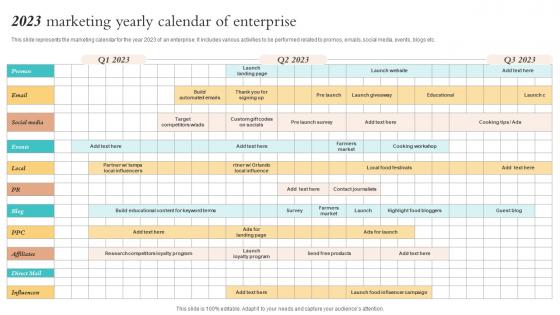
2023 Marketing Yearly Calendar Of Enterprise




Try Before you Buy Download Free Sample Product
 Impress Your
 Audience
 100%
100% Editable
 Save Hours
 of Time


This slide represents the marketing calendar for the year 2023 of an enterprise. It includes various activities to be performed related to promos, emails, social media, events, blogs etc.
People who downloaded this PowerPoint presentation also viewed the following :
2023 Marketing Yearly Calendar Of Enterprise with all 6 slides:
Use our 2023 Marketing Yearly Calendar Of Enterprise to effectively help you save your valuable time. They are readymade to fit into any presentation structure.





FAQs for 2023 Marketing Yearly
Key events for a 2023 marketing calendar include New Year's resolutions season, Valentine's Day, International Women's Day, Earth Day, Mother's Day, Father's Day, back-to-school periods, Halloween, Black Friday, and Cyber Monday. These strategic touchpoints enable brands to align campaigns with consumer mindsets, seasonal purchasing behaviors, and cultural moments, with many retail, e-commerce, and service organizations finding that synchronized timing ultimately delivers higher engagement rates and conversion opportunities.
Seasonal trends can be effectively integrated through comprehensive calendar planning, consumer behavior analysis, historical data review, and flexible campaign development that aligns with key shopping periods, holidays, and industry-specific cycles. Retailers leverage back-to-school and holiday seasons while B2B companies capitalize on fiscal year planning periods, ultimately delivering timely messaging and enhanced customer engagement.
Social media plays a pivotal role in shaping marketing calendars by providing real-time audience insights, trending topics, platform-specific seasonal campaigns, and engagement analytics that inform strategic timing decisions. Through social listening tools and performance data, businesses can align content launches with peak audience activity, capitalize on viral moments, and coordinate cross-platform campaigns, ultimately delivering higher engagement rates and more targeted customer experiences.
Businesses can leverage international observances by aligning campaigns with global events like Earth Day, International Women's Day, World Health Day, and Cultural Heritage Month to connect with diverse audiences authentically. Strategic planning around these observances enables companies to demonstrate social responsibility, expand market reach across different demographics, and create timely content that resonates globally, ultimately driving engagement and brand loyalty.
Best practices for aligning product launches with the 2023 marketing calendar include strategic timing around seasonal peaks, leveraging cultural moments and holidays, coordinating with industry events, avoiding competitor launch windows, and building pre-launch momentum campaigns. These approaches enhance market visibility by capitalizing on increased consumer attention, maximizing media coverage opportunities, and synchronizing promotional efforts, with many organizations finding that well-timed launches deliver significantly higher engagement rates and competitive advantage.
Businesses maintain marketing relevance by regularly analyzing performance metrics, monitoring industry trends, and adapting campaigns based on seasonal shifts, consumer behavior changes, and competitive landscape developments. Through quarterly strategy reviews, real-time social listening, and flexible content calendars, companies can pivot messaging, adjust targeting, and reallocate resources, ultimately delivering consistent engagement while staying responsive to market dynamics and emerging opportunities.
Tools for creating dynamic 2023 marketing calendars include project management platforms like Asana and Monday.com, specialized marketing software such as CoSchedule and HubSpot, and collaborative solutions like Google Workspace and Microsoft Teams. These platforms streamline campaign planning, content scheduling, and cross-team coordination, with many organizations finding that integrated calendar systems enhance operational efficiency and deliver more cohesive marketing strategies.
Brands should adapt their 2023 messaging by emphasizing value-driven narratives, personalized offers, authentic sustainability commitments, and omnichannel consistency during peak shopping events. Through strategic segmentation and real-time engagement, retailers like Target and Best Buy successfully blend promotional urgency with brand values, while leveraging social commerce and influencer partnerships to deliver memorable customer experiences and ultimately drive both immediate conversions and long-term brand loyalty.
**INPUT**: What metrics can be used to evaluate the success of marketing campaigns tied to specific dates in the calendar? **OUTPUT**: Key metrics include conversion rates, return on ad spend (ROAS), website traffic spikes, social media engagement, and sales attribution to specific calendar events. These measurements enable marketers to assess campaign performance by comparing pre-event baselines with peak-period results, while tracking customer acquisition costs and lifetime value helps optimize future seasonal strategies, ultimately delivering data-driven insights for enhanced calendar planning. [Word count: 60 words]
Small businesses can compete with larger companies using the 2023 marketing calendar by leveraging strategic timing, focusing on niche audiences during key seasonal periods, and maximizing cost-effective digital channels during high-engagement moments. This approach enables agile campaign launches, targeted local promotions, and authentic community engagement during peak seasons, while larger competitors often struggle with slower decision-making processes, ultimately delivering competitive advantage through personalized customer experiences.
Brands can leverage World Sleep Day with wellness campaigns, International Left-Handers Day through inclusive product showcases, Random Acts of Kindness Day via community engagement initiatives, and National Puzzle Day with interactive social content. These lesser-known observances enable authentic storytelling, targeted audience engagement, and creative differentiation, with many organizations finding that unique calendar moments deliver stronger brand recall and customer connections than oversaturated major holidays.
Marketers can maintain flexibility by building buffer periods between campaigns, allocating 15-20% of their budget for emerging opportunities, and creating modular content frameworks that adapt quickly across channels. This strategic approach enables rapid pivots when new platforms or consumer behaviors emerge, with many retail and technology companies finding that flexible calendars deliver faster market responses and competitive advantage.
Seasonal content priorities include holiday promotions, back-to-school campaigns, summer lifestyle themes, wellness-focused New Year content, and industry-specific seasonal trends. These strategic approaches enhance customer engagement by aligning with consumer mindsets, seasonal purchasing behaviors, and cultural moments, with many marketing teams finding that seasonal relevance significantly improves campaign performance and brand connection.
Cross-promotional opportunities are identified by analyzing overlapping campaigns, seasonal peaks, complementary product launches, and shared target audiences across monthly calendar segments. Through strategic calendar mapping, businesses can coordinate with partners during high-traffic periods like holiday seasons, back-to-school campaigns, or industry events, ultimately maximizing reach and reducing individual marketing costs while delivering enhanced customer value.
Common pitfalls include over-scheduling campaigns without buffer time, ignoring seasonal audience behavior shifts, failing to allocate resources for emerging platforms, and creating rigid timelines that can't accommodate real-time trends. Many organizations find that successful 2023 calendars balance strategic planning with flexibility, enabling teams to pivot quickly while maintaining consistent brand messaging and competitive advantage.
-
Qualitative and comprehensive slides.
-
Spacious slides, just right to include text. SlideTeam has also helped us focus on the most important points that need to be highlighted for our clients.