


2023 Human Resource Yearly Planning Calendar




Try Before you Buy Download Free Sample Product
 Impress Your
 Audience
 100%
100% Editable
 Save Hours
 of Time


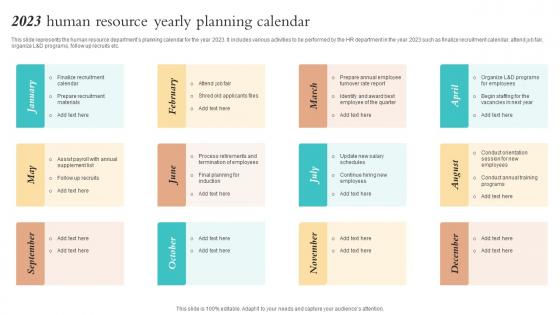
This slide represents the human resource departments planning calendar for the year 2023. It includes various activities to be performed by the HR department in the year 2023 such as finalize recruitment calendar, attend job fair, organize L and D programs, follow up recruits etc.
People who downloaded this PowerPoint presentation also viewed the following :
2023 Human Resource Yearly Planning Calendar with all 6 slides:
Use our 2023 Human Resource Yearly Planning Calendar to effectively help you save your valuable time. They are readymade to fit into any presentation structure.





FAQs for 2023 Human Resource
Start with a workforce audit - see what talent you've got right now. Then do demand forecasting to predict future hiring needs. Gap analysis shows you what's missing between those two. Succession planning covers your key roles (honestly, this part gets overlooked way too much). Build a recruitment strategy around all that. Retention planning matters too - way cheaper keeping good people than constantly hiring. The real trick? Don't treat these like separate projects. They need to connect. I'd personally start with auditing your current team first, then work forward from there.
Honestly, most HR teams get this backwards - they just react when people leave instead of thinking ahead. Start with where your company's actually going in the next few years, then figure out what roles and skills you'll need to get there. Don't do this alone though, that's where things fall apart. Get department heads involved so you can spot the gaps between what talent you have now versus what you'll need. Then build your hiring, training, and succession stuff around those specific gaps. Oh and make sure every HR move connects back to an actual business goal, not just filling empty desks.
Okay so workforce analytics is like having a crystal ball for HR stuff - you can actually predict staffing needs and catch trends early. The data shows you turnover patterns, skills gaps, when to hire, all that. Pretty wild how much the numbers reveal tbh. Rather than guessing about headcount decisions, you're working with real evidence. I'd say start simple though - maybe just track retention rates first? See what patterns emerge. Way better than flying blind on compensation and restructuring decisions. Once you get the hang of one metric, you can expand from there.
Honestly, you've gotta mix data analysis with thinking ahead about different scenarios. Check your current workforce numbers and business forecasts to spot skill gaps early - don't just look at what already happened. Most companies I know got caught off guard doing exactly that. Build forecasting models that consider best case, worst case, and realistic outcomes. Those workforce analytics tools are pretty solid, plus survey your people about where they want their careers to go. Oh and update everything quarterly because things change fast. Always have backup plans ready to roll.
Honestly? Start with what you've got - your current HRIS system or even Excel if that's it. I'm still doing half my workforce models in Google Sheets, which feels ridiculous but whatever works, right? For bigger companies, Workday and BambooHR handle the data side really well. Analytics tools like Visier are solid for spotting turnover patterns. Culture Amp's great if you want employee sentiment data. The predictive stuff can wait - build up your basic planning first, then add the fancy forecasting tools later. Don't overthink it at the start.
Honestly, D&I changes everything about how you plan your workforce. Start by building those metrics into your budget and forecasting right from the beginning - don't treat it like an afterthought. Your recruitment has to actually reach underrepresented groups, not just hope they'll magically apply. Factor in mentorship programs, bias training, all that stuff when you're planning headcount and development budgets. It's wild how much it actually improves your talent pipeline quality too. Oh, and flexible work arrangements - huge for retention. These days it's less about checking compliance boxes and more about building innovation capacity through diverse perspectives.
Honestly, start by figuring out what gaps you actually have - not what you think you have. Training your current people is way cheaper than hiring new ones, plus they'll stick around longer. Partner with local colleges or grab some online certs for them. Cross-training is clutch but everyone forgets about it for some reason. If you need skills right now, bring in contractors while your team gets up to speed. Oh, and change how you recruit - look for people with potential instead of perfect resumes. Sometimes the best hires don't look perfect on paper but they're hungry to learn.
Ugh, demographic shifts are such a pain but you can't ignore them. Aging workforce means tons of retirements and losing all that knowledge. Plus younger people want totally different things - remote work, better work-life balance, the whole deal. Your talent pool literally changes based on who's living where too. I swear, sometimes it feels like you're chasing a moving target. You've got to switch up how you recruit, what benefits you offer, maybe even your whole vibe as a company. My advice? Look at what's happening in your area over the next few years and plan around that.
Ugh, the hardest part is trying to predict what you'll actually need - forecasting feels impossible half the time. Budget constraints don't help either. I'd start by looking at multiple data sources instead of just one, and honestly? Upskilling your current people is way cheaper than hiring externally. Skills gaps are everywhere right now, so maybe partner with some local colleges. Build in flexibility since the economy keeps doing weird things. Oh, and succession planning - super boring but you'll thank yourself later. Check where your predictions have been totally wrong before, that's usually where you can improve most.
Honestly, just bake it into your regular workforce planning instead of treating it like some separate thing. Map out who's close to retirement or might bail, then see what your talent pipeline actually looks like. We got burned last year when our director bounced with zero heads up - total nightmare. Now I build it right into our annual cycle. Short bursts work better anyway. Quarterly reviews should include checking on internal candidates and what skills we're missing. The whole point is developing people continuously, not scrambling when someone leaves. Way less stressful that way.
Honestly, start simple with turnover rates and how long it takes to fill open spots. Employee engagement scores matter too - happy people stick around, you know? Internal mobility is huge though most companies totally ignore it. Can people actually move up or are they stuck? Oh, and succession planning coverage - basically having backup for key roles. Cost-per-hire is useful but kind of a pain to calculate consistently. Diversity metrics and skills gap stuff can wait until you've got the basics down. Don't try tracking everything right away or you'll burn out.
Here's the deal - your company culture totally shapes how you hire and develop people. Collaborative workplaces focus on team players and cross-training. High-performance environments? They're hunting for superstars and fast-track career paths. Innovation-heavy companies plan for flexible, creative positions. But here's where it gets messy (and honestly, most companies screw this up): leadership talks about wanting one culture while HR practices show something completely different. You need your talent planning to match the culture you actually want to build, not whatever's happening by accident right now.
Look, engagement scores are basically your cheat code for HR planning. Engaged people don't bail randomly - they stick around, which makes headcount forecasting way less of a guessing game. Your best employees literally recruit for you too, bringing in their talented friends. Disengaged teams? Total chaos. Turnover becomes this unpredictable mess that screws up every projection you make. I learned this the hard way at my last job honestly. When you're planning budgets or figuring out succession stuff, those engagement numbers tell you everything. Short sentences work. They're like having a crystal ball for workforce trends.
Look, workforce planning is basically your safety net when everything hits the fan. You map out which jobs are absolutely critical, then cross-train people so you're not totally screwed if someone leaves. Build succession plans too - honestly, most companies are terrible at this part. When disruptions happen (covid was a perfect example), you won't be frantically trying to fill gaps or teach new skills from zero. The key is figuring out what roles you can't live without and what skills you'll need in 2-3 years. It's like... having multiple backup plans ready to go.
HR's getting turned upside down right now. AI is wiping out tons of routine jobs, so you'll need people who can think creatively instead. Remote work opened up talent pools like crazy - geography doesn't matter anymore, which is honestly pretty cool. Data analytics helps predict who's gonna quit before they do. Employees want way more flexibility now too. My cousin works in HR and she says everyone expects personalized career paths these days. Super different from even five years ago. I'd start by figuring out which roles robots could do in the next few years. Then get those teams learning new skills ASAP.
-
Thrilled to see several customizable templates catering various verticals and industries.
-
Placing an order on SlideTeam is very simple and convenient, saves you a lot of your time.