


360 degree feedback process overview example of ppt




Try Before you Buy Download Free Sample Product
 Impress Your
 Audience
 100%
100% Editable
 Save Hours
 of Time


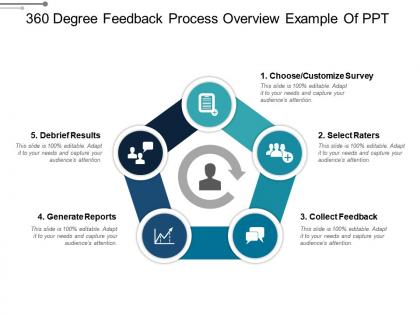
360-degree feedback process overview example of PPT is designed to gather anonymous feedback about an employee from all the people related to him irrespective of their hierarchy level. In the provided 360-degree appraisal system PPT diagram it shows that how the appraisal of an employee depends on the feedback received from 360-degree angle i.e all angles. The review system as shown in this feedback system PowerPoint model is unlike the traditional performance review system, in which the manager alone tells the team member about the job performance. 360 feedback process PPT presentation graphic focusses on all aspects that can be attributed to an employee’s behavior, to ensure there is an improvement from the angle of interaction, communication, and job performance. It is a very powerful tool to help employees develop and grow. Your thoughts have put you on the brink of success. Our 360 Degree Feedback Process Overview Example Of Ppt will get you across.
People who downloaded this PowerPoint presentation also viewed the following :
360 degree feedback process overview example of ppt with all 5 slides:
Dispel all causes of friction with our 360 Degree Feedback Process Overview Example Of Ppt. They help battle feelings of hatred.
FAQs for 360 degree feedback process overview
Honestly, 360 reviews are amazing because you finally get the full story on how someone's actually performing. Instead of just hearing from their manager (which can be super one-sided), you're getting input from peers and their direct reports too. People discover blind spots they never knew existed, and it really builds trust between teams. The feedback becomes way more balanced and useful than those old-school top-down reviews we're all used to. Oh, and pro tip - start with a small group of people who are actually excited about it first. Don't just throw it at the entire company right away or everyone will freak out.
So basically, 360 feedback gets input from your boss, coworkers, people under you, sometimes even clients - whereas regular reviews are just your manager's take. Traditional ones focus on hitting goals and what your boss thinks you're doing right or wrong. But 360s? They show you blind spots about how you actually come across to people. Like your communication style or leadership vibe that your manager probably never sees. Honestly, the soft skills stuff is usually the most eye-opening part. Way more useful than just "met expectations" nonsense.
Honestly, you're basically running the whole show when it comes to 360 feedback. Pick the right people to give feedback, set clear rules about keeping things confidential, and create an environment where everyone feels safe being honest. The hardest part? Staying neutral throughout - which is way harder than it sounds, trust me. Once results come back, help your person make sense of what they're hearing and turn it into actual steps they can work on. Oh, and treat this as development, not evaluation - people shut down fast if they think it's tied to their performance review. Do it right and they'll actually care about the feedback.
Get a third-party person to handle collecting everything - that way you can't see who said what. Tell people upfront their stuff will be turned into general themes, not quoted word-for-word. Trust me, anonymity makes people way more honest! You'll need at least 3-4 people per group so responses can't be traced back. Make sure whoever's running it knows how to keep things confidential. The biggest thing? Be super clear about your process from day one. Otherwise people won't actually open up and you'll get useless feedback.
Oh man, don't make it feel like punishment - that's the kiss of death. Keep your rater pool small, like 5-8 people max, and pick folks who actually work with them regularly. Random colleagues give trash feedback anyway. Give participants a heads up about what's happening instead of ambushing them. Never tie results to performance reviews or pay decisions - people will just lie. Position it as pure development stuff. Short sentences work. But you also need some flow between ideas to keep things readable. The follow-up conversation is where the magic happens, so don't skip that part. Set clear expectations upfront so everyone knows it's about growth, not judgment.
So 360-degree feedback basically lets your team see how everyone views them - boss, coworkers, people they manage. Way better than just getting feedback from above. People are terrible at seeing their own blind spots, you know? Getting input from all directions makes it feel more legit and less like one person's opinion. It highlights what they're already good at plus the stuff they don't realize they're doing wrong. Just don't dump the results on them and disappear - you've gotta help them actually use it to improve.
Honestly, I'd go with Culture Amp or 15Five - they handle all the annoying logistics for you. Lattice is solid too. SurveyMonkey works but feels clunky for 360s specifically. The good platforms automatically send reminders, compile everything, and give you charts that don't look like garbage. Some have AI that finds patterns in comments, which is actually pretty useful. Oh, and definitely try the free trials first. I made the mistake of jumping into one without testing it and regretted it later. See what clicks with your team before you're stuck paying for something nobody wants to use.
Honestly, brace yourself for some hard truths - that's always the worst part. I'd spend some time beforehand thinking about where you might've messed up, so you're not completely caught off guard. Try to go in curious instead of defensive (way easier said than done, I know). The thing is, these people actually bothered to give you real feedback because they're rooting for you. Oh, and definitely come with specific questions ready. Ask for examples and what exactly you should do differently. It sucks but it's worth it.
Don't get stuck reading every single comment - look for what multiple people are saying instead. That's where the good stuff is. The biggest gaps between how you see yourself vs how others see you? Start there. Those blind spots hit hardest. Honestly, some feedback is just someone's random opinion, so don't stress about fixing everything. Pick maybe 2-3 things to actually work on. Make a real plan with steps you can measure. Here's the part most people skip - circle back with those reviewers later. Ask if they're noticing changes. Shows you actually listened.
Track survey completion rates and who actually shows up to follow-up sessions. But honestly, that's just the surface stuff. The real test is whether people are still using what they learned 6-12 months out - check performance reviews, team scores, maybe do pulse surveys asking if coworkers notice changes. Skip measuring if people "enjoyed" it because that tells you nothing useful. Focus on retention rates and promotion success instead. Oh, and team performance metrics if you can swing it. Start small though - pick like 2-3 things you can actually track before your next cycle.
Start with training your managers first - seriously, this will make or break the whole thing. They need to know how to give feedback without being jerks about it. Make 360 reviews part of your regular performance cycle, not some random quarterly experiment. Oh, and create actual safe spaces where people can be honest without worrying they'll get fired. I'd pilot it with a small group first because you'll definitely hit some bumps. The upward feedback to leadership is usually the scariest part, but it's also where you'll see the biggest wins. Don't overcomplicate it though.
Your peers notice the stuff that matters day-to-day - like whether you actually listen in meetings or just zone out waiting to talk. They see your communication style up close. Supervisors? They're looking at the bigger picture. Performance metrics, strategic thinking, whether you hit your goals. It's kinda wild how different the perspectives can be. Coffee chat conversations reveal way more than quarterly reviews sometimes. When both types of feedback align, you're golden. But those gaps between what peers and supervisors say? That's where you'll find your real blind spots.
Honestly, most places totally mess this up - they just hand out reports and call it done. You've gotta start with actual development plans that have real deadlines. Then book follow-up meetings in like 30-60 days max to see what's actually happening. The managers need to coach people through this stuff, not just dump feedback and walk away. Oh, and definitely track if anyone's working on their weak spots (spoiler: half won't be). When someone improves, make noise about it! The whole thing only works if it's ongoing conversations, not some yearly thing that gets filed away forever.
Oh man, 360 feedback is basically a reality check from everyone around you - your team, peers, boss, the whole crew. You'll discover blind spots you didn't even know you had, especially with how you communicate or make decisions. The gap between how you think you're leading and how people actually experience it? Sometimes it's huge, honestly. What really helped me was picking just 1-2 things to work on instead of trying to overhaul everything at once. That's where you actually see change happen.
Honestly? Once a year works for most places, though some stretch it to 18-24 months if things are pretty stable. Don't overdo it though - people get so tired of giving feedback they'll just phone it in. You need at least 6-9 months between rounds so folks can actually work on stuff before getting hit with another survey. Oh, and if your company's going through chaos or swapping out leaders left and right, maybe wait a bit longer. The whole point falls apart if people don't have time to improve, you know?
-
Appreciate the research and its presentable format.
-
Use of different colors is good. It's simple and attractive.