


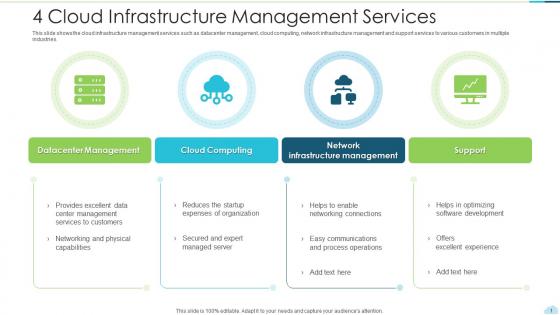
4 cloud infrastructure management services




Try Before you Buy Download Free Sample Product
 Impress Your
 Audience
 100%
100% Editable
 Save Hours
 of Time


Our 4 Cloud Infrastructure Management Services are topically designed to provide an attractive backdrop to any subject. Use them to look like a presentation pro.
People who downloaded this PowerPoint presentation also viewed the following :
4 cloud infrastructure management services with all 9 slides:
Use our 4 Cloud Infrastructure Management Services to effectively help you save your valuable time. They are readymade to fit into any presentation structure.








FAQs for 4 cloud
You'll need monitoring/alerting, auto-scaling, security policies, and cost optimization stuff. Plus backup plans and governance rules for who can spin up what. But honestly? Most teams totally screw up the monitoring part first - like, you think everything's fine until your phone's buzzing at 2am. Track your performance metrics, resource usage, and spending across everything. Oh and start with monitoring and cost controls - that's where I'd focus initially. Build out the rest as you grow, but those two will save your ass early on.
Honestly, you'll want to hit this from multiple angles. Encrypt everything - data moving around AND stored data. Multi-factor auth is non-negotiable these days, plus tight access controls. I know the compliance paperwork is a nightmare (been there), but automated tools make it way more bearable. Security audits need to happen regularly too. Keep detailed logs for when auditors come knocking. Cloud providers have decent built-in security stuff, so use that. My advice? Set up a solid framework from day one and actually stick to it across everything. Way easier than trying to retrofit security later.
Figure out your basics first - how much compute power and storage you actually need. Pricing models vary wildly between providers, so definitely compare those carefully. Geographic coverage matters if you've got users spread out globally. Some providers are just better at certain regions, honestly. Security certs are huge depending on your industry - don't skip that research. Support quality differs massively too. AWS has tons of resources but can feel overwhelming. I'd make a quick spreadsheet with your top 3 options and score them on your must-haves vs nice-to-haves.
So instead of manually clicking through everything, automation just handles the boring repetitive tasks - server provisioning, scaling, deployments, all that stuff. Scripts and tools kick in based on triggers or schedules. Way more consistent since you're not fat-fingering configs at 2am (trust me on this one). Traffic spikes? Your system responds in seconds instead of you scrambling around. You'll actually get to do interesting work rather than babysitting infrastructure constantly. Honestly, start with something simple like automating backups. Then keep adding pieces once you see how much time it saves.
Ok so first thing - get monitoring set up everywhere: infrastructure, apps, user experience, the whole deal. Automated alerts are your friend for CPU, memory, disk, network stuff. But seriously don't go nuts with alerts or you'll end up ignoring them all (learned that one the hard way). Pick thresholds that actually mean something's broken. Dashboards help you spot trends and figure out what "normal" looks like. If you're dealing with microservices, distributed tracing will save your sanity. Way better to catch issues early than scramble when everything's on fire. Get alerts running this week, then tweak monthly.
Look, cost management tools are total lifesavers for cloud spending. Set up budget alerts first - trust me on this one. They'll ping you before things get expensive, plus you can track which resources are eating your money. The visibility is probably the best part though. You'll catch stuff like forgotten test environments or way oversized instances just sitting there. Cloud costs get weird fast if you're not paying attention (learned this the hard way lol). Start with basic monitoring, then check out their optimization tips once you know what's actually running.
So multi-cloud basically means you're not putting all your eggs in one basket - spread your stuff across AWS, Azure, Google, whatever. If one provider screws you over with pricing or goes down, you've got backup options. Plus you can cherry-pick the best features from each one. Like maybe AWS for general compute but Google's way better for machine learning tools. But honestly? It gets messy fast. You're juggling different dashboards, billing systems, security setups - it's a headache. I'd say pick one main provider first, get comfortable with it, then slowly add others when you actually need their specific features. Don't go crazy trying to do everything multi-cloud right away.
Honestly, containerization is your best friend here - Docker and Kubernetes work everywhere. Use open standards instead of getting sucked into AWS's ecosystem (learned that one the hard way). Multi-cloud management tools help too. Standard data formats and APIs are clutch for keeping things portable. Oh, and avoid vendor-specific databases if you can swing it. I'd audit what you've got now and figure out which services would be the biggest pain to migrate. Way better to think about this stuff early than try untangling everything later.
Cloud governance is like having guardrails for your infrastructure - stops teams from spinning up random stuff everywhere. Without it? Total chaos. You'll get blown budgets, security holes, and good luck finding what's actually running where. Pretty much like herding cats tbh. Setting up standardized policies upfront saves your sanity later. Cost controls, security baselines, compliance rules - all that gets applied automatically. Teams can still build what they need, just within reasonable boundaries. Honestly wish more companies would do this from day one instead of trying to fix the mess afterward.
Track your SLAs like crazy and get monitoring set up everywhere. Cloud providers have their own uptime dashboards, but their "downtime" definition probably won't match what you actually care about. Grab third-party tools like Pingdom or DataDog - they'll show you what users really experience. Dig into historical uptime before you commit to anyone. Always have a backup ready. Here's the thing though - set alerts for slowdowns, not just total crashes. Slow sites make people rage-quit faster than dead ones. Test your disaster recovery stuff regularly so you're not totally screwed when things break.
Honestly, start with Terraform or CloudFormation for infrastructure-as-code - keeps everything consistent. Monitoring's huge though. CloudWatch, Datadog, or Prometheus will literally save your sanity when things break at 2am (learned that the hard way). For automation, Ansible and Puppet are solid choices, plus there's cloud-native stuff now. Kubernetes is basically expected for containers these days. Oh, and you'll want CI/CD pipelines - Jenkins, GitLab, GitHub Actions all work. My advice? Don't try everything at once. Pick one IaC tool and one monitoring solution first, then expand.
So DevOps is basically your bridge between dev teams and cloud stuff. You automate everything - provisioning, deployments, the whole deal. Tools like Terraform let you manage cloud resources just like regular code. Pretty neat actually. CI/CD pipelines handle deployments automatically while monitoring gives you real-time performance visibility. Once it's running smooth, it's honestly a total game-changer. The secret sauce? Treat infrastructure like code. Version it, test it, deploy through automated pipelines. My advice - start small with one service first, then expand from there.
Security issues will bite you first, then data migration gets messy fast. Everyone thinks they know the timeline but you're looking at way longer than expected. Your old systems weren't built for this stuff, so don't skip the upfront planning phase. Start small with a pilot run. Cloud-native security tools are your friend here. Get leadership on board early or you'll regret it later. That whole "lift and shift" thing sounds tempting but honestly it usually creates more headaches. Add 30% to whatever budget and timeline you're thinking. Oh, and definitely consider hiring a consultant for your first big move - learned that one the hard way.
So with serverless, you're basically dumping all that infrastructure headache onto the cloud provider. No more stressing about servers or scaling - they handle it. You just write code that fires when something triggers it. Honestly, it's pretty sweet once you wrap your head around it. Though you do lose some control, and yeah, you can get stuck with one provider (which kinda sucks). The whole mindset shift is weird at first - you'll go from "how many servers?" to thinking in functions and events. My advice? Start with just a couple functions first. Don't dive headfirst into converting everything.
Honestly, automation and AI-driven management are huge right now - platforms that predict problems and auto-scale without you babysitting them. Multi-cloud is basically standard now because vendor lock-in sucks (trust me on this one). Edge computing's pushing everything closer to users, which makes sense. Security and compliance tools are getting way better too, which is nice since that stuff used to be such a pain. Oh, and definitely mess around with Infrastructure as Code if you haven't yet. Seriously saves so much time once you get the hang of it.
-
Appreciate the research and its presentable format.
-
Commendable slides with attractive designs. Extremely pleased with the fact that they are easy to modify. Great work!
-
Very well designed and informative templates.
-
Innovative and attractive designs.
-
Awesome use of colors and designs in product templates.